
FTSE 100 fell 0.17% and European indices edged lower as CENTCOM reported 55 vessels redirected under the US Iran blockade. Trump signals “low-key” approach while oil holds near $84.50 amid stalled Hormuz reopening talks.
British and European stocks traded modestly lower on Monday as unresolved US-Iran tensions surrounding the Strait of Hormuz blockade restrained risk appetite. The FTSE 100 slipped 0.17% in early trade, while Germany’s DAX and France’s CAC 40 edged down slightly. Sterling held steady near 1.3492 against the dollar as investors monitored naval developments and mixed signals from Washington and Tehran.
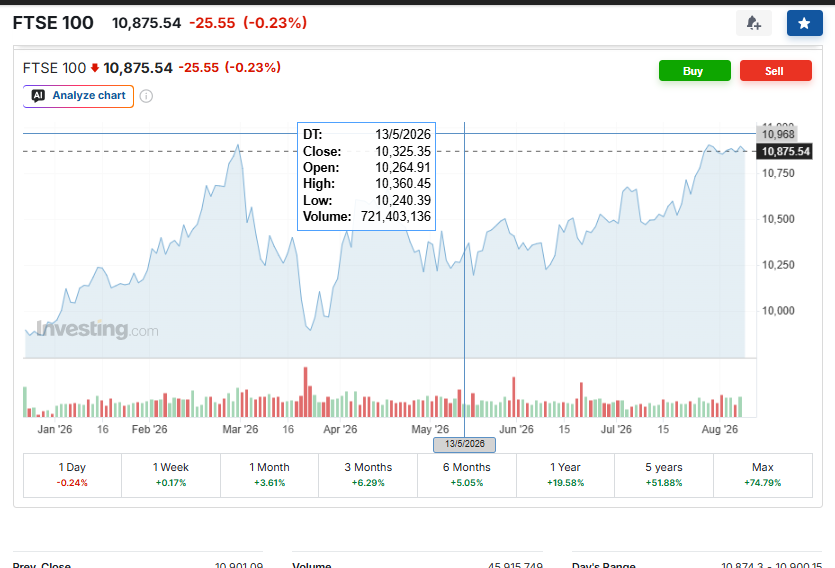
FTSE 100 Slips 0.17% as CENTCOM Redirects 55 Vessels and Trump Signals Low-Key Iran Approach
The FTSE 100 fell 0.17% as of early European trading (around 03:30 ET / 07:30 GMT), with futures earlier pointing to a softer open of about 0.3%. Germany’s DAX declined 0.06% and France’s CAC 40 lost 0.03%. The pan-European STOXX 600 was little changed after a strong prior week.
US Central Command (CENTCOM) reported that 55 commercial vessels have now been redirected as part of enforcement of the US naval blockade against Iran, up from 53 as of August 8. Two vessels have been disabled and two boarded to ensure compliance. More than 30 ships have been allowed passage for humanitarian aid. Over 20 US warships remain deployed in the region, with sailors maintaining F/A-18E Super Hornets aboard the USS Abraham Lincoln to keep the carrier strike group mission-ready.
President Donald Trump told Axios on Sunday that the US is taking a “low-key” approach: “We are only semi-negotiating with them. We are just watching Iran with its huge inflation and the fact they have no money.” A separate Wall Street Journal report suggested Trump may be prepared to set aside a formal nuclear agreement and declare victory if Tehran fully reopens the Strait of Hormuz, though Iranian demands — including an end to the naval blockade, withdrawal of US forces, sanctions relief and war reparations — continue to complicate talks.
Oil prices firmed on the uncertainty, with Brent crude rising around 0.6–1.1% toward $84.50 a barrel and WTI near $78.80.
Hormuz Risks Cap European Stocks as Oil Holds Near $84.50 Amid Supply Uncertainty
Persistent uncertainty over the Strait of Hormuz — a critical chokepoint that historically carried about one-fifth of global oil supplies — kept energy prices elevated and risk sentiment cautious. Investors weighed the risk of prolonged supply disruptions against hopes of a diplomatic breakthrough.
The modest declines in European equities reflected a wait-and-see stance rather than outright panic, following Wall Street’s record closes on Friday driven by softer US jobs data. Higher oil prices raised concerns about potential inflationary pressures ahead of key US CPI data later in the week, while the ongoing naval enforcement underscored that a quick resolution remains elusive.
Hormuz Standoff: Iran-Oman Deal Near but US Conditions and Naval Blockade Persist
Tensions in the Strait of Hormuz have fluctuated amid the broader US-Iran conflict. Iran has said a deal with Oman to define new shipping lanes is in its final stages but maintains that the waterway will reopen only after the US meets additional conditions.
CENTCOM’s progressive increases in redirected vessels highlight the active enforcement of the US blockade on traffic to and from Iranian ports, while allowing humanitarian passages and free transit for non-Iranian-bound shipping. Trump’s latest comments signal a preference for economic pressure over immediate military escalation, describing the situation as “like a chess game.” Iranian officials continue to reject direct talks while Washington is seen as breaching prior interim understandings.
Focus Turns to CENTCOM Updates, Iran-Oman Deal Progress and US CPI Data
Markets will monitor further CENTCOM updates on vessel movements, any concrete progress on the Iran-Oman shipping-lane agreement, and additional comments from US or Iranian officials. Wednesday’s US July consumer price index report will be closely watched for inflation signals that could influence Federal Reserve rate expectations.
Broader energy market reaction and any escalation or de-escalation in naval activity will shape risk appetite through the week. Corporate earnings updates and euro-zone data will provide additional domestic drivers for European indices.
Sources & Methodology
Primary-source standard: Market-moving facts should link to original data releases, regulator notices, company filings or official project announcements whenever available. Secondary reporting is used for additional context, not as a substitute for original evidence.
Page last reviewed: