Quick Answer
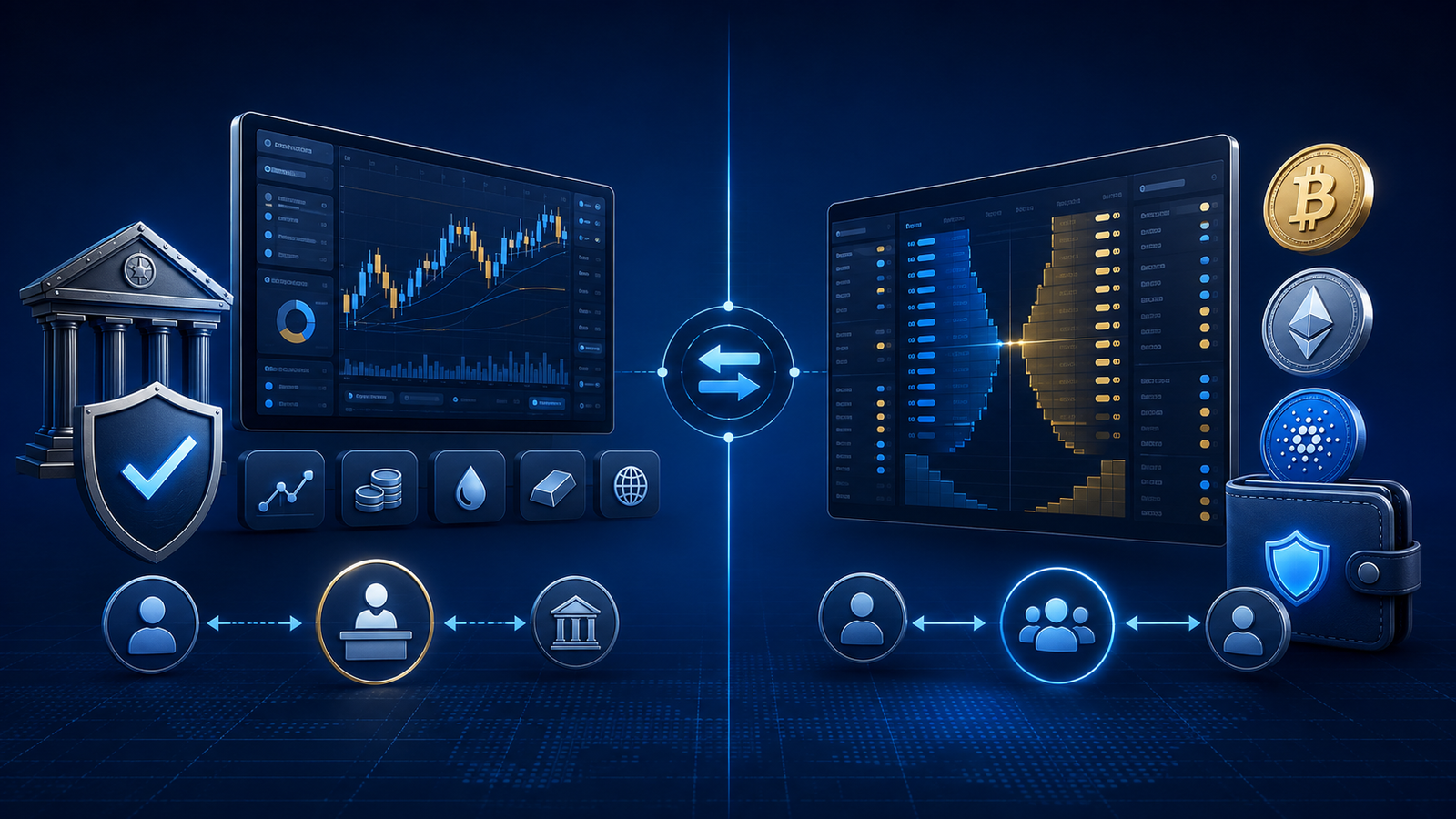
A crypto exchange is primarily a marketplace where users can buy and sell digital assets, often with access to order books, multiple trading pairs and on-platform custody. A crypto broker is an intermediary that gives clients crypto price exposure or facilitates purchases through a simpler trading interface. The important distinction is what you actually own: some brokers let clients buy the underlying cryptocurrency, while others offer CFDs or other derivatives that track crypto prices without giving ownership of the coins. Exchanges can offer broader asset selection and more control, while brokers can offer simpler execution and integrated risk tools. Neither structure is automatically safer or cheaper; regulation, custody, fees, product type and the legal entity serving the account matter more than the label.
Crypto Broker vs. Exchange at a Glance
| Factor | Crypto Exchange | Crypto Broker |
|---|---|---|
| What you trade | Usually spot crypto; some venues also offer derivatives, staking or other services | Underlying crypto at some brokers, or derivatives such as CFDs at others |
| Ownership | Spot buyers may own the crypto balance and sometimes withdraw it to a wallet | Depends on product; CFD or derivative traders do not own the underlying coin |
| Pricing | Often order-book or market-maker pricing with visible bid/ask depth | Broker quotes or routed market pricing, depending on execution model |
| Asset choice | Often broader, including smaller tokens | Usually narrower and focused on major assets |
| Order control | Can include limit, stop, market and advanced orders | Varies; many brokers offer standard trading orders and risk tools |
| Custody | Exchange may hold client crypto unless withdrawn to self-custody | May hold assets, use a custodian, or provide derivative exposure only |
| Leverage | Available on some venues and products; risk can be extreme | Common with CFDs or margin products where legally permitted |
| Main risk | Platform/custody risk, market risk, token risk and possible leverage risk | Counterparty, market and leverage risk; ownership may be indirect |
What Is a Crypto Exchange?
A cryptocurrency exchange is a trading venue that matches buyers and sellers or otherwise provides a market for digital assets. On a spot exchange, a user can typically exchange fiat currency or another crypto asset for Bitcoin, Ether or another supported token. The platform may use an order book, a request-for-quote model, internal liquidity or a combination of methods.
The defining advantage is usually market access and control. Exchanges can provide many trading pairs, visible order books, limit orders, market orders and, on some platforms, futures, perpetual contracts, staking or lending. That flexibility is useful for experienced traders, but it also increases complexity.
A critical beginner question is custody. If crypto remains on the exchange, the user is exposed not only to the price of the asset but also to the operational and financial health of the platform. If the exchange allows withdrawal to a personal wallet, the user can move to self-custody, but that creates a different set of responsibilities around private keys and wallet security.
What Is a Crypto Broker?
A crypto broker acts as an intermediary rather than simply presenting an exchange order book. The broker may quote a price, route the order to a liquidity venue, hold the underlying asset through a custodian, or offer a derivative linked to the cryptocurrency price.
This is why the phrase “crypto broker” can be misleading if the product is not checked. Buying Bitcoin through a broker that provides transferable ownership is very different from trading a Bitcoin CFD. With a CFD, the trader is speculating on the price difference between entry and exit and does not own Bitcoin itself. There is no wallet withdrawal because the underlying coin is not being purchased.
Brokers can be appealing to users who want a familiar trading interface, charting, stop-loss and take-profit tools, one account for multiple asset classes, or customer support. The trade-off can be a smaller crypto selection, wider spreads or financing costs on leveraged positions.
The Biggest Difference: Underlying Crypto vs. Price Exposure
The most important comparison is not “exchange or broker?” but “what product am I buying?” A spot crypto purchase generally creates ownership of the digital asset. A derivative such as a CFD, futures contract or perpetual contract provides economic exposure to the price without necessarily transferring ownership of the underlying coin.
That difference changes custody, leverage, financing, liquidation risk and what the user can do after the trade. A spot Bitcoin owner may be able to withdraw BTC to a private wallet. Our step-by-step cryptocurrency buying guide explains the purchase and custody workflow. A Bitcoin CFD trader cannot withdraw coins because there are no coins in the account – only a leveraged contract whose value changes with Bitcoin.
Key Differences Between Crypto Brokers and Exchanges
1. Trading Method and Execution
Exchanges typically give users direct access to a digital-asset marketplace. On an order-book exchange, buyers place bids and sellers place offers, while market orders execute against available liquidity. Brokers may instead show a quoted price or route orders to external venues. Neither model is inherently better: execution quality depends on liquidity, spread, slippage, venue quality and how the broker or exchange handles the order.
2. Fees and Total Trading Cost
The original article assumed that exchanges are always cheaper and brokers always more expensive. That is too broad. Exchanges can charge maker/taker fees, withdrawal fees, conversion charges or funding fees on derivatives. Brokers can charge spreads, commissions, overnight financing and currency-conversion costs. The correct comparison is total cost for the specific product and trading frequency.
A platform advertising a 0% commission can still be expensive if its spread is wide. Likewise, a broker with an explicit commission can be competitive if the underlying spread is tight. Active traders should also consider slippage, because a low headline fee does not guarantee a good fill during volatile conditions.
3. Custody and Withdrawal
Spot exchanges commonly hold crypto assets on behalf of users unless those assets are withdrawn. This creates counterparty and custody risk. Self-custody removes the exchange from the storage relationship but places responsibility for private keys, wallet backups and transaction security on the user.
A broker may use a third-party custodian, hold assets internally, or provide no crypto ownership at all if the product is a derivative. Beginners should check whether withdrawals to an external wallet are supported before assuming they own transferable crypto.
4. Leverage and Liquidation Risk
Leverage is available on some exchanges and at brokers, but the mechanics differ by product and jurisdiction. Crypto futures, perpetuals, margin accounts and CFDs can all magnify gains and losses. A leveraged position may be liquidated or closed before the underlying asset has time to recover.
The existence of 50x or 100x leverage on a platform should not be treated as a benefit for beginners. Read what leverage means in trading before considering any margin product. Higher leverage reduces the adverse price movement required to cause a large percentage loss in account equity.
5. Asset Selection
Crypto exchanges often list more digital assets and trading pairs than traditional brokers. That can be useful for traders who understand smaller tokens, but a large selection can also encourage speculation in illiquid or poorly understood assets. Brokers usually focus on Bitcoin, Ether and other larger cryptocurrencies, especially when the products are regulated derivatives.
6. Trading Tools and User Experience
Both exchanges and brokers can provide sophisticated trading tools. The old assumption that exchanges are complex while brokers are always beginner-friendly is no longer reliable. Large exchanges can offer simplified purchase flows, while brokers can provide professional charting and advanced order types. A beginner should test the interface in a demo or low-risk environment and confirm that stop orders, position sizes and fees are clearly displayed. See our cryptocurrency order types guide before using an unfamiliar platform.
Regulation: Do Not Assume Brokers Are Regulated and Exchanges Are Not
Regulation depends on the jurisdiction and legal entity, not the word “broker” or “exchange.” Some crypto exchanges operate under formal licensing or registration regimes, while others operate offshore or offer services in markets where protections are limited. Brokers can also be strongly regulated, lightly regulated or offshore.
In the European Union, MiCA created a common framework for crypto-asset service providers. Other countries use different licensing, securities, commodities, payments or money-transmission rules. A trader should therefore verify the exact legal entity, regulator, licence or registration, and the products that authorisation actually covers.
Regulation also does not eliminate market risk. A licensed platform cannot prevent Bitcoin, Ether or another crypto asset from falling sharply. It primarily addresses the conduct, authorisation and operation of the service provider.
Security: Exchange Risk vs. Broker Risk
Security should be evaluated at two levels: the platform and the account. Platform-level controls can include cold-storage policies, segregation or safeguarding arrangements, external custody, proof-of-reserves practices, penetration testing and withdrawal controls. Account-level controls include strong passwords, app-based two-factor authentication, withdrawal whitelists and anti-phishing procedures.
Brokers introduce counterparty risk as well. If the broker is the counterparty to a CFD or holds client assets, the financial strength and regulation of that entity matter. A regulated broker is not automatically safer than a well-regulated exchange, and an exchange is not automatically unsafe simply because it is an exchange.
When a Crypto Exchange May Be the Better Fit
A crypto exchange may be more suitable when the primary goal is to buy and own the underlying cryptocurrency, withdraw it to a personal wallet, access a broad range of tokens, use an order book, or participate in crypto-native services available on the venue.
It can also suit active spot traders who want granular control over limit orders and pair selection. The trader still needs to assess custody, liquidity, fees, regulation and whether the platform is legally available in the user’s jurisdiction.
When a Crypto Broker May Be the Better Fit
A broker may be more suitable when the user wants crypto exposure inside a broader multi-asset trading account, prefers a traditional trading platform, needs standard risk-management tools, or does not need to withdraw coins to a blockchain wallet.
A broker can also be convenient for trading crypto CFDs where those products are legally offered. In that case, the user should understand that the position is a leveraged derivative, not ownership of Bitcoin or another digital asset.
What Beginners Should Check Before Choosing Either
Identify the legal entity that will hold or service the account.
Verify the regulator, licence or registration through an official public register where available.
Confirm whether you are buying spot crypto or a derivative such as a CFD, future or perpetual contract.
Check whether crypto can be withdrawn to an external wallet and who controls the private keys while it remains on-platform.
Compare the full cost: spread, commission, maker/taker fee, withdrawal fee, financing, funding rate and conversion charges.
Review liquidity and typical slippage for the assets you plan to trade.
Understand leverage, margin and liquidation rules before opening any leveraged position.
Enable strong account security such as app-based 2FA and withdrawal controls.
Read the platform rules on outages, order execution, complaints and account restrictions.
Avoid choosing a platform purely because it offers more leverage, more tokens or a large promotional bonus.
Common Misconceptions About Crypto Brokers and Exchanges
“Exchanges always have lower fees.”
Not necessarily. Total cost depends on maker/taker pricing, spreads, withdrawals, conversion, funding and slippage.
“Brokers are always safer because they are regulated.”
Some brokers are regulated and some are offshore. The same is true for exchanges. Verify the exact legal entity and applicable framework.
“If I trade Bitcoin with a broker, I own Bitcoin.”
Only if the broker is actually selling the underlying asset. A CFD or other derivative gives price exposure without ownership.
“Self-custody removes all risk.”
Self-custody removes platform custody risk but creates operational risks such as lost keys, phishing, malware and irreversible transfers.
“More listed coins means a better platform.”
A broad asset list increases choice, but it can also include illiquid or highly speculative tokens. Quality matters more than quantity.
Frequently Asked Questions
What is the difference between a crypto broker and a crypto exchange?
An exchange provides a marketplace for digital assets, while a broker acts as an intermediary and may quote or route trades. The more important distinction is whether the product gives ownership of the underlying crypto or only derivative price exposure.
Is a crypto exchange cheaper than a broker?
Sometimes, but not always. Compare the total cost of the exact product, including spreads, commissions, maker/taker fees, withdrawal charges, financing, funding rates and slippage.
Do I own crypto when I use a broker?
It depends. Some brokers provide underlying crypto ownership, while others offer CFDs or other derivatives. If you cannot withdraw the asset to a wallet because it is a derivative, you do not own the underlying coin.
Are crypto exchanges safe?
Safety varies by exchange, jurisdiction and custody model. Regulation, financial strength, custody controls, account security and withdrawal procedures all matter. Crypto market losses are still possible even on a well-run platform.
Are crypto brokers better for beginners?
A broker may offer a simpler interface, but simplicity should not replace due diligence. Some exchanges also have beginner-friendly interfaces. A beginner should prioritise clear product terms, regulation, custody, costs and risk controls.
Can I use leverage on a crypto exchange?
Some exchanges offer margin, futures or perpetual contracts with leverage. Availability and limits depend on the jurisdiction. Leverage can cause rapid losses and liquidation.
Which is better for buying Bitcoin: a broker or an exchange?
If the goal is to own and withdraw Bitcoin, choose a provider that offers underlying BTC and wallet withdrawals. If the goal is only short-term price exposure, a broker or derivative venue may fit, but the risks and costs are different.
Bottom Line
A crypto broker and a crypto exchange can both provide access to cryptocurrency markets, but they are not interchangeable. Exchanges are generally built around digital-asset markets and can offer direct ownership, wallet withdrawals and broad token selection. Brokers may provide a simpler multi-asset trading experience, but some broker products are derivatives that do not give ownership of the underlying cryptocurrency.
For beginners, the most important decision is not which label sounds safer. Readers who are new to the market can first review our beginner crypto trading guide. Verify the legal entity, understand what product you are buying, check who holds the assets, compare total trading costs and avoid unnecessary leverage. AAFX.io provides educational trading and broker-comparison guides to help readers evaluate these differences before choosing a platform.
Risk Warning
Crypto assets and crypto-linked derivatives are highly volatile and can produce substantial losses. Leveraged products can magnify losses and may result in liquidation. Custody, regulatory and compensation protections vary by legal entity, product and jurisdiction. This material is educational and does not constitute personalized financial advice.
Sources & Methodology
Primary-source standard: Market-moving facts should link to original data releases, regulator notices, company filings or official project announcements whenever available. Secondary reporting is used for additional context, not as a substitute for original evidence.
Page last reviewed: