Quick Answer
CFD trading means speculating on the price of an asset through a Contract for Difference rather than buying the underlying asset itself. You agree with a CFD provider to exchange the difference between the opening and closing price of the contract. If you go long and the price rises, the position can gain; if you go short and the price falls, it can gain. CFDs are usually leveraged, so a relatively small amount of margin can create much larger market exposure. That makes gains and losses move faster. CFD availability and retail protections vary by country, and the product is generally not available to ordinary U.S. retail traders in the same OTC form common in the UK and Australia.
What Does CFD Mean?
CFD stands for Contract for Difference. It is a derivative contract between a trader and a provider, usually a broker, based on the price movement of an underlying market such as a share, stock index, currency pair, commodity or cryptocurrency.
You do not normally own the underlying asset. If you trade an Apple share CFD, for example, you are not becoming a shareholder in Apple. You are taking price exposure to the movement of the share through the CFD contract. That distinction affects ownership rights, dividends, voting rights, financing and regulation.
The profit or loss is based on the difference between the price at which the CFD position is opened and the price at which it is closed, multiplied by the position size, before trading costs.
How Does CFD Trading Work?
A CFD trade starts with a market view. If you expect the underlying price to rise, you open a long position. If you expect it to fall, you open a short position. The provider quotes a buy price and a sell price, and the difference between them is the spread. Depending on the account and instrument, a separate commission may also apply.
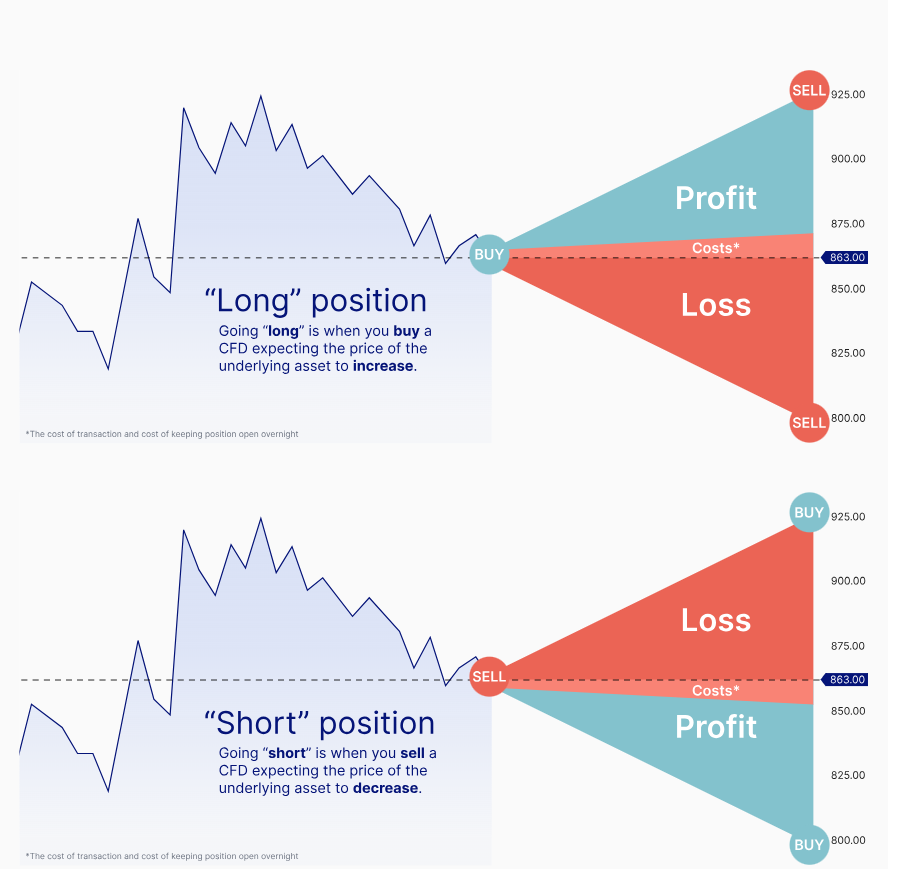
Long and short CFD positions: the original source diagram is retained because it clearly illustrates how the same contract can gain or lose value in either market direction.
Long CFD Example
Suppose a stock CFD is quoted at $100 and you buy 20 CFD units. Your market exposure is $2,000. If the price rises to $104 and you close the position, the gross price movement is $4 x 20 = $80. If the price instead falls to $96, the gross loss is $4 x 20 = $80. Spreads, commissions and financing would then be added to or deducted from the final result.
Short CFD Example
Now suppose you sell 20 CFD units at $100 because you expect the price to fall. If it drops to $95, the gross movement is $5 x 20 = $100 in your favour. If the price rises to $105 instead, the gross loss is $100. Short positions are useful for taking bearish exposure, but losses still increase when the market moves against the position.
CFD Leverage and Margin Explained
Leverage is one of the defining features of CFD trading. Instead of paying the full value of the market exposure, a trader deposits margin. For example, 10:1 leverage means a $10,000 position requires $1,000 of initial margin. The position still behaves like a $10,000 exposure, so a 1% move in the underlying creates roughly a $100 change before costs – equal to 10% of the $1,000 margin.
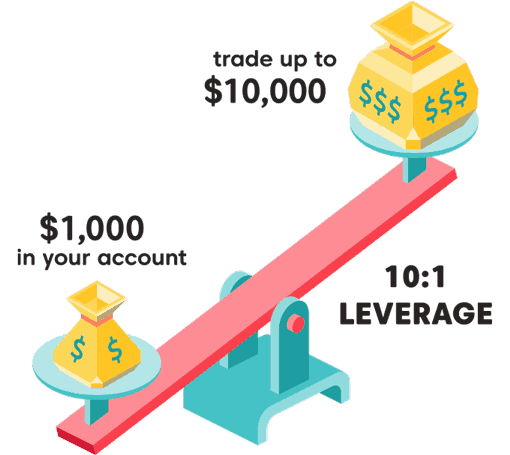
The retained leverage diagram is useful because it visualises the difference between margin deposited and total market exposure.
Leverage does not make a trade more accurate. It simply increases exposure relative to the money committed. That is why regulators treat CFDs as complex, high-risk products. In the UK, retail CFD leverage is restricted to between 30:1 and 2:1 depending on the underlying asset. UK rules also include a 50% margin close-out rule and negative balance protection for retail CFD accounts. Australia applies comparable retail protections through ASIC.
What Can You Trade With CFDs?
| Underlying market | Typical CFD exposure | Important note |
|---|---|---|
| Forex | EUR/USD, GBP/USD, USD/JPY and other pairs | Often the most heavily leveraged CFD category |
| Stock indices | S&P 500, Nasdaq, FTSE 100 and others | Tracks index price movement; no ownership of index components |
| Individual shares | Apple, Nvidia, Tesla and other stocks | Share CFDs do not normally provide shareholder voting rights |
| Commodities | Gold, silver, oil, natural gas | Pricing may be based on spot or futures-related markets |
| Cryptocurrency | Bitcoin, Ether and other crypto references | Retail leverage can be very restricted; availability varies by jurisdiction |
What Does CFD Trading Cost?
The spread is only one part of CFD cost. A useful comparison looks at the full cost of opening, holding and closing the position.
Spread
The difference between the provider’s buy and sell prices.
Commission
Some share CFDs and raw-spread accounts charge an explicit commission.
Overnight financing
Cash CFDs held beyond the daily financing cut-off can incur a debit or, less commonly, a credit depending on the contract.
Currency conversion
A broker may convert profit, loss, commissions or deposits when the account currency differs from the traded market.
Slippage
The executed price can differ from the requested price during fast or illiquid markets.
Guaranteed-stop fee
Some providers charge for guaranteed stop-loss protection where the feature is available.
CFD Trading Risks Beginners Should Understand
1. Leverage Can Magnify Losses Quickly
A small move in the underlying market can translate into a much larger percentage move relative to the margin deposited. ASIC found that most retail clients lost money trading CFDs and introduced product-intervention rules specifically to reduce the size and speed of those losses.
2. Margin Close-Out Can End a Trade Early
A leveraged position can be closed automatically if the account no longer has enough funds to support the required margin. That means a trader can be forced out before the market later reverses. Margin requirements and close-out rules therefore matter as much as the directional view.
3. Stop-Loss Orders Are Not Perfect Price Guarantees
A standard stop-loss is an instruction to close a position once a trigger is reached, but the final fill can be worse than the stop level during gaps or rapid price moves. A guaranteed stop, where offered, works differently and can carry an additional fee.
4. Holding Costs Can Change the Trade Economics
A CFD held for days or weeks can accumulate financing charges. A trade that moves modestly in the expected direction may still produce a disappointing net result after spread, commission and overnight financing.
5. Counterparty and Regulatory Risk Matter
A CFD is usually an over-the-counter contract with the provider rather than an exchange-traded asset you own directly. Before opening an account, verify the exact legal entity, its regulator, the products it is authorised to offer and the client protections that apply in your jurisdiction.
Can You Lose More Than Your Deposit?
The answer depends on jurisdiction and client classification. In the UK, retail CFD rules require negative balance protection, meaning a retail client cannot lose more than the total funds in the protected CFD account. ASIC’s Australian retail CFD framework also includes negative balance protection. These protections do not apply everywhere, and professional or offshore accounts can have different terms.
CFDs vs. Buying the Underlying Asset
| Feature | CFD | Underlying asset |
|---|---|---|
| Ownership | No direct ownership of the underlying asset | You own the share, coin, ETF or other purchased asset |
| Leverage | Common | Depends on product/account; cash purchases may be unleveraged |
| Short exposure | Usually straightforward through a sell CFD | May require short-selling or derivatives |
| Financing | Overnight financing can apply | No CFD financing charge on a fully paid cash holding |
| Voting rights | Normally none on share CFDs | Shareholders may have voting rights |
| Expiry | Many cash CFDs have no fixed expiry; some futures-based CFDs do | Depends on the underlying instrument |
| Counterparty structure | Usually OTC with CFD provider | Ownership/custody structure differs by market |
CFDs vs. Futures and Options
Futures and options are different derivatives with their own contract specifications, expiry rules and pricing. Exchange-traded futures are standardised contracts traded on regulated venues, while retail CFDs are commonly OTC contracts with a provider. Options add a right – but not an obligation – to buy or sell under defined terms and include time value and volatility in their pricing.
CFDs can be simpler to size in small increments and may have no fixed expiry on cash products, but simplicity does not make them lower risk. For some traders, exchange-traded futures or cash-market ownership may provide a structure that better fits their objectives.
Where Is CFD Trading Allowed?
CFD availability is jurisdiction-specific. CFDs are widely offered to retail clients in markets such as the UK and Australia, subject to leverage, risk-warning and client-protection rules. For ordinary U.S. retail traders, OTC CFDs are generally unavailable under U.S. swap and securities rules. A June 2026 SEC enforcement action, for example, involved stock-based CFDs offered to U.S. retail investors without the registrations and exchange requirements that applied to those instruments.
If a website offers extremely high-leverage CFDs to residents of a country where the product is restricted, that is a reason to verify the provider and legal entity carefully before depositing.
Is CFD Trading Good for Beginners?
CFDs are easy to understand at a basic mechanical level but difficult to manage well because leverage, margin, financing and fast execution all interact. A beginner should not judge the product by the small margin deposit required to open a position. The real risk is the full exposure and the distance to the level where the trade is invalidated or the account reaches a margin threshold.
If you are learning, a demo account can help with platform mechanics such as order entry, stop placement and margin calculations. Demo results are not proof of live profitability because real trading adds slippage, execution uncertainty and emotional pressure.
A Simple CFD Trading Checklist
Identify the underlying market and decide why you expect it to rise or fall.
Check the total position size, not just the margin required.
Calculate the potential loss at your planned stop before entering.
Review the spread, commission and expected overnight financing.
Check whether a scheduled news event could create a gap or volatility spike.
Confirm the broker’s regulator, legal entity and retail protections.
Understand the margin close-out and negative-balance rules on your account.
Use a position size small enough that one failed trade does not dominate the account.
Review the trade afterward, including execution costs and whether you followed the plan.
Frequently Asked Questions
What is CFD trading?
CFD trading is speculation on the price movement of an underlying market through a Contract for Difference rather than direct ownership of the asset.
What does CFD mean?
CFD stands for Contract for Difference. The contract settles the difference between the opening and closing value of the position.
How do CFDs work?
You open a long or short position with a CFD provider. The profit or loss depends on the price change multiplied by your position size, less trading costs.
Do you own the asset when trading CFDs?
No. A share CFD, gold CFD or crypto CFD normally gives price exposure without ownership of the underlying asset.
Why are CFDs risky?
They are leveraged. A relatively small market move can create a large percentage gain or loss compared with the margin deposited. Financing, slippage and margin close-outs add further risk.
Can CFD traders lose more than they deposit?
Retail negative-balance protection in jurisdictions such as the UK and Australia can limit losses to funds in the protected CFD account, but protections vary by jurisdiction and client classification.
Are CFDs legal in the United States?
Ordinary OTC CFDs are generally not available to U.S. retail traders under U.S. swap and securities rules. The legal treatment depends on the underlying product and transaction structure.
What is the difference between CFD trading and forex trading?
Retail forex can be provided through different legal structures. In many regions, a broker’s leveraged forex product is structured similarly to a CFD or rolling spot derivative. Always check the product terms rather than relying only on the marketing label.
Is CFD trading profitable?
It can produce profits or losses. There is no guaranteed profitable method, and regulators repeatedly warn that a large proportion of retail CFD clients lose money. Costs and leverage make disciplined risk control essential.
Bottom Line
CFDs are derivatives that let traders take long or short price exposure without owning the underlying asset. Their main attractions are flexible market access, straightforward short exposure and leveraged position sizing.
Those same features create the main risks. Leverage can make losses accelerate quickly, margin rules can force positions to close, and spreads, commissions and financing can materially change the final result.
For AAFX.io readers, the practical takeaway is to understand the full exposure, total cost and regulatory structure before treating a CFD as a simple alternative to buying the underlying market.
Editorial Sources
- UK Financial Conduct Authority — Contract for Difference rules and expectations
- ASIC Moneysmart — Contracts for Difference risks
- CFTC — Leveraged retail forex customer advisory
- ESMA — Retail CFD product-intervention measures
Risk Warning
CFDs are complex leveraged products and can result in rapid losses. Leverage limits, negative balance protection and product availability vary by jurisdiction and client classification. This article is for educational purposes only and does not constitute personalised financial advice.
Approximate document word count: 2,109 words
Sources & Methodology
Primary-source standard: Market-moving facts should link to original data releases, regulator notices, company filings or official project announcements whenever available. Secondary reporting is used for additional context, not as a substitute for original evidence.
Page last reviewed: