FTSE 100 climbed 0.26% on Aug 17 after U.S. retail sales fell 0.6% in July. UK house prices dropped 2% (Rightmove), AstraZeneca halted a lung-cancer trial, and Hormuz traffic remained near zero as the U.S.-Iran MoU expired.
British stocks edged higher on Monday as a sharper-than-expected 0.6% fall in U.S. retail sales reduced expectations for near-term Federal Reserve tightening. The FTSE 100 rose 0.26% in early trade, clawing back ground after a 1.4% weekly loss. European peers were mixed while sterling firmed and oil prices eased amid ongoing geopolitical uncertainty over the Strait of Hormuz.
FTSE 100 Up 0.26% as U.S. Retail Sales Fall 0.6%; UK House Prices Drop 2%
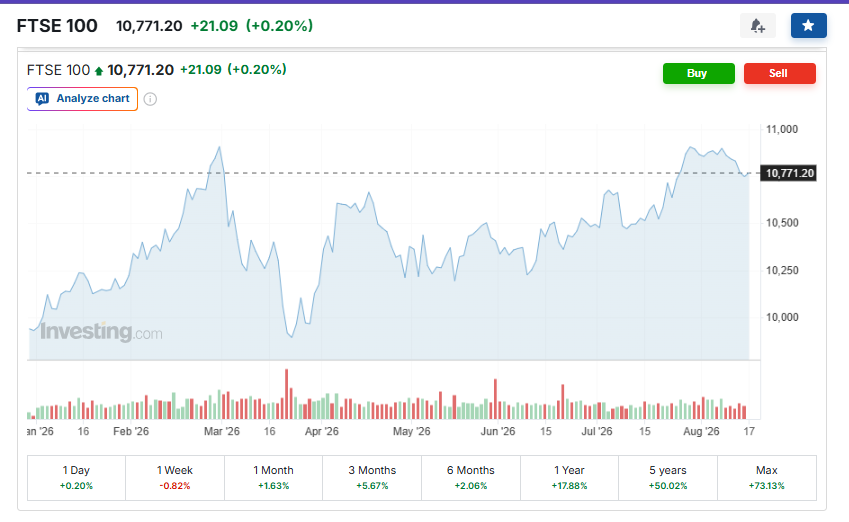
The FTSE 100 advanced 0.26% to around 10,778–10,783 points as of early London trading on August 17, 2026. Germany’s DAX slipped 0.03% and France’s CAC 40 edged down 0.05%. Sterling rose 0.22% to $1.3562.
U.S. retail sales fell 0.6% month-on-month in July, missing forecasts of a 0.1% rise and marking the steepest decline since May 2025. The drop was driven by weaker nonstore retail (-2.2%), motor vehicles & parts (-1.8%), and gasoline stations (-0.9%).
UK housing data added a cautious note: Rightmove reported average asking prices for newly listed homes fell 2% month-on-month in August to £364,999 — the largest August drop since 2018 and the sharpest annual decline (-1%) since December 2023. Available stock hit a 12-year seasonal high. Rightmove cut its full-year 2026 price forecast to between 0% and -2% (from +2% previously).
Brent crude slipped 0.30% to $88.26 a barrel and WTI fell 0.70% to $80.90. Gold futures rose 0.36% to $4,453.35 an ounce; spot gold gained 0.46% to $4,397.18.
AstraZeneca discontinued the Phase III eVOLVE-Lung02 trial of volrustomig plus chemotherapy after an independent review concluded it was unlikely to meet progression-free or overall survival endpoints versus pembrolizumab plus chemotherapy. The trial had enrolled 895 patients; other volrustomig studies continue.
Ship-tracking firm Kpler recorded no commodity vessel crossings of the Strait of Hormuz on Sunday and only five on Saturday, versus 31 the previous weekend. The 60-day U.S.-Iran memorandum of understanding expired Monday with no extension talks under way.
Soft U.S. Retail Sales Lift FTSE After 1.4% Weekly Drop; Geopolitics Cap Gains
The unexpected U.S. retail sales decline lowered Treasury yields and the dollar on Friday, improving risk appetite into Monday’s session and reducing bets on aggressive Fed tightening. This supported a modest rebound in London blue chips after the previous week’s 1.4% decline.
Geopolitical headlines limited upside: the expired U.S.-Iran MoU, near-zero Hormuz traffic, and Jefferies’ assessment of a “no war and no peace” stalemate kept oil markets volatile. Analysts noted Asia and Europe remain more exposed than the U.S. to prolonged disruption. Domestic UK housing weakness and the AstraZeneca trial setback added selective pressure.
FTSE Rebounds After First Weekly Drop in Five Weeks Amid Middle East Uncertainty
The FTSE 100 had logged its first weekly drop in five weeks on Friday amid mining weakness. The U.S. data interruption followed five consecutive monthly retail-sales gains. The Middle East situation remains unresolved after the June MoU, with the Mecca Joint Defence Agreement (Saudi Arabia, Türkiye, Pakistan) drawing a welcome from Washington. Jefferies strategists warned the uneasy truce may hold only until U.S. mid-term elections, after which escalation risk rises.
Focus Turns to Hormuz Access, Oil Prices and UK Autumn Budget
Markets will watch for any U.S. or Iranian statements on sanctions or Hormuz access, oil-price reaction, and the UK chancellor’s autumn Budget for housing-market implications. Further corporate updates and global economic data will shape near-term direction for the FTSE 100.
Sources & Methodology
Primary-source standard: Market-moving facts should link to original data releases, regulator notices, company filings or official project announcements whenever available. Secondary reporting is used for additional context, not as a substitute for original evidence.
Page last reviewed: