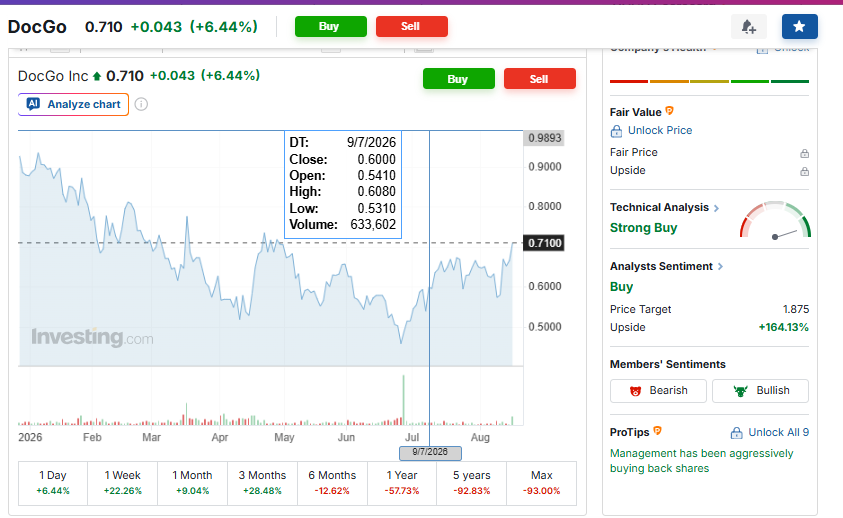
DocGo shares slid to about $0.62 after Q2 revenue of $73.4 million and a $0.16 adjusted loss missed estimates, full-year EBITDA guidance widened to a $17–22 million loss, and the company announced a debt-heavy Hicuity Health acquisition.
DocGo Inc. (NASDAQ: DCGO) shares tumbled nearly 13% in pre-market and after-hours trading to around $0.62 on Tuesday after the company reported second-quarter 2026 results that missed analyst expectations on both revenue and earnings, while sharply widening its full-year adjusted EBITDA loss outlook. The mobile health and medical transportation provider also announced a debt-heavy acquisition of Hicuity Health amid a broader risk-off market environment.
DocGo Q2 Revenue $73.4M Misses Estimates, Adjusted EBITDA Loss Widens to $6.3M, Full-Year Outlook Cut to $17–22M Loss
For the quarter ended June 30, 2026, DocGo reported revenue of $73.4 million, down 8.7% from $80.4 million a year earlier and short of the $75.4 million consensus estimate. The decline was entirely attributable to the wind-down of migrant-related contracts, which contributed zero revenue in Q2 2026 versus $18.8 million in Q2 2025. Excluding migrant revenue, core business revenue grew 19% year over year. Medical transportation revenue reached a record $52.0 million.
The company posted an adjusted loss per share of $0.16, wider than the consensus forecast of a $0.10 loss. GAAP net loss was $18.0 million (versus $13.3 million a year earlier), and adjusted EBITDA was a loss of $6.3 million (versus a $6.1 million loss in Q2 2025). GAAP gross margin was 26.9% and adjusted gross margin 30.5%.
DocGo narrowed full-year 2026 revenue guidance to $305–$310 million (from $300–$315 million previously) but cut its adjusted EBITDA outlook to a loss of $17–$22 million, a significant deterioration from the prior guidance of a $5–$10 million loss. Management still expects to reach a positive adjusted EBITDA run rate by year-end. The guidance excludes any contribution from the pending Hicuity deal.
Separately, DocGo signed a definitive agreement to acquire Hicuity Health, a telemedicine and virtual care provider that generated approximately $65 million in trailing 12-month revenue and $4.5 million in adjusted EBITDA. The deal is structured primarily through the assumption of roughly $52 million in Hicuity’s existing debt (held by Perceptive Advisors, now maturing in December 2029) plus up to $50 million in new financing commitments from Perceptive.
DocGo Slides as Earnings Miss and Wider $17–22M EBITDA Loss Guidance Hit Amid Risk-Off Market and $0.45–$1.73 Range
Investors focused on the dual disappointment of the earnings miss and the dramatically wider full-year EBITDA loss guidance, which raised questions about the pace of the transition away from migrant contracts and the timeline to profitability. The debt-laden structure of the Hicuity acquisition added near-term balance-sheet concerns even as it signals a strategic push into higher-acuity virtual care. Small-cap, high-beta names like DocGo (52-week range $0.45–$1.73) are particularly vulnerable in a risk-off environment; U.S. equity futures were under pressure as geopolitical tensions with Iran escalated, with the Nasdaq futures down about 1.1% and S&P 500 futures off 0.5%.
DocGo Navigates Migrant Wind-Down with Core Growth Focus as Stock Trades Far Below $1.73 High
DocGo has been navigating a multi-quarter revenue transition as government migrant-related programs wind down, shifting focus to core medical transportation, mobile health, in-home care and virtual services (including the earlier SteadyMD acquisition). Management has emphasized record volumes in key non-migrant lines and cost-control efforts, but first-half losses proved larger than expected, prompting the guidance reset. The Hicuity deal aims to expand DocGo’s hospital-to-home and high-acuity virtual care capabilities. The stock remains well below its 52-week high of $1.73 and has declined significantly year-to-date.
Investors Eye Hicuity Close, H2 EBITDA Improvement and Year-End Positive Run-Rate for DocGo
Investors will watch for closing of the Hicuity acquisition, sequential improvement in adjusted EBITDA in the second half, progress toward the stated year-end positive run-rate goal, and any updates on core growth and margin recovery. Broader market sentiment, especially around small-cap healthcare and risk appetite amid geopolitical developments, will also influence the shares.
Sources & Methodology
Primary-source standard: Market-moving facts should link to original data releases, regulator notices, company filings or official project announcements whenever available. Secondary reporting is used for additional context, not as a substitute for original evidence.
Page last reviewed: