Cardano trades near $0.174 as founder Charles Hoskinson lays out plans for private ADA DeFi, a move designed to solve decentralized finance’s transparency problem and draw institutional capital off the sidelines. In a video shared August 16, Hoskinson described confidential on-chain applications, including lending pools, order books, and arbitrage tools, now available on Cardano. The initiative rests on the Dijkstra upgrade, arriving in two phases through 2027, and Midnight, Cardano’s dedicated privacy-focused sidechain launched in March.
Private ADA DeFi Targets Institutions
In a video shared on X on August 16, Cardano founder Charles Hoskinson outlined the arrival of private ADA DeFi, aimed at fixing a structural weakness in decentralized finance. DeFi’s core design makes every on-chain transaction, position, and order publicly visible, a level of transparency that has kept many institutions from participating fully in the space. Hoskinson said Cardano has now developed privacy-preserving DeFi tools, including confidential lending pools, order books, and arbitrage applications, that let institutions transact on-chain without exposing sensitive trading details. He framed the development as a systemic fix rather than a single product, describing next-generation DeFi applications running fully encrypted on Cardano smart contracts while preserving trust and interoperability across the network.
Dijkstra Upgrade Arrives in Two Phases
Hoskinson said Cardano’s privacy push is built around the Dijkstra upgrade, which is rolling out in two stages. The first phase, centered on Ouroboros Linear Leios, targets code completion by the fourth quarter of 2026 and focuses on boosting transaction throughput using supplementary Endorser Blocks. The second phase, Ouroboros Peras, is scheduled for activation in the second quarter of 2027 and is expected to improve settlement finality. Cardano’s broader roadmap also includes CIP-179, a new governance tool, as the network works through a separate and more immediate challenge: a September 1 deadline to renew four of seven Constitutional Committee seats, with delegate support currently sitting well below the 67% threshold required to avoid a governance freeze.
- Phase one (Ouroboros Linear Leios): targets code completion by Q4 2026
- Phase two (Ouroboros Peras): scheduled for activation in Q2 2027
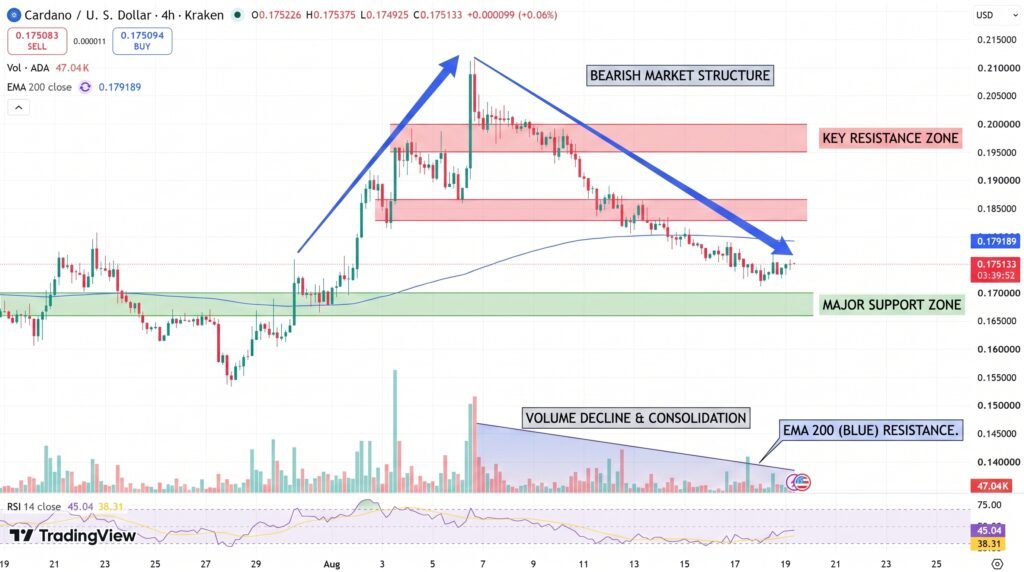
- ADA price: trading near $0.174, down roughly 2.65% over 24 hours
Midnight Powers the Privacy Layer
The privacy infrastructure behind Hoskinson’s announcement traces back to Midnight, the fourth-generation privacy-dedicated chain he unveiled in March as a companion network to Cardano. Midnight allows interoperable tokens, including stablecoins, to move across protocols without exposing transaction details, using shielded and unshielded asset modes that let institutions choose their level of on-chain visibility. Real-world use cases already extend beyond speculative trading: reports point to institutions such as Monument Bank piloting private tokenized deposits worth hundreds of millions of dollars on the network, alongside selective-disclosure tools that let users prove compliance status without revealing full personal data.
Cardano’s private DeFi push represents a deliberate bet that institutional capital will only enter decentralized finance once transparency stops being a liability. The Dijkstra upgrade’s multi-year timeline means the technical groundwork will take time to fully mature, and Cardano’s near-term governance deadline adds a separate source of uncertainty the network must resolve first. Still, the combination of Midnight’s privacy infrastructure and Cardano’s scalability roadmap gives Hoskinson’s vision a concrete technical path, even as ADA’s price continues to trade well below prior highs.
Sources & Methodology
Primary-source standard: Market-moving facts should link to original data releases, regulator notices, company filings or official project announcements whenever available. Secondary reporting is used for additional context, not as a substitute for original evidence.
Page last reviewed: