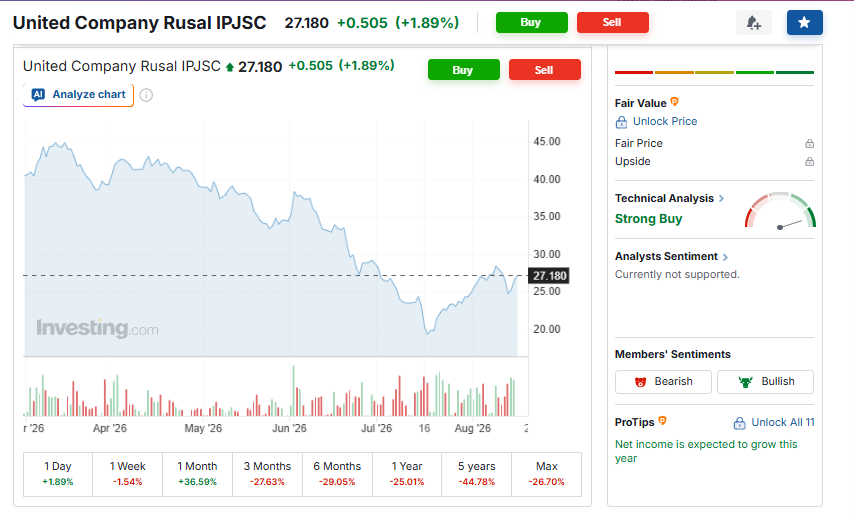
Rusal shares rose 1% to HK$3.12 after posting $196m adjusted H1 profit and 10.9% revenue growth to $8.34bn, driven by elevated aluminium prices amid Hormuz supply disruptions.
United Company Rusal stock rose 1.0% to HK$3.12 on Wednesday after the Russian aluminium giant returned to profitability in the first half of 2026, driven by higher aluminium prices. The company posted an adjusted net profit of $196 million for the six months ended June 30, reversing a $194 million loss a year earlier, while revenue climbed 10.9% to $8.34 billion, as reported by company filings and market data.
Rusal Posts $196m Adjusted H1 Profit as EBITDA Surges 64% on Higher Aluminium Prices
Rusal reported adjusted net profit of $196 million in H1 2026, compared with a $194 million adjusted net loss in H1 2025. Under IFRS, net profit reached $419 million versus a $87 million loss previously. Revenue rose 10.9% to $8.338 billion from $7.520 billion.
Adjusted EBITDA surged 64.4% to $1.230 billion, lifting the margin to 14.8% from 9.9%. Gross profit increased to $2.028 billion from $1.410 billion, with the gross margin expanding to 24.3% from 18.8%. Cost of sales rose only 3.3% to $6.310 billion, mainly due to higher energy costs (up 32.6%).
Aluminium production grew 4.5% to 2.01 million tonnes. Primary aluminium and alloys sales volume fell about 10% to 2.057 million tonnes, but the weighted average selling price rose 23.6%, supported by an average LME aluminium price of $3,386 per tonne versus $2,538 a year earlier. Share of profits from associates and joint ventures (primarily Norilsk Nickel) climbed to $503 million from $291 million. Basic earnings per share stood at $0.0276 versus a loss of $0.0057.
Chairman Bernard Zonneveld noted that aluminium prices “surged to four-year highs within just a couple of months, and then rapidly retreated to their starting point,” while premiums in many markets served by Rusal reached historic levels.
Rusal Shares Outperform Muted Hang Seng After Reversing $455m 2025 Loss
Investors welcomed the return to profit and stronger margins after the company had posted a full-year 2025 net loss of $455 million. The results confirmed the benefit of elevated aluminium prices amid supply constraints. Rusal shares outperformed a muted Hang Seng Index, which faced pressure from rising U.S. Treasury yields (with the 10-year and 30-year yields at multi-year or multi-decade highs). Global markets were soft on higher borrowing costs and ongoing geopolitical uncertainty.
Rusal’s 2025 $455m Loss Reversed as Hormuz Disruptions Cut Gulf Output by 2mt and Lifted LME Aluminium to $3,787/t Highs
The profitability turnaround was widely anticipated due to a meaningful rise in aluminium prices. Supply disruptions linked to the U.S.-Israeli conflict with Iran disrupted shipping through the Strait of Hormuz and constrained Gulf-region aluminium output (estimated losses of around 2 million tonnes of annual capacity). This pushed LME prices higher earlier in 2026, with the three-month contract reaching four-year highs near $3,670–$3,787 per tonne before retreating.
Rusal, the world’s largest aluminium producer outside China, benefited from higher realised prices and premiums even as its own sales volumes declined. The 2025 full-year net loss of $455 million (versus a $803 million profit in 2024) had been driven by foreign-exchange headwinds (including a large FX loss), higher debt-servicing costs, elevated energy and raw-material expenses, and the ongoing impact of Western sanctions. Revenue in 2025 had still risen 22.6% to $14.81 billion on higher volumes and prices.
Electricity tariff increases remain a near-term cost concern; Rusal views them as temporary but warned of potential impairment if prices stay at H1 2026 average levels.
Rusal Focus Shifts to Aluminium Price Stability, Energy Costs and Full-Year 2026 Guidance Amid Hormuz Risks
Attention will focus on whether aluminium prices stabilise at elevated levels or ease further if Hormuz-related logistics improve and Gulf smelter capacity recovers. Rusal will monitor energy costs and any further tariff movements. Investors will also watch the contribution from its Norilsk Nickel stake and the company’s ability to sustain margins amid sanctions and geopolitical risks. Full-year 2026 results and any guidance on volumes, costs, or dividends will be key catalysts.
Sources & Methodology
Primary-source standard: Market-moving facts should link to original data releases, regulator notices, company filings or official project announcements whenever available. Secondary reporting is used for additional context, not as a substitute for original evidence.
Page last reviewed: