
Shares in Chesterfield-based packaging manufacturer Robinson plc (AIM: RBN) fell sharply on 20 August 2026 after the company reported a steep decline in first-half profitability and cut its full-year outlook. Revenue rose 5% to £28.9 million for the six months ended 30 June 2026, but underlying operating profit more than halved to £0.9 million from £2.0 million a year earlier, with gross margin contracting to 20% from 22%. The board now guides full-year underlying operating profit of £2.2–£2.6 million, well below the £3.6 million achieved in 2025.
Revenue +5% to £28.9m, volumes +3%, but underlying OP halves to £0.9m as margin falls to 20%
Robinson, a custom manufacturer of plastic and paperboard packaging with operations in the UK, Poland and Denmark, posted group revenue of £28.9 million (H1 2025: £27.6 million), driven by a 3% increase in sales volumes. UK Plastics volumes rose 9%, helped by strong PET bottle demand and gains in the PP chilled-soup sector, while Denmark volumes increased 10% on better-than-expected demand from a major customer. Paperbox revenue also grew significantly after a substantial new project, though an isolated raw-material quality issue generated extra rectification costs and prevented a profit contribution.
Poland remained weak, with sales volumes 15% lower year-on-year amid a challenging trading environment. Gross margin fell to 20% from 22%, hit by higher polymer, energy and freight costs linked to the Middle East crisis (including premiums to secure material availability), the Paperbox quality issue (which added £0.9 million to sales but no gross profit), and negative operational gearing from lower Polish volumes. Underlying operating costs rose 18% to £4.9 million, reflecting higher distribution and storage costs, investment in a new functionally led structure, wage inflation and lower property rental income.
Statutory profit before tax was £1.0 million (H1 2025: £1.8 million), including gains from surplus property sales. Net debt rose to £6.4 million from £5.4 million at 31 December 2025, despite £1.5 million of cash proceeds from three completed property disposals (Cannon Mill, Walton Works and Hipper House). Capital expenditure was £2.0 million and working-capital outflow £2.1 million. The company announced an unchanged interim dividend of 2.5p per share (payable 9 October 2026) and reiterated its intention for a full-year total of 6.0p.
Robinson reshaped its organisation, appointing external candidates to newly created Head of Commercial and Head of Operations roles to support a refreshed strategy focused on customer centricity, operational excellence and sustainability. Further property sales are expected, including potential completion of deals worth £2.2 million and an option over Boythorpe Works (total consideration £2.85 million).
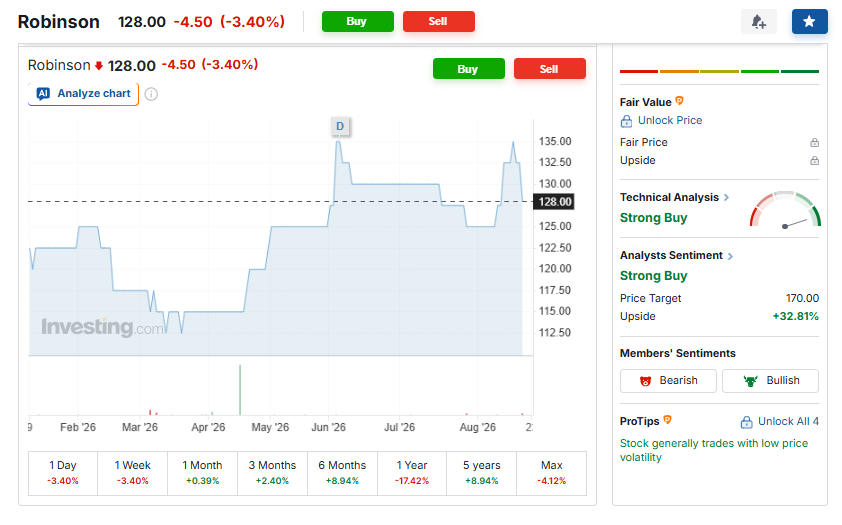
Robinson shares fall ~5–7.5% to 122.5p after FY underlying OP guidance cut to £2.2–£2.6m from £3.6m
Investors focused on the sharp drop in underlying operating profit, margin compression and the guidance cut. The board now expects full-year underlying operating profit of £2.2–£2.6 million, down from £3.6 million in 2025, citing persistent cost inflation, increased competition that led to some business losses, supply-chain disruptions from the Middle East conflict, and ongoing weakness in Poland. These pressures are expected to last longer than previously anticipated, with recovery through customer pricing remaining uncertain.
Shares traded around 122.5p on the day (down approximately 5–7.5% depending on the reference point), moving closer to the 52-week low of 110p and well below the 52-week high of 169.85p. The broader UK AIM market offered little support, with the reaction driven by company-specific concerns over profitability and the path to the medium-term 6–8% underlying operating margin target.
2025 profit £3.6m on £56.2m revenue, serving major FMCG brands
Robinson specialises in technical and value-added packaging solutions for food, homecare, personal care and luxury gift sectors, supplying major FMCG customers including Bakkavor, McBride, Procter & Gamble and Unilever. The group employs nearly 400 people and has a long history dating to 1839. In 2025 it delivered underlying operating profit of £3.6 million on revenue of £56.2 million and a 22% gross margin, supported by UK volume growth and property disposals.
Earlier in 2026 the company had indicated underlying operating profit would be slightly lower than 2025 due to strategic investments and reduced rental income, while expecting UK growth to offset challenges in Poland and Denmark. The Middle East crisis has elevated polymer, energy and freight costs and constrained material availability, increasing working-capital needs. The shift to a functionally aligned structure (replacing the former regional model) aims to improve collaboration, embed best practice and create a scalable platform for growth.
UK and Denmark growth expected; Poland profits lower; medium-term 6–8% margin target retained
UK Plastics is expected to deliver further revenue and profit growth from new projects. Denmark revenue and profit should exceed 2025 levels. Paperbox full-year sales are seen slightly ahead of 2025 but profit lower due to format changes, a lost contract and the first-half quality issue. Poland profits are expected to be materially below 2025, though newly awarded projects support the longer-term outlook.
Additional surplus property disposals are anticipated in the second half, which should reduce net debt and provide a material benefit to reported (but not underlying) profit before tax. The company maintains its medium-term target of above-market profitable growth and a 6–8% underlying operating margin. Investors will watch for evidence of margin recovery, successful implementation of the new organisational structure, and easing of supply-chain and cost pressures.
Sources & Methodology
Primary-source standard: Market-moving facts should link to original data releases, regulator notices, company filings or official project announcements whenever available. Secondary reporting is used for additional context, not as a substitute for original evidence.
Page last reviewed: