
Bitcoin traded near $71,750 on Aug. 20 after an advance of more than 10% from Wednesday’s lows, with an intraday high around $72,500. CoinGlass and subsequent reports put market-wide short liquidations at $2.7 billion to about $3.1 billion over 24 hours, the largest such wave in records that run back to 2021. More than $1 billion of bitcoin shorts were closed in roughly one hour as price ran from about $64,100 toward $70,000, then higher. That is forced buying. It is not, by itself, a new bull market.
Forced Buying Drove the First Leg
The first impulse was mechanical. A dense band of short liquidation levels sat above the six-week range that had held bitcoin between about $62,000 and $66,900 since July 8. When the U.S. Treasury said it would at least double buybacks of longer-dated notes, the 30-year yield fell back from about 5.34%. Risk assets jumped. Shorts that had been comfortable in a quiet range were closed by the exchange. CoinDesk later put bitcoin’s share of the flush near $1.67 billion and ether’s near $1.14 billion.
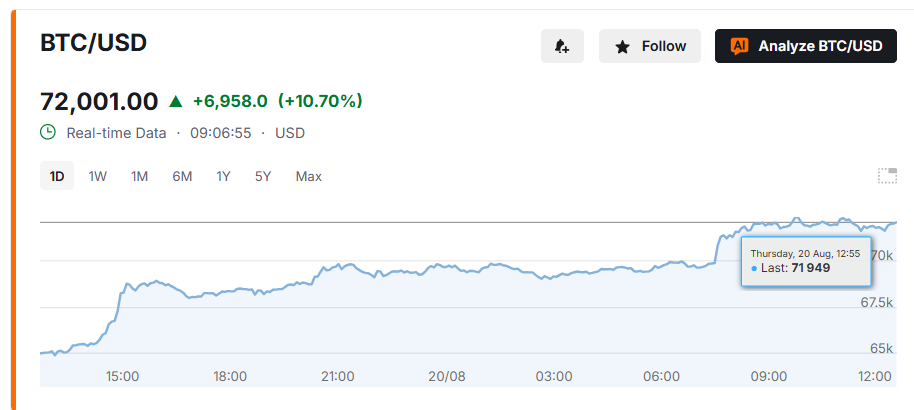
Follow-through into the $71,000s on Thursday is a second question. Spot demand can take over after a squeeze. It can also fail once the last forced bid is gone. Glassnode described the daily move as a 5.8-standard-deviation shock versus 30-day volatility, the largest upside surprise since October 2023. Extremes of that size often mean a pause, not a straight line.
The 52-week range is still about $57,900 to $126,100. Year-to-date bitcoin remains down on the order of 18%. A reclaim of $70,000 is a recovery of spring losses, not a break of the 2026 high.
Policy Headlines Are Not a Law
President Trump met crypto executives at the White House on Aug. 19 and called for a “fair version” of the Clarity Act. Senate cloture is set for Sept. 15. Cloture is 60 votes. It is not passage, and it is not a statute. Ethics language, illicit-finance terms and stablecoin rewards are still open.
The SEC on Aug. 18 proposed Regulation Crypto Assets, a long offering framework with exemptions up to $5 million and $75 million. That is a proposal. Coinbase and Strategy rose with the tape. Sympathy in related stocks shows the same risk bid. It does not write the Senate math.
Trump also said the CFTC is exploring a compliant path for Hyperliquid and has spoken about official bitcoin holdings. Those are statements of intent. They do not replace the buyback-and-squeeze sequence that actually moved the price.
Overbought, Still Below $126,000
Daily momentum is stretched. The source chart put 14-day RSI near 78, with average directional movement high enough to confirm a trend on that window. Weekly and monthly measures are less one-sided. Bitcoin is still more than 40% below the 52-week peak.
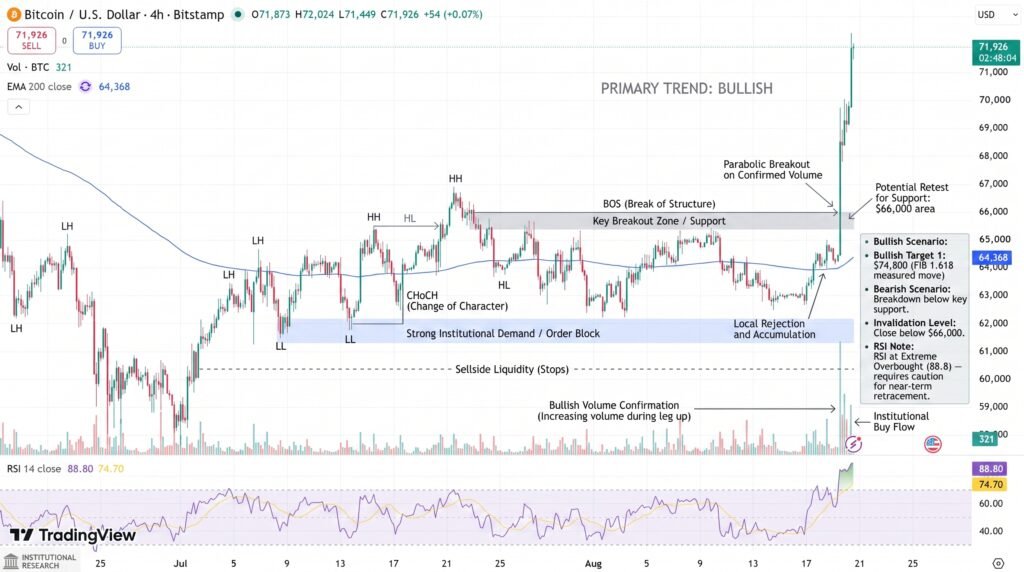
A close that holds above the $72,500 high would argue the range is finished. Failure there, after an RSI of 78, would put the mid-$65,000s back in play—the zone that was resistance last week and is now the first obvious support. The next scheduled binary is not a chart level. It is Sept. 15. If cloture fails, this rally will be judged as another squeeze inside a lower high.
Conclusion
Bitcoin above $71,000 has a real catalyst stack: cheaper long-term money, a record short flush, and a week of Washington headlines. It does not yet have proof of a new bull run. The move began as covering, not as a slow build of spot. Until price holds the breakout after RSI cools, or the Senate produces 60 votes, treat $72,500 as a test and $126,000 as history. Forced buyers do not stay buyers once they are flat.
Sources & Methodology
Primary-source standard: Market-moving facts should link to original data releases, regulator notices, company filings or official project announcements whenever available. Secondary reporting is used for additional context, not as a substitute for original evidence.
Page last reviewed: