
Ripple (XRP) and Stellar (XLM) faced renewed selling pressure on Thursday, October 29, as weakening derivatives indicators and cautious investor sentiment limited recovery attempts. XRP traded near $1.302, placing its $1.30 support level at risk, while XLM hovered around $0.168. The Federal Reserve kept interest rates at 3.75%-4.00% but maintained a cautious stance on inflation. The decision added to uncertainty across cryptocurrency markets, where traders are watching funding rates, market positioning and technical price levels for signs of the next move.
Fed Policy Weighs on XRP and XLM
The Federal Reserve’s October 28 decision left its benchmark interest rate unchanged following a 10-2 vote. Policymakers said inflation remained elevated and indicated that additional economic data would help guide future decisions. Two officials favored a quarter-percentage-point increase, underscoring concerns that price pressures may require tighter monetary policy.
Higher interest rates can weigh on cryptocurrencies by making interest-bearing assets more attractive and reducing investors’ appetite for risk. Although the Fed did not raise rates at this meeting, its inflation concerns kept markets alert to the possibility of further tightening.
Both XRP and XLM are also contending with weaker derivatives positioning. According to the supplied CoinGlass derivatives data, the long-to-short ratio stood at 0.60 for XRP and 0.74 for XLM. Ratios below one indicate that short positions outweigh long positions under the metric’s methodology, suggesting a bearish trading bias.
Funding rates, however, reveal a difference between the two assets. XRP’s funding rate was positive at 0.0080%, meaning long-position holders were paying short-position holders. XLM’s rate turned negative at -0.0051%, indicating the opposite payment direction and a more bearish derivatives signal.
XRP Price Forecast: $1.30 in Focus
XRP traded at approximately $1.302, just above the $1.300 horizontal support level. Its price remained below the 100-day exponential moving average (EMA) at $1.333, the 50-day EMA at $1.357 and the 200-day EMA at $1.372. These moving averages track price trends and can act as resistance when an asset trades below them.
The Relative Strength Index (RSI) stood at 41, indicating subdued momentum without reaching the commonly used oversold threshold of 30. The Moving Average Convergence Divergence (MACD) had improved slightly, but that alone does not confirm a lasting reversal.
Key XRP levels include:
- Support: $1.300.
- First resistance: $1.333.
- Additional resistance: $1.357 and $1.372.
- Higher barriers: $1.540 and $1.900.
A sustained break below $1.30 could deepen the correction. Conversely, a recovery above $1.372 would help weaken the immediate bearish structure, although higher resistance would remain.
Stellar Price Forecast: Momentum Fades
XLM traded near $0.168, below its 50-day and 100-day EMAs around $0.187 and its 200-day EMA near $0.190. The position of these averages suggests that the broader price trend remains under pressure.
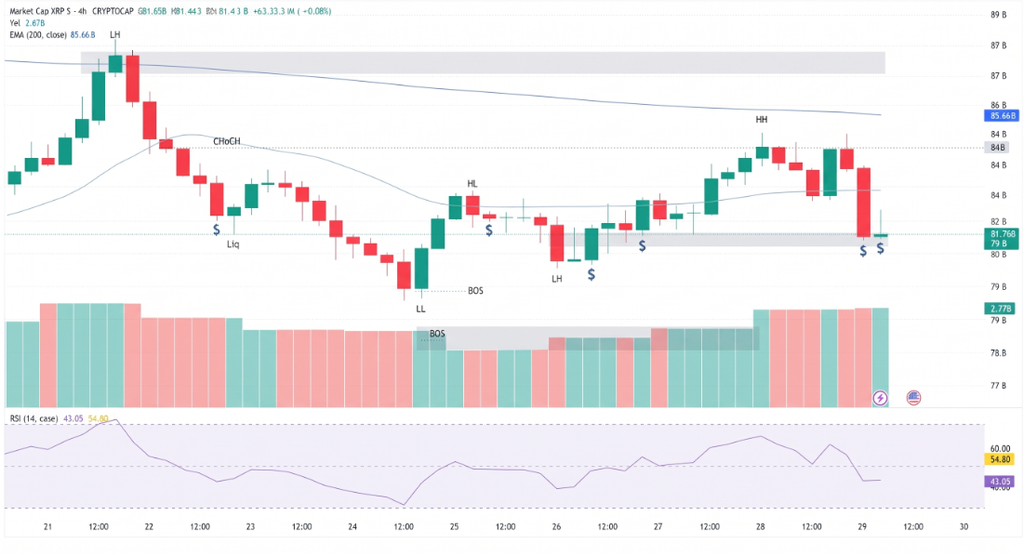
Momentum indicators also point to weakness. XLM’s RSI hovered near 35, approaching oversold territory, while its MACD remained negative. These readings indicate persistent selling pressure but do not rule out short-term rebounds.
The main levels to watch are $0.153 as support, $0.173 as initial resistance, the $0.187-$0.190 moving-average zone and $0.234 as a higher resistance level. A break below $0.153 could expose XLM to additional losses, while holding above that level could allow consolidation.
Conclusion
XRP and XLM remain vulnerable as derivatives positioning and technical indicators signal caution. XRP’s ability to defend $1.30 and XLM’s ability to hold $0.153 will be important in the near term. A stronger recovery would require both assets to reclaim key resistance levels, while further deterioration in market sentiment could extend their declines. These levels are technical reference points, not guarantees of future prices.
Sources & Methodology
Primary-source standard: Market-moving facts should link to original data releases, regulator notices, company filings or official project announcements whenever available. Secondary reporting is used for additional context, not as a substitute for original evidence.
Page last reviewed: