
The Australian dollar weakened against the US dollar on Thursday, October 29, slipping 0.14% to around 0.7040 after retreating from a monthly high of 0.7068. Traders are assessing whether the currency pair can sustain its recent breakout as fresh US economic data approaches. The release of third-quarter gross domestic product (GDP) and September Personal Consumption Expenditures (PCE) inflation could influence expectations for Federal Reserve policy. Meanwhile, stronger Australian inflation has increased expectations of another Reserve Bank of Australia (RBA) rate increase, offering underlying support to the Aussie.
US Data Puts the Dollar in Focus
The US Dollar Index (DXY), which measures the dollar against six major currencies, rose 0.1% to approximately 102.20 during the reported session. The dollar recovered some ground after the Federal Reserve held its benchmark interest rate at 3.75%-4.00% on Wednesday.
The Fed’s 10-2 decision left policymakers divided, with two officials favoring a quarter-percentage-point increase. The central bank also said inflation remained elevated, keeping the possibility of further tightening in focus.
The US Bureau of Economic Analysis scheduled its advance estimate of third-quarter GDP and September personal income and outlays report for Thursday at 8:30 a.m. Eastern Time, equivalent to 12:30 GMT. Both releases could shift expectations for interest rates and influence the dollar’s direction.
According to forecasts cited in the supplied market report, US GDP growth was expected to accelerate to 2.5% from 2.2%, while annual core PCE inflation was projected to rise to 3.1% from 3.0%. These are forecasts, not confirmed results. Strong growth alongside persistent inflation could support the dollar by reinforcing expectations that US rates will remain elevated.
Australian Inflation Supports RBA Bets
The Australian dollar has received support from expectations that the RBA may raise interest rates at its November meeting. Recent Australian inflation figures reportedly exceeded market expectations, strengthening the case for additional monetary tightening.
According to figures cited by Brown Brothers Harriman, annual headline consumer price inflation reached 4.3% in September, up from 4.0% in August and above the 4.2% consensus forecast. Rising housing and transport costs contributed to the increase.
Higher inflation can prompt a central bank to raise interest rates to slow demand and contain price pressures. Expectations of higher Australian rates can support the Aussie by improving the relative return on Australian-dollar assets. However, the currency’s performance will also depend on US data and broader market sentiment.
AUD/USD Technical Outlook and Key Levels
On the four-hour chart, AUD/USD is testing the upper boundary of its recent consolidation range between 0.6994 and 0.7040. The pair remains slightly above its 20-period exponential moving average (EMA) at 0.7036, suggesting that short-term buyers retain some control.
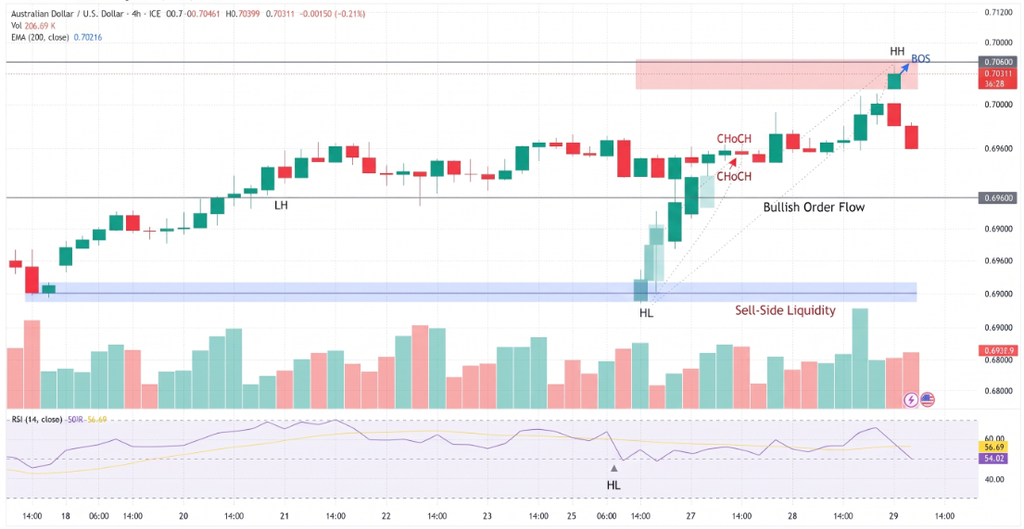
The Relative Strength Index (RSI) stands at 58, indicating positive momentum without entering traditionally overbought territory.
Key levels to watch include:
- Immediate support: 0.7036, near the 20-period EMA.
- Lower support: 0.6994, the bottom of the consolidation range.
- Near-term resistance: 0.7068, the recent monthly high.
- Potential upside target: 0.7100, if buying momentum strengthens.
Conclusion
AUD/USD remains near a technically important level as traders weigh resilient Australian inflation against the outlook for US growth and prices. A sustained move above 0.7040 could strengthen the case for a test of 0.7068 and potentially 0.7100. A decline below 0.7036 would weaken the immediate bullish setup, while a break under 0.6994 could signal a deeper correction. The US data releases and evolving RBA rate expectations are likely to remain central to the pair’s next move.
Sources & Methodology
Primary-source standard: Market-moving facts should link to original data releases, regulator notices, company filings or official project announcements whenever available. Secondary reporting is used for additional context, not as a substitute for original evidence.
Page last reviewed: