
The euro advanced against the British pound on Monday, with EUR/GBP rising nearly 0.3% and approaching resistance around 0.8360. Stronger-than-expected Eurozone manufacturing figures and a reversal in oil prices helped the single currency recover, while upbeat UK factory data failed to provide lasting support to sterling. The pair’s technical indicators suggest that bearish momentum is easing, but buyers still need to clear resistance before a broader recovery can take shape.
Euro gains as manufacturing improves
The euro found support after the final HCOB Eurozone Manufacturing PMI was revised higher to 52.7 in October, compared with the preliminary estimate of 52.4. The reading remained close to September’s 52.9, indicating that manufacturing activity continued to expand.
Germany’s final manufacturing PMI was confirmed at 52.7, while France and Spain recorded upward revisions. Italy was the exception, with factory activity unexpectedly contracting. The figures suggest that the recovery across the currency bloc remains uneven, even as the overall manufacturing sector maintains expansion.
A PMI reading above 50 indicates that activity is increasing, while a result below 50 signals contraction. The improvement in the Eurozone figures therefore provided some support for the euro, although the modest decline from September suggests that the sector’s momentum has not accelerated.
The reversal in oil prices also helped the euro recover. Lower energy costs can ease inflationary pressure for energy-importing economies such as those in the Eurozone, potentially improving the region’s economic outlook.
Sterling struggles despite stronger UK data
The pound failed to benefit significantly from an improvement in British manufacturing activity. The final S&P Global UK Manufacturing PMI confirmed October’s reading at 52.8, matching the preliminary estimate and rising from 51.9 in September. It was the strongest reading in five months.
The data point to improving factory conditions and could influence expectations for the Bank of England. Traders are assessing the possibility of a 25-basis-point interest-rate increase, although manufacturing strength alone does not determine the central bank’s decision. Inflation, wage growth and broader economic conditions will also matter.
Despite the improved PMI, sterling remained on the defensive against the euro, allowing EUR/GBP to approach the 0.8360 resistance area.
EUR/GBP forecast: 0.8360 is pivotal
On the four-hour chart, EUR/GBP trades near 0.8356, with momentum indicators showing signs of stabilization. The Relative Strength Index (RSI) is close to 50, indicating balanced momentum after recovering from oversold territory. The MACD has moved slightly above zero, suggesting that selling pressure is easing.
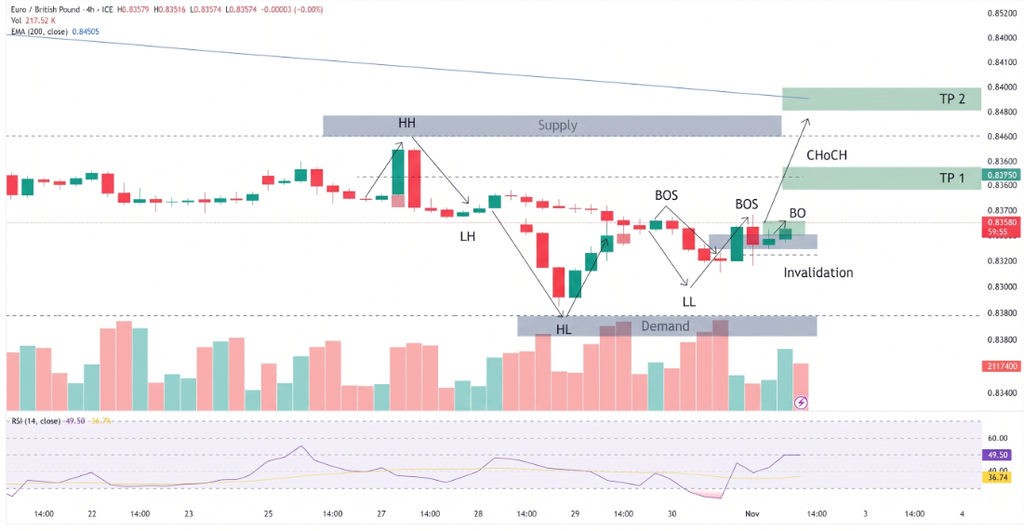
Traders are monitoring these levels:
- Immediate resistance: 0.8360.
- Next resistance: 0.8380, the October 28 high.
- Major bullish threshold: 0.8400, the October 26 high.
- Initial support: 0.8320, near Friday’s low.
- Lower support: 0.8300, followed by 0.8220–0.8240.
Conclusion
EUR/GBP has regained upward momentum, but the recovery remains unconfirmed below 0.8360. A sustained break above that barrier could open the way toward 0.8380 and 0.8400, strengthening the bullish outlook. However, failure to clear resistance may bring sellers back into the market, exposing 0.8320 and potentially 0.8300. For now, the euro has the near-term advantage, but a confirmed move beyond resistance is needed to establish a stronger recovery.
Sources & Methodology
Primary-source standard: Market-moving facts should link to original data releases, regulator notices, company filings or official project announcements whenever available. Secondary reporting is used for additional context, not as a substitute for original evidence.
Page last reviewed: