
Asian equities retreat as Brent nears $91, U.S. 30-year yields hit 2007 highs and Japan 10-year yields reach 1996 peaks. Tech shares lead declines despite Nvidia’s $105B OpenAI financing support.
Asian stocks mostly declined on Tuesday, August 18, 2026, as higher oil prices and climbing global bond yields outweighed optimism from AI infrastructure spending. The MSCI AC Asia Pacific gauge fell about 0.6%, with technology shares under pressure in Japan, South Korea, China and Hong Kong. Brent crude rose around 0.4% to near $91.24 a barrel, while the U.S. 30-year Treasury yield climbed to about 5.3%, its highest since June 2007. Japanese 10-year yields also extended gains to multi-decade highs.
Asian Markets Slide as Nikkei Falls 1.9%, KOSPI 1.1% and Tech Stocks Lead the Decline
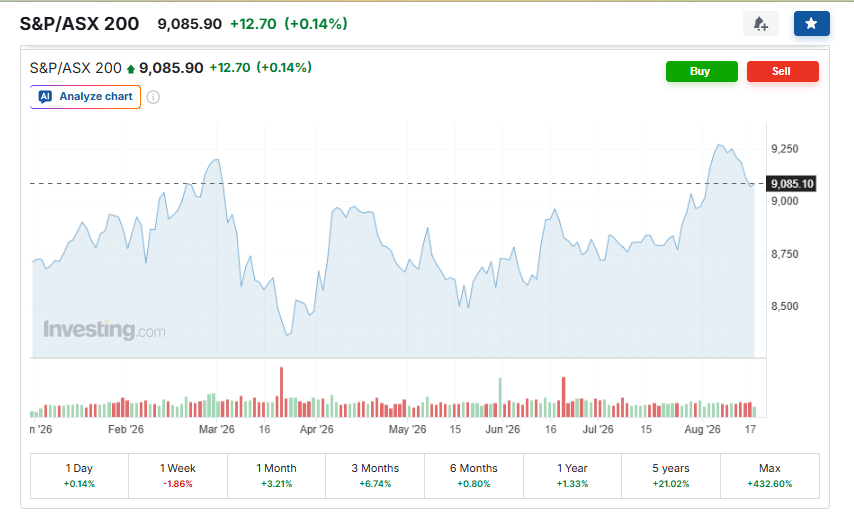
Japan’s Nikkei 225 dropped about 1.9% (some reports cited declines of 1.6–2%), while the broader TOPIX fell 0.5%. South Korea’s KOSPI erased an early gain of more than 3% and slid around 1.1% after returning from a holiday, with later trading showing mixed recovery. China’s Shanghai Shenzhen CSI 300 fell 0.8% and the Shanghai Composite lost 0.39%. Hong Kong’s Hang Seng declined about 0.73% (reports ranged 0.6–0.7%). Australia’s S&P/ASX 200 edged 0.2% higher. Singapore’s FTSE Straits Times fell 1.3%, India’s Nifty 50 slipped 0.3%, and Indonesia’s IDX Composite rose 1.3%.
Japanese technology shares led the pullback: Kioxia Holdings plunged 8.3%, Murata Manufacturing dropped 9.6%, TDK lost 3.7% and Sony slipped 1.2%. In South Korea, Samsung Electronics fell 1.4% and LG Innotek declined 1.3%, though SK Hynix gained 1.4%. Chinese and Hong Kong tech names also weakened, with Foxconn Industrial Internet down 3.1%, Luxshare Precision off 2.3%, Semiconductor Manufacturing International Corp slipping 0.5%, JD.com losing 2.7%, Meituan dropping 3.4% and Tencent declining 1.8%. Oil-linked shares advanced, including Japan’s Inpex (+2.7%), Eneos (+2.2%) and Hong Kong-listed CNOOC (about +2%).
Nasdaq 100 futures dropped 0.8% and S&P 500 futures slipped 0.4%. The pullback followed several sessions of gains and came despite Nvidia agreeing to support up to $105 billion of financing for a new OpenAI data-center campus in Ohio (up to roughly 8 gigawatts of capacity, with Nvidia backing residual value on the initial phase).
Rising Oil & Bond Yields Raise Inflation and Rate-Hike Concerns
Markets reassessed the inflation and interest-rate outlook. Brent crude’s rise (around 0.4% to ~$91.24, following earlier gains that pushed it above $90) reflected renewed Middle East uncertainty, fading prospects for a quick U.S.-Iran agreement, and concerns over supplies through the Strait of Hormuz. The U.S. 30-year Treasury yield reached its highest since June 2007 (around 5.3–5.32%), while Japan’s 10-year government bond yield hit its highest since 1996 (near 2.94%), driven by expectations of further Bank of Japan tightening and Japan’s fiscal concerns. Higher yields raise borrowing costs and pressure valuations, especially for growth and technology stocks.
DBS analysts noted the broader equity-risk backdrop remains relatively benign, supported by strong corporate earnings, the AI boom and a less hawkish Federal Reserve. They warned the risk profile could deteriorate if the AI rally falters, geopolitical tensions escalate or the Fed resumes rate hikes.
Oil Supply Risks and Rising Bond Yields Challenge AI-Driven Market Gains
The move followed a period of gains fueled by AI-related optimism and robust earnings. Oil had zigzagged earlier (between roughly $72 and $102 in recent months) amid fluctuating hopes for a U.S.-Iran deal that would ease tanker restrictions in the Persian Gulf. The U.S.-Iran truce expiration and Tehran’s more assertive posture, alongside renewed fighting in the region, revived supply fears. Long-dated global bond yields had already climbed to multi-year or multi-decade highs, reflecting inflation concerns, heavy government and corporate debt issuance (including AI-related), and fiscal worries.
Australia’s Westpac-Melbourne Institute consumer sentiment index rose 6% to 88.9 in August, a second straight monthly improvement (from 83.9 in July), though it remained nearly 10% below year-earlier levels and below the long-term average near 100. Gains were concentrated among mortgage holders after the Reserve Bank of Australia held rates.
Bank Indonesia Rate Decision Ahead as BI-Rate Expected to Hold at 5.75%
Attention turns to Wednesday’s Bank Indonesia policy decision on August 19. Consensus expects the central bank to leave the BI-Rate unchanged at 5.75% (after holding in July), with new leadership signaling continuity amid stable inflation and easing rupiah pressures. Investors will also monitor further Middle East developments, oil price movements, bond-yield trends, and any signals from the Federal Reserve on the inflation outlook. Geopolitical escalation or a sustained rise in long-term yields could further pressure risk assets, while continued AI infrastructure commitments may provide support.
Sources & Methodology
Primary-source standard: Market-moving facts should link to original data releases, regulator notices, company filings or official project announcements whenever available. Secondary reporting is used for additional context, not as a substitute for original evidence.
Page last reviewed: