
Bitcoin fell 2.7% to $84,148.70 by 02:14 ET Thursday, extending the previous session’s losses as higher US Treasury yields and rising oil prices reduced appetite for risk-sensitive assets. The decline came alongside losses across major cryptocurrencies after a strong September rally. Bitcoin remains higher for the month, but the latest move highlights the market’s sensitivity to interest-rate expectations, inflation risks and shifts in global risk appetite.
Rising Yields Pressure Bitcoin
The latest Bitcoin decline followed a sharp move higher in US borrowing costs. The 10-year Treasury yield climbed above 5%, reaching its highest level since 2007, according to market data. A strong US business survey and weak demand at a five-year Treasury auction contributed to the move. The five-year note auction cleared at 5.033%, its highest yield since 2006.
The S&P Global US Composite PMI rose to 58.4 in September from 56.0 in August, marking the fastest expansion in more than five years. The survey also pointed to stronger employment and accelerating input-price pressures.
Higher government-bond yields can make non-yielding assets such as Bitcoin less attractive relative to interest-bearing securities. They can also increase financing costs for leveraged positions, adding another source of pressure when investors reduce exposure to speculative assets.
The Federal Reserve raised its benchmark policy rate by 25 basis points last week. The combination of resilient US activity and persistent price pressures has kept monetary-policy expectations at the center of the cryptocurrency market’s near-term outlook.
- Bitcoin: $84,148.70, down 2.7%
- US 10-year Treasury yield: above 5%
- Five-year Treasury auction yield: 5.033%
Oil Adds to Inflation Concerns
Higher oil prices have added another layer of uncertainty for markets because energy costs directly influence inflation expectations. Brent crude rebounded more than 4% to nearly $104 a barrel on Wednesday, ending a six-session decline, according to CoinDesk’s market report.
The oil rebound came as hopes for a rapid improvement in US-Iran relations weakened. Developments involving Iran and the Strait of Hormuz remain important for global energy supply and inflation expectations.
For Bitcoin, the combination of higher yields and elevated energy prices creates a difficult macro backdrop. If markets continue to price persistent inflation and tighter monetary policy, demand for higher-risk assets can remain sensitive to incoming economic and geopolitical news.
At the same time, the cryptocurrency market continues to receive support from changes in US digital-asset regulation. The Securities and Exchange Commission announced a five-year conditional exemption on September 17 allowing certain venues to facilitate trading in tokenized US stocks under specified conditions.
Altcoins Extend Bitcoin’s Decline
The broader cryptocurrency market followed Bitcoin lower as investors reduced exposure after strong gains earlier in September. Ethereum fell 2.5% to $2,685.83, while XRP dropped 7.5% to $1.5052.
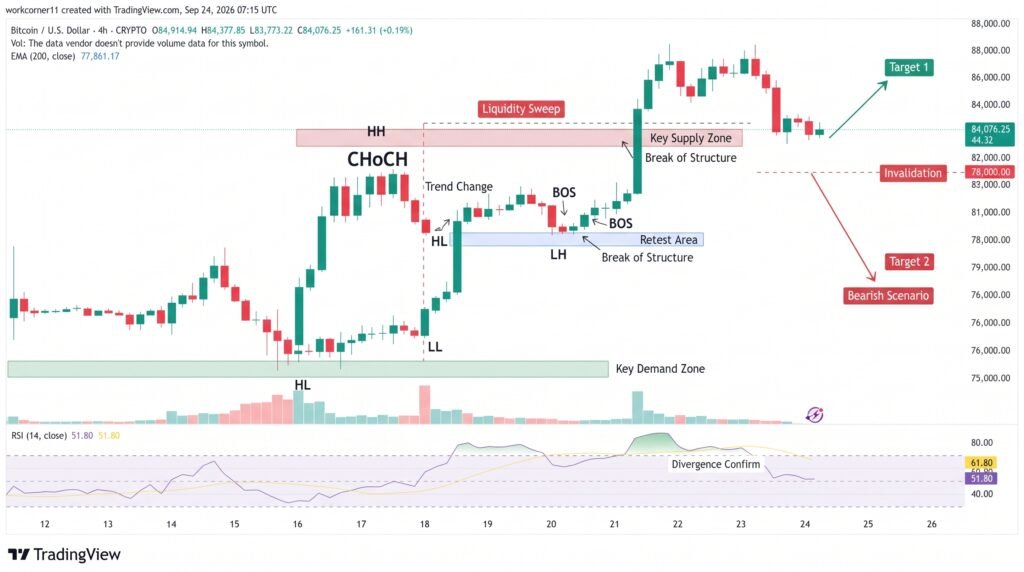
SOL declined 3.3%, Cardano lost 7.1%, and BNB fell 2.5%. The losses were broader among meme tokens, with Dogecoin down 7.7% and $TRUMP falling 11.4%.
The breadth of the declines indicates that the move was not limited to Bitcoin. Instead, it reflected a wider reduction in risk appetite across digital assets as investors responded to higher yields, stronger US economic data and renewed oil-market pressure.
Key market moves:
- Ethereum: -2.5%
- XRP: -7.5%
- Cardano: -7.1%
- Dogecoin: -7.7%
Conclusion
Bitcoin’s decline to around $84,149 reflects a broader shift in macro conditions rather than a cryptocurrency-specific development alone. Treasury yields above 5%, stronger US economic activity and rebounding oil prices have increased pressure on risk assets by keeping inflation and interest-rate expectations elevated. Meanwhile, regulatory developments such as the SEC’s five-year tokenized-stock exemption provide a separate structural development for the digital-asset sector. For now, Bitcoin and major altcoins remain sensitive to movements in yields, oil and overall risk appetite.
Sources & Methodology
Primary-source standard: Market-moving facts should link to original data releases, regulator notices, company filings or official project announcements whenever available. Secondary reporting is used for additional context, not as a substitute for original evidence.
Page last reviewed: