Bitcoin is trading near $75,963 on the two-hour chart after slipping below the former support area around $76,559. What catches my attention is that the rebound from $74,903 has failed to recover this broken floor, suggesting sellers still control the short-term structure.
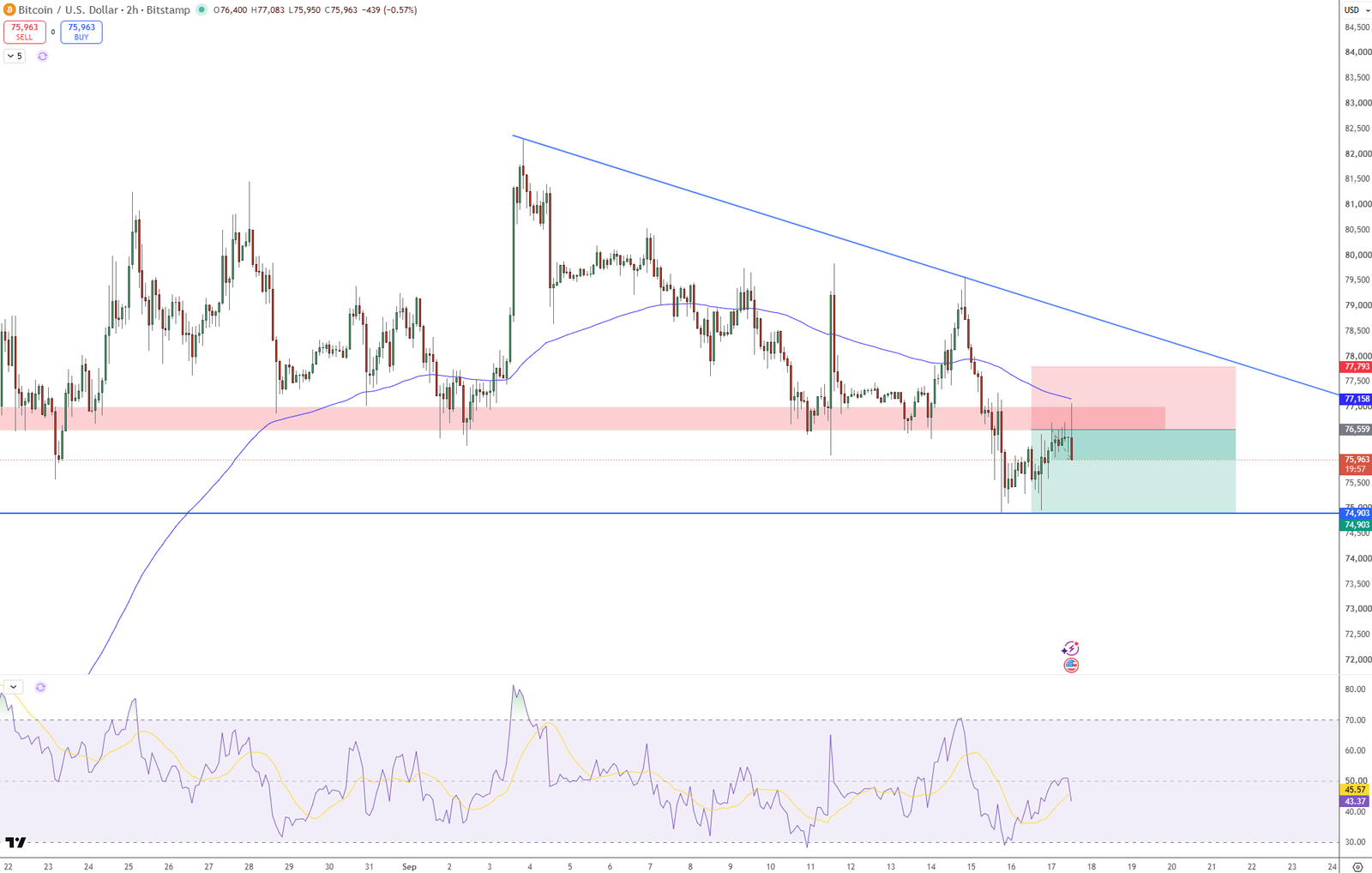
BTC trade idea: Bearish below $76,559, with $74,903 as the initial target. The setup is invalidated above $77,793.
Price also remains below the descending trendline drawn from the September high and under the moving average near $77,158. Together, these barriers create a resistance cluster between $76,559 and $77,158. Unless Bitcoin reclaims this zone on a two-hour closing basis, the current recovery looks more like a corrective bounce than the start of a sustained reversal.
Momentum supports the cautious bearish view. RSI is near 43, below both the neutral 50 level and its signal line around 46. Buying pressure has weakened, although the indicator is not yet oversold. Sellers therefore still have room to test lower support.
A failed retest of $76,559 could provide a short opportunity, with $74,903 as the first target. This level has already produced a reaction and remains the key near-term floor. A clean break beneath it could expose $74,000 and then $73,000, but traders should wait for confirmation rather than chase a sharp move lower.
The bearish setup would weaken if BTC closes back above $77,158. For tighter risk control, a stop above $77,793 would place the invalidation beyond the nearby resistance cluster. Based on an entry around $76,559, the move toward $74,903 offers roughly 1.3 times the risk relative to that stop.
My bias remains bearish below $76,559, with $74,903 in focus. A sustained recovery above $77,793 would invalidate the setup and shift attention toward the descending trendline near $79,000.
This analysis is for educational purposes and is not financial advice.
Sources & Methodology
Primary-source standard: Market-moving facts should link to original data releases, regulator notices, company filings or official project announcements whenever available. Secondary reporting is used for additional context, not as a substitute for original evidence.
Page last reviewed: