
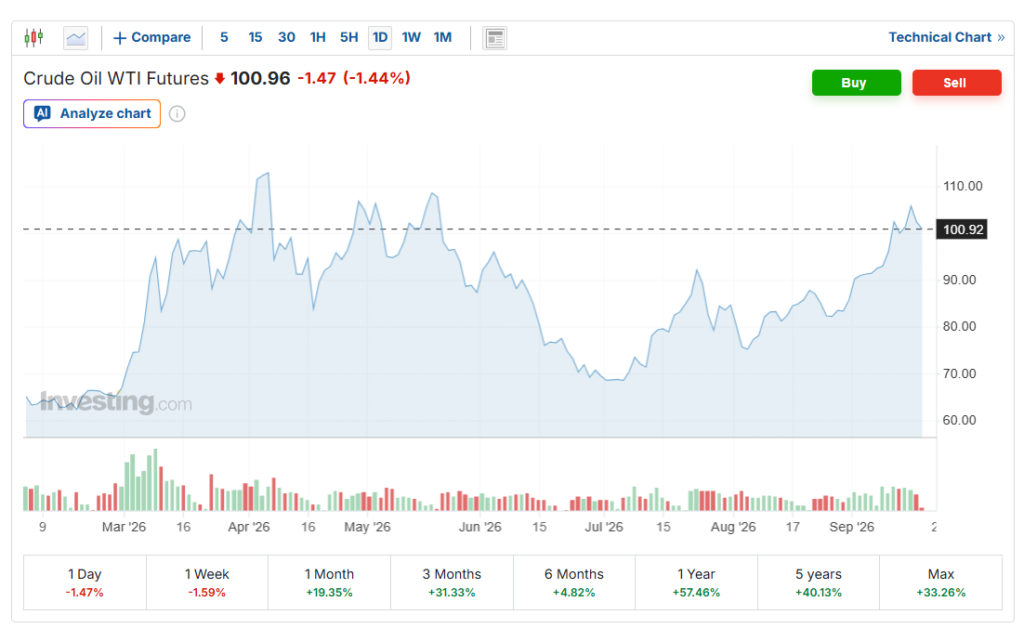
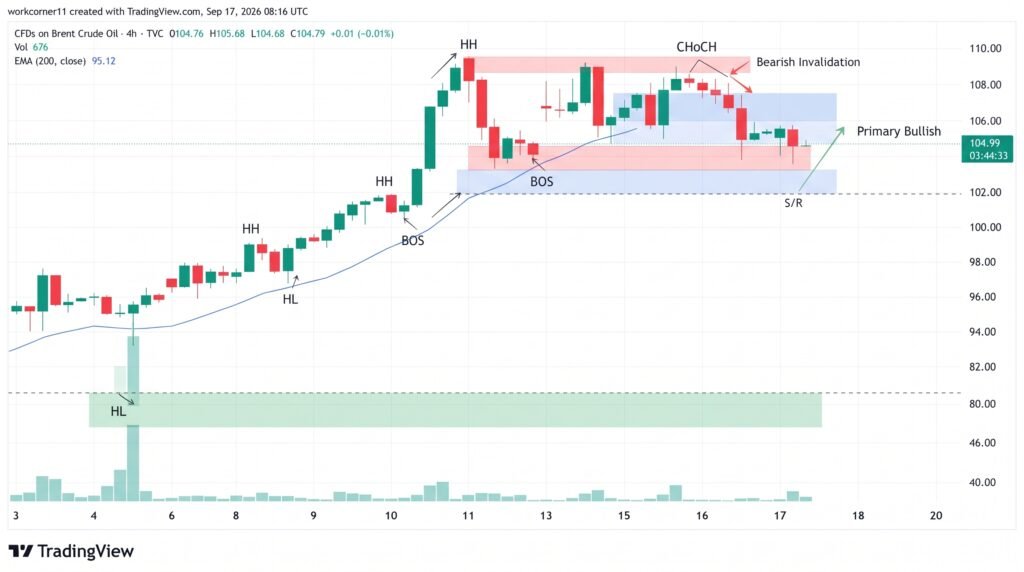
Brent oil has entered a critical technical phase, with the supplied 5-hour chart showing the latest candle closing around $103.66 after falling through nearby support. The immediate focus is now the $101.50-$102.50 area, where the 50-period moving average and trend indicators could determine whether the recent correction develops into a broader reversal. The fundamental backdrop has also softened, with Brent futures falling to $103.95 on September 17 as concerns over Middle East supply disruptions eased.
Brent Oil Tests Major Support
The latest technical setup places Brent between short-term resistance near $106.58 and a broader support band around $101.50-$102.50. At $103.66, the benchmark is approaching the lower boundary of that range, leaving limited room before the broader bullish structure comes under greater pressure.
The 50-period moving average near $102.12 remains an important technical reference. Holding above that level would keep the medium-term trend structure intact, while a sustained close beneath $101.50 would represent a more significant deterioration.
The current market decline also follows a sharp pullback from recent highs. Brent settled at $105.83 on September 16, down 2.7%, after supply concerns eased and U.S. inventory data reduced some pressure on the market.
- Chart price: $103.66
- Major support: $101.50-$102.50
- 50-period SMA: $102.12
- Immediate resistance: $106.58
Bearish Signals Gain Momentum
Momentum indicators are shifting lower as Brent approaches the key support zone. The MACD and RSI in the supplied setup both point toward weakening buying pressure.
The chart also shows a potential double-top formation around the previous $109.97 high. A double top becomes more meaningful when price breaks the intervening support and confirms a lower high, so the pattern remains incomplete until Brent loses additional support.
The September 10 bearish-engulfing candle adds another warning. Together with rising volume on declining sessions, the pattern suggests that selling interest has increased after the recent rally.
The SuperTrend and Ichimoku Cloud also sit close beneath current prices. A decisive break below those indicators would provide further evidence that the correction is gaining strength.
Oil Fundamentals Add Downside Pressure
The fundamental picture has also become less supportive for crude. Reuters reported Thursday that Brent fell 1.8% to $103.95 as Saudi Arabia offered additional crude shipments to Asian refiners through Oman, reducing immediate concerns over supply disruptions caused by attacks on the country’s East-West pipeline.
U.S. inventory data provided another factor. The Energy Information Administration reported that commercial crude inventories fell by 640,000 barrels for the week ended September 11 to 423.4 million barrels, although the decline was smaller than the 1.4 million-barrel fall expected by analysts.
For the technical outlook, $106.58 remains the first major upside hurdle. A recovery above that level would reduce immediate downside pressure, while a sustained close below $101.50 would put the broader uptrend at risk.
The $103.50-$106.00 region remains vulnerable to false moves while Brent trades near its major indicators. A confirmed breakdown accompanied by stronger volume would carry more technical significance than an intraday move alone.
Conclusion:
Brent oil is testing a key technical boundary near $103.66 after retreating from the $109.97 area. The $101.50-$102.50 zone is now central to the medium-term structure, with the 50-period SMA near $102.12 adding importance to the support region. A break below $101.50 would strengthen the bearish setup, while a recovery above $106.58 would ease immediate downside pressure. The latest decline is also being supported by easing supply concerns and a smaller-than-expected U.S. crude inventory draw.
Sources & Methodology
Primary-source standard: Market-moving facts should link to original data releases, regulator notices, company filings or official project announcements whenever available. Secondary reporting is used for additional context, not as a substitute for original evidence.
Page last reviewed: