
Dogecoin is holding near $0.083 after finding support around its 50-day and 100-day exponential moving averages, but the rebound lacks strong evidence of sustained demand. ETF activity remains subdued, derivatives positioning is divided and DOGE is still well below its 200-day EMA. The result is a market balanced between a potential recovery and another leg lower.
DOGE traded around $0.083 Tuesday, broadly matching recent market levels. CoinGlass data show open interest near $1.22 billion, while 24-hour futures volume is about $1.28 billion, underscoring the amount of leverage still active in the market.
ETF Demand Remains Weak
Institutional interest has provided little confirmation for Dogecoin’s recent recovery. SoSoValue data cited Tuesday showed spot DOGE ETF flows remaining quiet, limiting evidence of fresh institutional accumulation.
The weak ETF picture has become more significant after Bitwise announced that its BWOW Dogecoin ETF will be liquidated, with trading expected to end on October 14, 2026. The Securities and Exchange Commission filing said the fund will cease operations after that date, with remaining shareholders scheduled to receive cash based on the October 21 net asset value.
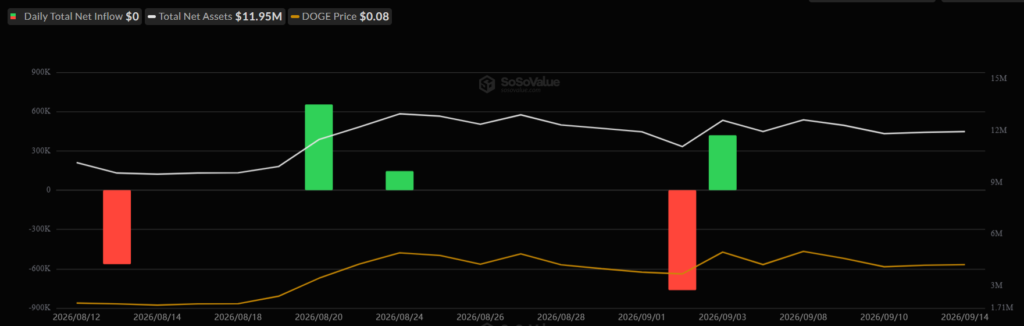
That decision does not determine DOGE’s price direction, but it highlights the difficulty some dedicated Dogecoin investment products have had attracting sufficient demand.
Derivatives data are more conflicted. CoinGlass’ DOGE long-to-short ratio was reported at 0.66, its lowest level in more than a month, indicating that short positioning outweighed long positioning. However, the open-interest-weighted funding rate turned positive on September 9 and stood at 0.0010% Tuesday, meaning long traders were paying shorts.
Technical Setup Stays Fragile
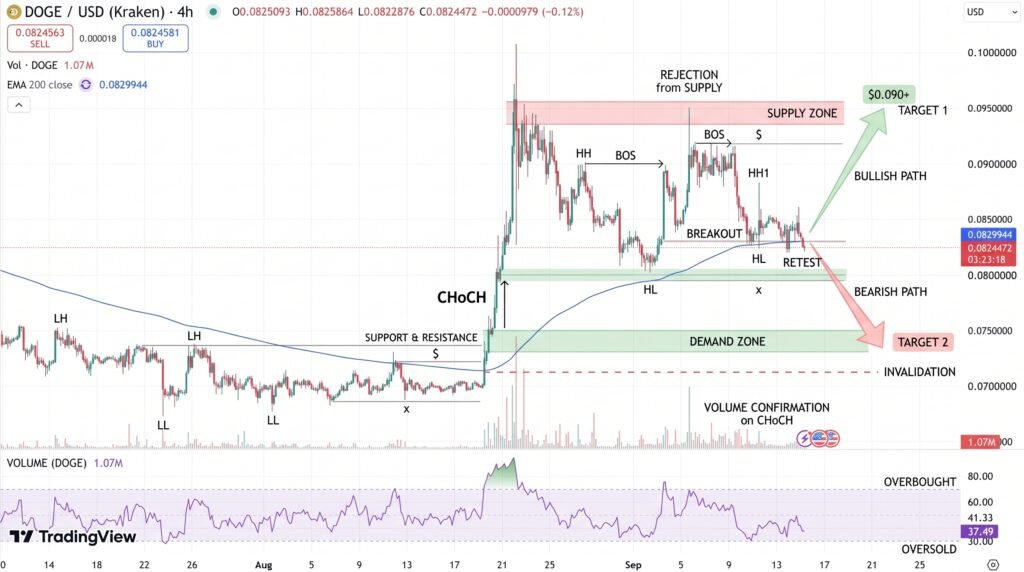
DOGE remains above the 50-day EMA near $0.081 and 100-day EMA around $0.082, creating a narrow support cluster beneath the current price. Holding this zone keeps the recent recovery attempt alive, but the broader chart remains constrained by the 200-day EMA near $0.092.
Momentum is close to neutral. The RSI is around 49, suggesting neither buyers nor sellers have established a strong short-term advantage, while the MACD remains slightly below zero. Recent price action also shows DOGE recovering from the $0.070 area without yet producing a decisive trend reversal.
The market’s main technical levels are:
- Immediate support: $0.081–$0.082
- First resistance: $0.088
- Major resistance: $0.092
- Critical downside support: $0.070
A sustained move above $0.088 would improve the short-term structure and expose the 200-day EMA near $0.092. Clearing that average would be more meaningful because it would place DOGE above a widely followed measure of its longer-term trend.
$0.070 Remains the Major Risk
A failure to defend the EMA support cluster would shift attention back to the lower part of the recent range. A daily close below $0.070 would invalidate much of the recent recovery and increase the probability of a deeper correction.
The broader crypto market also remains sensitive to U.S. monetary policy. Reuters reported that investors were preparing for a potential Federal Reserve rate increase, a backdrop that can weigh on speculative assets such as meme coins through higher yields and tighter financial conditions.
For DOGE, that makes confirmation more important than short-term price swings. A rally supported by improving ETF flows, stronger spot demand and rising derivatives participation would carry greater weight than a move driven primarily by leveraged futures.
Conclusion
Dogecoin’s $0.081–$0.082 support zone is keeping the recovery attempt alive, but conviction remains limited. Quiet ETF flows, Bitwise’s planned fund liquidation and a long-to-short ratio below one point to cautious positioning, while positive funding offers one counterweight. The immediate test is $0.088, followed by the $0.092 200-day EMA. Failure to hold the EMA cluster would put $0.070 back in focus and leave DOGE vulnerable to a deeper correction.
Sources & Methodology
Primary-source standard: Market-moving facts should link to original data releases, regulator notices, company filings or official project announcements whenever available. Secondary reporting is used for additional context, not as a substitute for original evidence.
Page last reviewed: