
Ether rose about 18% in 24 hours to $2,252.80, ending a five-week stretch between roughly $1,870 and $1,950 and lifting the weekly gain to 19.65%. Trading volume increased 402% as price cleared $2,003. The move was not an Ethereum-only event. It followed the Treasury’s larger long-bond buybacks, a bitcoin squeeze, and more than $1 billion of ether short liquidations. Two risks now sit in front of the tape: prior supply near $2,426–$2,500, and a pair of Hyperliquid whale shorts that Lookonchain put at 50,838 ETH, or about $98 million.
Breakout Clears $2,003 on Huge Volume
The $2,003 print had capped the range. Once it gave way, buyers paid through offers. CryptoQuant recorded $2.55 billion of hourly taker buy volume on Aug. 19, the third-highest such hour since Feb. 7. That is aggressive demand: traders lifting the ask rather than waiting.
Momentum is extended. The source chart’s RSI reached 92.14. Daily readings were also overbought, in the low 80s on some 14-day measures. MACD expanded with the impulse. Oscillators that high after a one-day 18% rise usually require time or price to cool. Holding $2,003—and preferably Wednesday’s prior close near $1,917—keeps the new structure. Losing $2,003 puts ether back inside the old band and treats the volume spike as a range break that failed.
April Supply Sits Near $2,426
The next map is not $2,636. It is the April supply zone around $2,426.30 and the broader $2,431–$2,500 shelf, a prior swing high with heavy historical volume. Sellers who were active there can sell again as price returns. Ether has already tagged as high as about $2,326–$2,333 on some venues, so that shelf is close.
A useful advance from here would absorb that supply on sustained volume, then build higher lows while RSI works back toward 60–70. Only if buying holds above $2,500 does $2,636—an older support-turned-resistance—become the next reference. Repeated failure in the $2,431–$2,500 band would show that the 18% burst has met inventory large enough to stop it.
$98 Million in Whale Shorts Remain
Lookonchain flagged two wallets short a combined 50,838 ETH on Hyperliquid, about $98 million notional. One book was roughly 25,750 ETH at 10 times, with liquidation near $2,273. The other was about 25,080 ETH at 20 times, with liquidation near $2,147. Subsequent reporting said the 20-times book closed into the rally; the 10-times book was still open. That leaves a live squeeze level just above the current print.
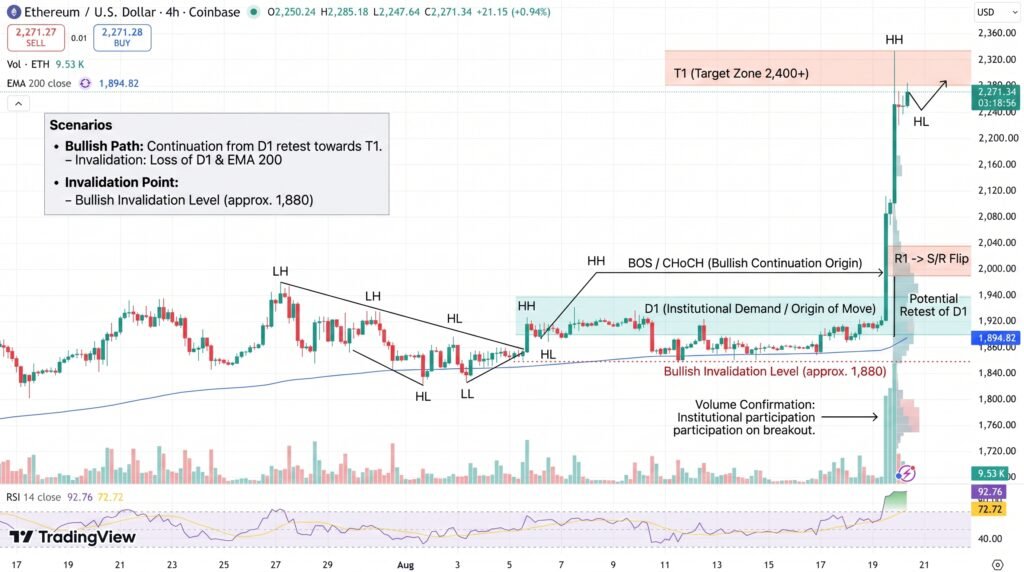
If taker buying continues through $2,273, forced covering could add a last burst of demand. If those shorts are absorbed and price stalls under $2,426, the same leverage works the other way. CoinGlass put ether liquidations near $1.11 billion over 24 hours, about $1.02 billion of that on the short side. That is already a large flush. What remains is concentrated, not the whole market.
Conclusion
Ether’s 18% rise and 402% volume spike broke a five-week range. They did not retire April supply or the remaining Hyperliquid short. The two risks that can halt the move are a rejection in $2,431–$2,500 and a failure to hold $2,003 after an RSI extreme. $2,636 is a later level, not the immediate one. Until price either accepts above $2,500 or loses the breakout floor, the rally is a squeeze plus a Treasury liquidity shock—not a finished trend.
Sources & Methodology
Primary-source standard: Market-moving facts should link to original data releases, regulator notices, company filings or official project announcements whenever available. Secondary reporting is used for additional context, not as a substitute for original evidence.
Page last reviewed: