
Ethereum is experiencing rapid growth across decentralized finance, stablecoins and tokenized assets, yet the network’s expanding activity is not translating proportionally into value for ETH. In the second quarter of 2026, applications built on Ethereum generated about $1.79 billion in fees, while the Ethereum base layer captured only $88.4 million, or roughly 4.9% of that total.
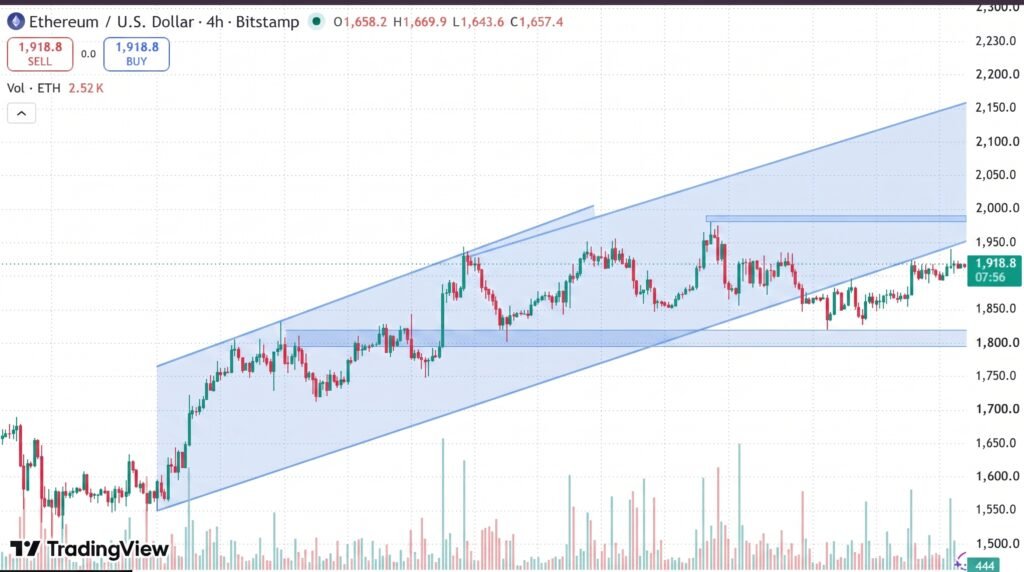
The disparity highlights a growing challenge for Ethereum investors: network adoption can rise sharply without producing equivalent demand for the blockchain’s native asset. ETH remains below $2,000, approximately 60% beneath its 2025 record high, even as the broader ecosystem continues expanding.
Layer-2 Growth Changes Ethereum’s Economics
Ethereum’s scaling strategy has shifted much of its transaction activity to Layer-2 networks, particularly rollups. These systems execute transactions away from the main blockchain before using Ethereum for security and settlement. The approach has dramatically increased capacity, with rollups processing roughly 1,270 user operations per second, compared with about 20 on Ethereum’s base layer.
Lower transaction costs have helped expand activity in DeFi, gaming and tokenization. However, the same efficiency has reduced the fees paid directly to Ethereum’s main network.
Ethereum’s blob mechanism has accelerated that transition by allowing Layer-2 networks to publish data more cheaply. While the technology improves scalability, it also limits the amount of ETH removed from circulation through transaction-fee burning.
Recent data showed only about 0.22 ETH burned through blob fees over a seven-day period, weakening the supply-reduction dynamics behind Ethereum’s earlier “ultrasound money” narrative.
ETH Supply Adds to Value-Capture Debate
Ethereum’s changing fee structure comes as its token supply is estimated to be increasing by roughly 0.85% annually, while staking yields remain near 2.6%. For investors, that creates a more complicated equation between network usage, ETH scarcity and potential returns.
The key figures illustrate the shift:
- Ethereum applications generated about $1.79 billion in Q2 fees.
- The base layer captured approximately $88.4 million.
- Rollups process around 1,270 operations per second.
- ETH supply is growing near 0.85% annually.
The figures do not necessarily indicate that Ethereum’s architecture is failing. Instead, they show that the network is prioritizing cheaper and larger-scale activity over maximizing fees collected by its base layer.
Institutional Demand Could Change ETH’s Outlook
Ethereum continues to strengthen its position in institutional finance. The blockchain currently supports about $299.4 billion in stablecoins and approximately $17.2 billion in tokenized real-world assets, reinforcing its role in the development of blockchain-based financial infrastructure.
This growth could support a different investment thesis for ETH. Rather than depending primarily on retail users paying transaction fees, Ethereum could increasingly derive value from institutions using ETH as collateral, reserve capital and settlement infrastructure.
The critical question is whether expanding stablecoin transfers, tokenized securities and institutional transactions will eventually create enough demand for Ethereum’s underlying settlement layer to benefit ETH holders.
Ethereum has largely addressed its scalability limitations through Layer-2 technology. Its next challenge is economic: ensuring that ecosystem growth translates into sustainable demand for the native token.
If Layer-2 networks continue absorbing most activity while keeping base-layer fees low, ETH could remain disconnected from Ethereum’s broader adoption. If institutional settlement and tokenized assets instead drive stronger demand for ETH, the current value gap could narrow.
That balance between network growth and token value capture may become one of the defining factors for Ethereum’s investment outlook in the next stage of blockchain adoption.
Sources & Methodology
Primary-source standard: Market-moving facts should link to original data releases, regulator notices, company filings or official project announcements whenever available. Secondary reporting is used for additional context, not as a substitute for original evidence.
Page last reviewed: