
EUR/USD traded near 1.1190 in early European dealings on Friday, October 30, as the euro drew support from the European Central Bank’s decision to keep interest rates unchanged while maintaining concern about rising energy costs. However, the currency pair remained below important technical resistance, leaving its recovery vulnerable. Traders were also assessing the latest euro-area growth data and the possibility of another ECB rate increase in December.
ECB Hold Keeps December Hike in Focus
The European Central Bank kept its deposit rate at 2.50% on October 29, following September’s 25-basis-point increase. The decision was widely anticipated, but the accompanying statement carried a cautious, inflation-focused message.
Policymakers said rising energy prices could push inflation higher while weighing on economic growth. At the same time, underlying inflation and wage pressures had remained broadly stable. The ECB reiterated that future decisions would depend on incoming data and be taken meeting by meeting.
Markets continued to consider another increase in December. Reuters reported that three ECB policymakers viewed a December 17 hike as highly likely, barring a sharp fall in energy prices. Such a move would lift the deposit rate to 2.75%, although officials also see reasons to pause afterward as tighter financial conditions weigh on the economy.
Energy costs remain central to the outlook. Higher natural gas prices can feed through to household bills, business expenses and broader consumer prices, complicating the ECB’s effort to control inflation without damaging growth.
Euro Faces Growth and Inflation Risks
The euro’s near-term direction depends partly on whether economic activity can withstand higher energy costs and tighter financing conditions. The ECB has identified investment in artificial intelligence, public spending and stronger exports as potential supports for growth. However, uncertainty over energy prices and government finances continues to weigh on business and consumer confidence.
Scotiabank strategists have described the euro’s technical outlook as neutral to bearish, identifying 1.1113—the mid-October low—as an important support area. Their assessment suggests that a break below this level could intensify selling pressure.
Key developments for currency traders include:
- ECB policy: Expectations for a December rate increase remain important.
- Energy prices: Higher fuel and gas costs could strengthen inflation concerns.
- Economic growth: GDP and export data may influence expectations for the euro-area economy.
EUR/USD Forecast: 1.1200 Resistance
The daily chart retains a bearish bias because EUR/USD remains below its 100-day simple moving average and the middle line of its Bollinger Bands. The 14-day Relative Strength Index, near 41 in the cited market snapshot, also indicates subdued buying momentum.
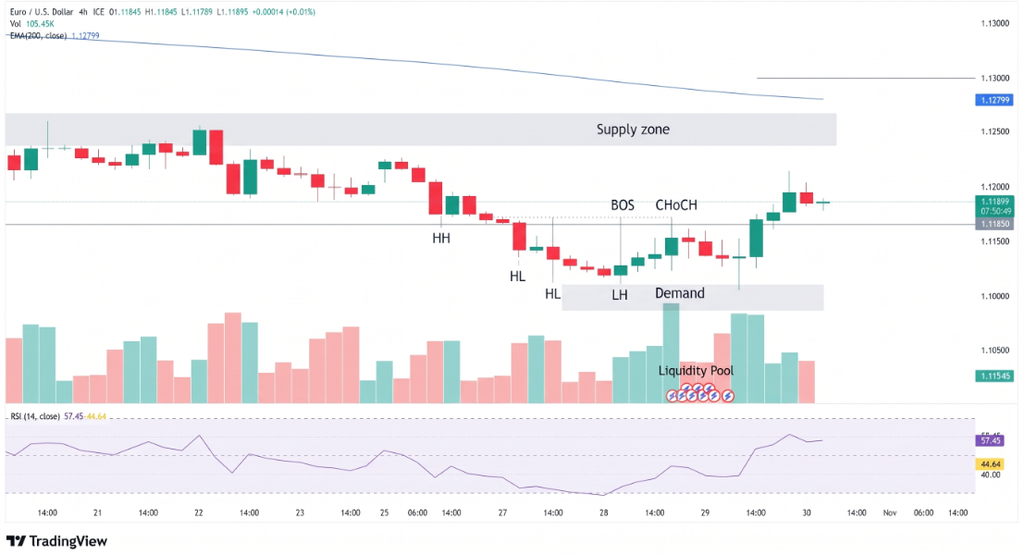
The immediate technical levels are:
- Resistance: 1.1200, followed by 1.1265 and 1.1325.
- Major resistance: The 100-day SMA near 1.1432.
- Initial support: 1.1135, near the lower Bollinger Band.
- Further support: 1.1100, followed by 1.0951.
A sustained move above 1.1200 could open the way toward 1.1265 and 1.1325. A break below 1.1135, by contrast, would expose the 1.1100 psychological level and potentially the 1.0951 area.
Conclusion
EUR/USD has gained some support from the ECB’s cautious stance, but its technical recovery remains unconfirmed. The 1.1200 level is the immediate test for buyers, while 1.1135 is the first downside threshold. The next sustained move will depend on economic data, energy-price developments and changing expectations for December’s ECB decision.
Sources & Methodology
Primary-source standard: Market-moving facts should link to original data releases, regulator notices, company filings or official project announcements whenever available. Secondary reporting is used for additional context, not as a substitute for original evidence.
Page last reviewed: