Leverage Trading Explained: Forex Leverage, Margin, Risks and Examples
Quick Answer
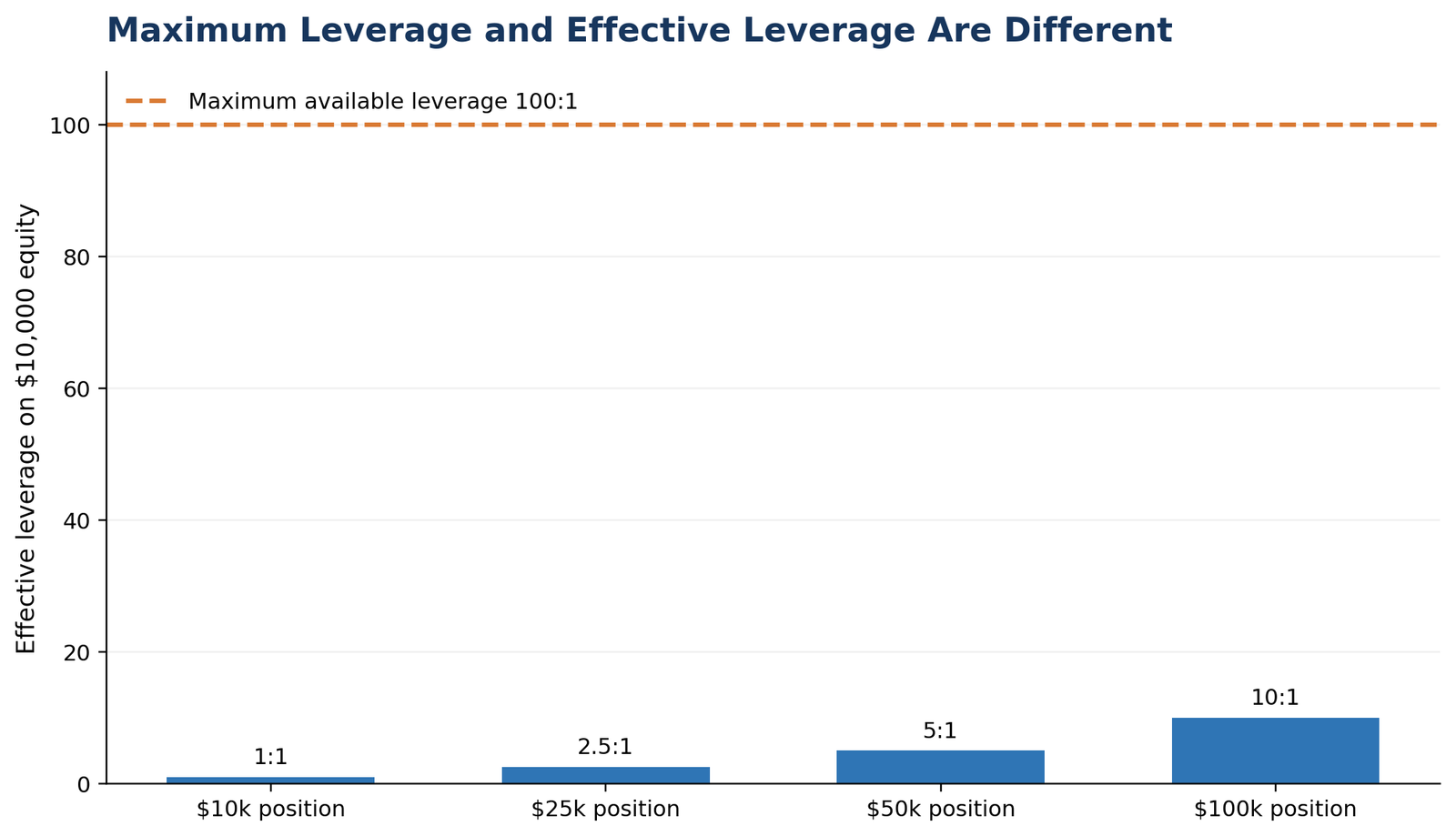
Leverage trading lets you control a market position larger than the cash you commit as margin. A leverage ratio of 30:1 means $1,000 of required margin can support a $30,000 position. Profit and loss are calculated on the full position, not only on the margin deposit, so leverage magnifies the effect of price movement on account equity. Margin is the collateral required to open and maintain the position; leverage is the relationship between exposure and margin. Maximum leverage is not the same as the leverage you actually use. A trader can have access to 100:1 leverage and still run an effective leverage of only 3:1 or 5:1 by choosing a smaller position.
What Is Leverage Trading?
Leverage trading is a method of taking market exposure that exceeds the amount of capital allocated as margin. It is common in forex, CFDs, futures and securities margin accounts, although the legal structure and risk protections differ by product and jurisdiction.
Leverage should not be treated as a conventional cash loan in every market. In leveraged forex and CFDs, exposure is commonly created through margin terms rather than a broker delivering borrowed cash to the trader. Financing, swap or overnight charges may still apply depending on the instrument, trade direction and holding period.
In my trading analysis, the leverage number is not the first risk number I look at. What matters more is the notional position, stop distance, dollar risk and combined exposure across the account. A trader with 500:1 available leverage can use less risk than a trader with 30:1 if the first trader chooses a much smaller position.
How Is Leverage Calculated?
Leverage = Total position value / Margin required
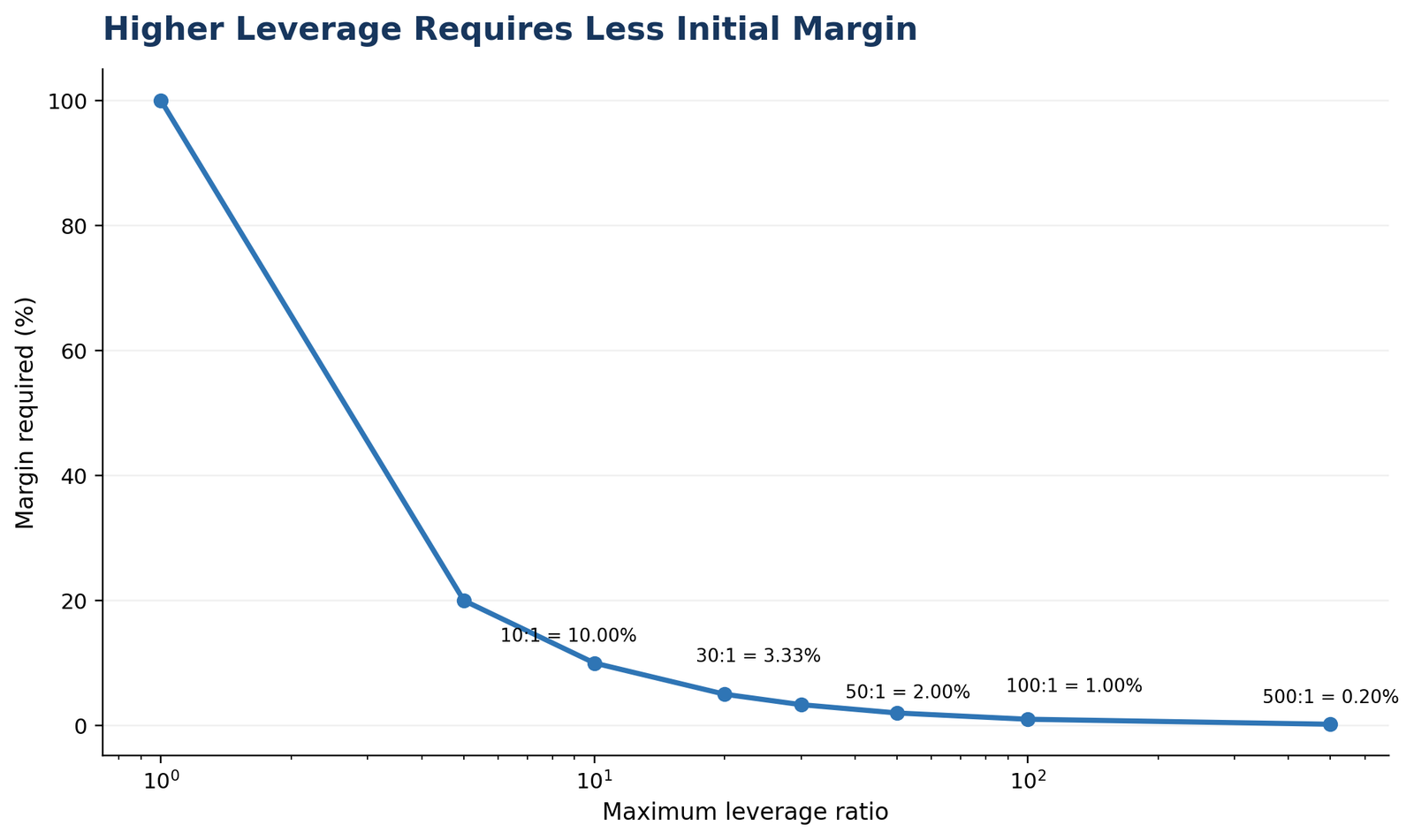
Margin requirement (%) = 100 / Leverage ratio
Required margin = Position value / Leverage ratio
If a trader opens a $30,000 position at 30:1 leverage, the required margin is $1,000. At 20:1, the same position requires $1,500. At 10:1, it requires $3,000. The market exposure is unchanged; only the amount of collateral required to support it changes.
Leverage Ratio and Margin Requirement Table
| Leverage | Margin requirement | $100,000 position requires |
|---|---|---|
| 1:1 | 100% | $100,000 |
| 5:1 | 20% | $20,000 |
| 10:1 | 10% | $10,000 |
| 20:1 | 5% | $5,000 |
| 30:1 | 3.33% | $3,333 |
| 50:1 | 2% | $2,000 |
| 100:1 | 1% | $1,000 |
| 500:1 | 0.20% | $200 |
These figures show minimum collateral mechanics only. They do not mean the account can safely absorb the full position size.
Leverage vs Margin: What Is the Difference?
Leverage and margin are linked but not interchangeable. Leverage describes the size of the market exposure relative to the collateral requirement. Margin is the capital set aside to support the position. In retail forex, U.S. NFA rules refer to this collateral as a security deposit for covered retail forex transactions.
| Term | Meaning | Why it matters |
|---|---|---|
| Balance | Closed-trade account balance before current floating P/L. | Does not show the live effect of open positions. |
| Equity | Balance plus or minus unrealized P/L. | Changes as open positions move. |
| Used margin | Collateral currently reserved for open leveraged positions. | Reduces the capital available for additional positions. |
| Free margin | Equity minus used margin. | Shows the remaining cushion for losses and new positions. |
| Margin level | Equity divided by used margin, commonly expressed as a percentage. | Can trigger restrictions or forced close-out depending on broker/regulation. |
| Notional value | Full face value of the position. | P/L sensitivity is based on this exposure, not the margin alone. |
Free margin = Equity – Used margin
Margin level (%) = Equity / Used margin x 100
Forex Leverage Example
Assume a trader has $10,000 in account equity and opens a $30,000 EUR/USD position. At 30:1 leverage, the position requires approximately $1,000 of margin. The remaining equity is not automatically at risk in a fixed amount, but it supports the account as floating P/L changes.
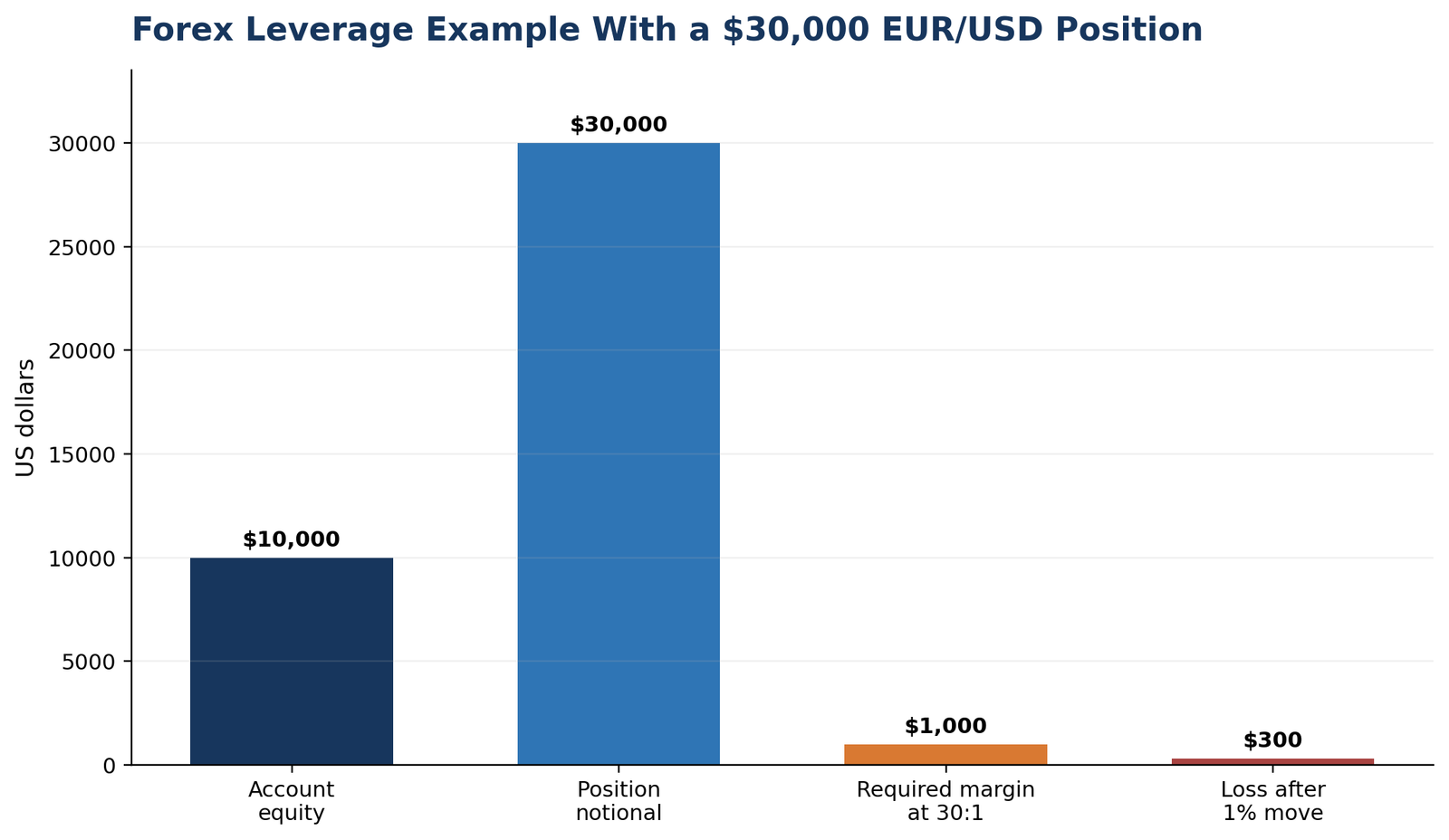
If EUR/USD moves 1% against a $30,000 position, the position loses about $300 before spread, slippage and financing. That is only a 1% move in the market, but it equals 30% of the $1,000 margin used for that position. Relative to the full $10,000 account, however, the loss is 3%. This difference is why traders should distinguish return on margin from return on total account equity.
How Leverage Amplifies Profit and Loss
Leverage does not make the market move more. It changes how much exposure the trader controls relative to the capital committed. If two traders take the same notional position, their dollar P/L from a 1% move is the same even if their brokers offer different maximum leverage. The difference is how much margin each account had to reserve.
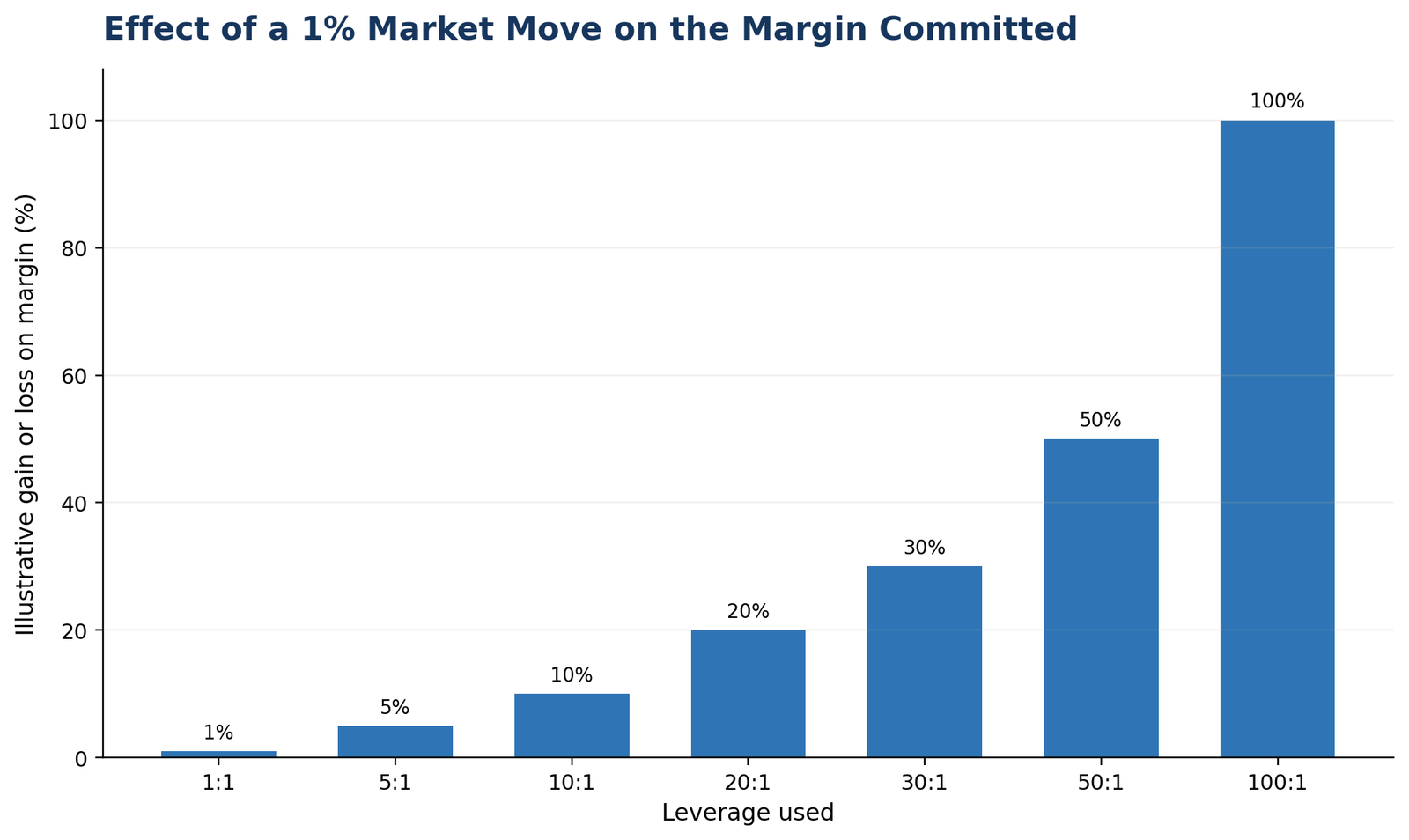
This is why statements such as “100:1 leverage multiplies profits by 100” can mislead beginners. The multiplier only applies if the trader actually uses a notional exposure equal to 100 times the capital being compared. Available leverage and used leverage are not the same thing.
What Is Effective Leverage?
Effective leverage = Total open notional exposure / Account equity
Suppose a $10,000 account opens one $25,000 position. Effective leverage is 2.5:1 even if the account is allowed to use 100:1. If the same account opens $100,000 of total positions, effective leverage rises to 10:1. This is often a more useful risk metric than the broker’s headline maximum leverage.
Leverage Is Not a Position-Sizing Method
A common beginner mistake is to start with the maximum leverage and then decide how much to trade. A better process works in the opposite direction: define the technical stop, decide the maximum planned loss, calculate the position size, then check whether the broker’s margin rules can support that position.
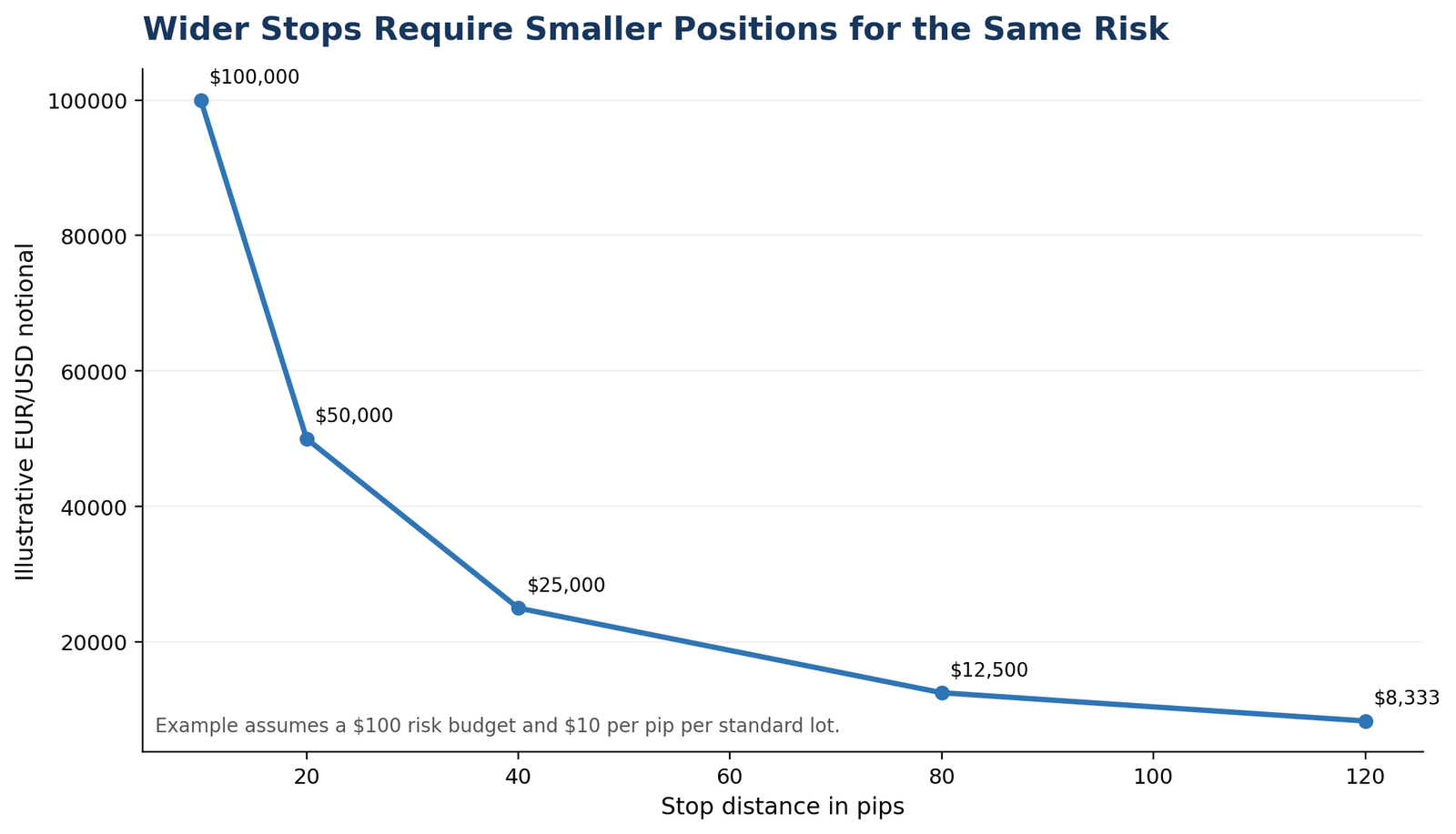
Risk management and position sizing should come before any leverage decision. Maximum leverage determines the minimum collateral requirement. Position sizing determines how much money is lost if the trading idea fails.
What Is a Margin Call?
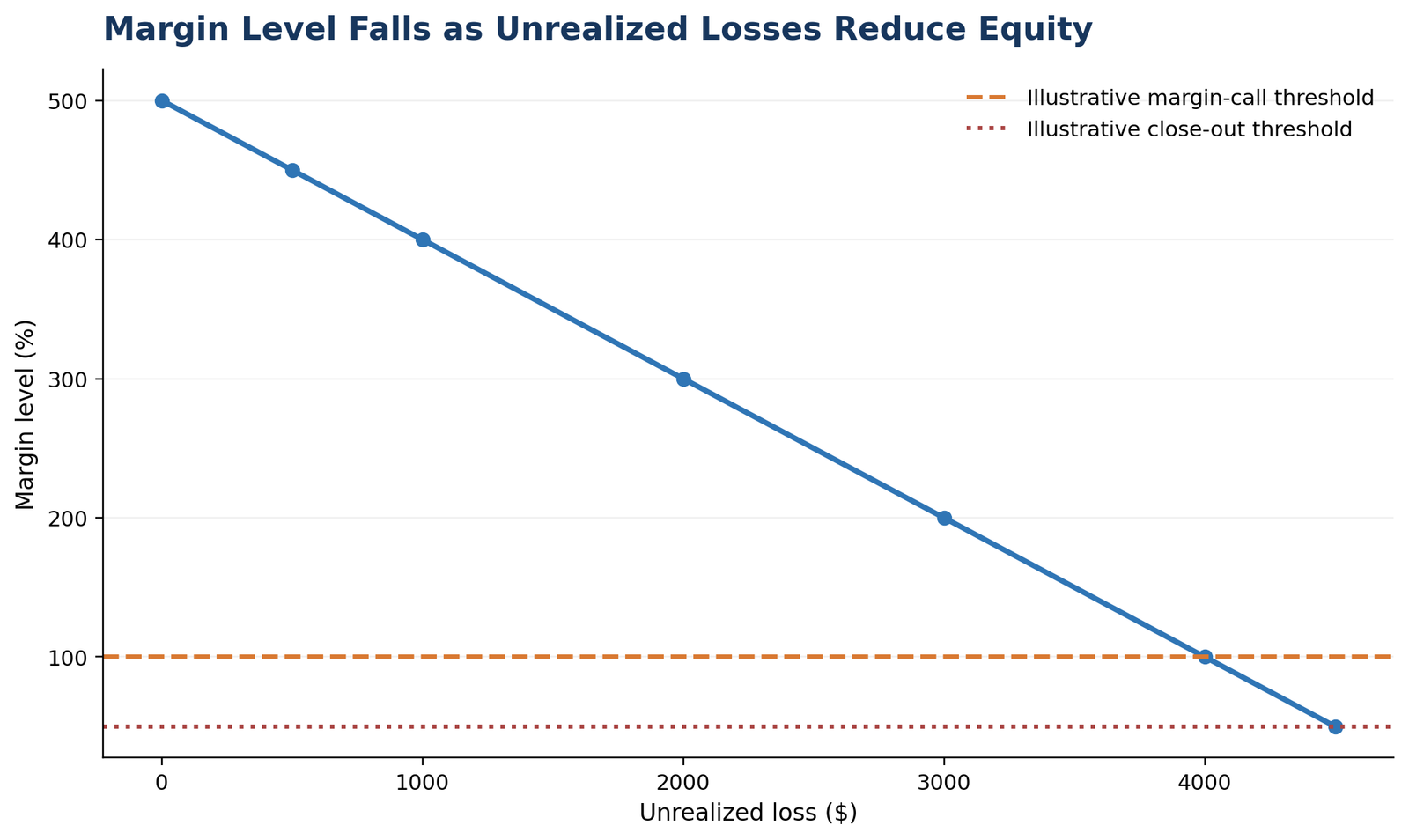
A margin call occurs when account equity falls too close to the minimum level required to support open leveraged positions. Historically this could mean a broker contacting the trader to add funds. On modern retail platforms, it may instead mean restrictions on new positions, automatic warnings or a progression toward forced liquidation. Broker terminology and thresholds differ, so traders should read the account terms rather than assume that “margin call” always means the same event.
What Is a Stop-Out or Margin Close-Out?
A stop-out or margin close-out is the forced reduction of open exposure when the account falls below a specified margin threshold. The broker may close one or more positions to restore the margin level. This is not the same as a trader’s stop-loss order. It is an account-protection or broker-risk mechanism triggered by insufficient margin.
Does a Stop-Loss Remove Leverage Risk?
No. A stop-loss can reduce planned market risk, but it does not guarantee the exact exit price. During gaps, news shocks or thin liquidity, execution may occur beyond the stop. High leverage leaves less room for this difference to be absorbed. A stop order should therefore be part of the risk system, not treated as a guarantee that leveraged losses cannot exceed the planned amount.
Does Leverage Always Mean You Are Paying Interest?
No. The idea that every leveraged product works like a mortgage is too literal. Securities margin accounts may charge borrowing costs on a loan balance. Spot forex and CFDs may instead apply overnight financing, swap or funding adjustments according to the product, direction and holding period. Futures use different financing mechanics. Traders should check the cost structure of the actual instrument rather than assume every leveraged trade charges interest on a cash loan.
Other trading costs can include spread, commission, slippage and conversion fees. A wider spread is a higher transaction cost and may reflect thinner liquidity, but it is not a universal measure of market risk.
Retail Leverage Limits by Jurisdiction
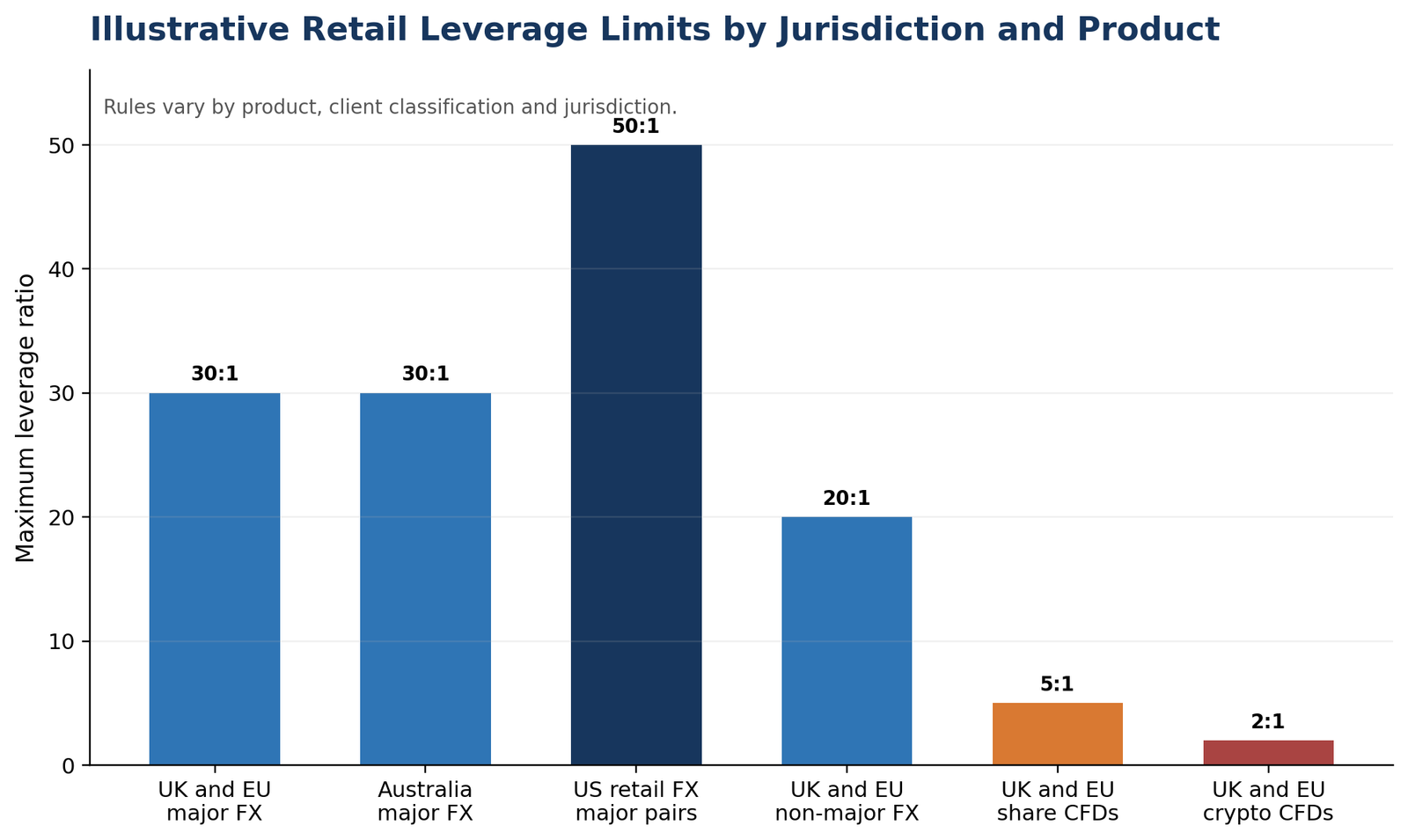
Retail leverage is regulated differently around the world. The limits below are examples of current rules for specific regulated products and should be verified before trading because client classification, product type and jurisdiction matter.
| Jurisdiction / rule | Major FX | Selected other retail products | Other protections |
|---|---|---|---|
| UK FCA retail CFD rules | Up to 30:1 | 20:1 non-major FX/gold; 5:1 shares; 2:1 crypto CFDs. | 50% margin close-out and negative balance protection. |
| EU / ESMA framework adopted nationally | Up to 30:1 | 20:1 non-major FX/gold/major indices; 10:1 other commodities/minor indices; 5:1 equities; 2:1 crypto. | 50% account-level margin close-out and negative balance protection. |
| Australia ASIC retail CFD rules | Up to 30:1 | 20:1 minor FX/gold/major indices; 10:1 other commodities/minor indices; 5:1 shares; 2:1 crypto. | Margin close-out and negative balance protection; order currently extended to May 2027. |
| U.S. NFA retail forex security deposits | 2% deposit on listed major currencies, equivalent to 50:1 maximum leverage. | 5% deposit on other currency transactions, equivalent to 20:1. | FDM must collect additional security deposit or liquidate positions if requirements are not met. |
These are retail limits for the stated frameworks, not global limits for every professional or institutional client. Some offshore jurisdictions permit much higher ratios. Higher permitted leverage does not mean a higher-quality account or better trading conditions.
Where Is Leverage Used?
| Market / product | How leverage appears | Key distinction |
|---|---|---|
| Retail forex | Margin or security deposit supports a larger currency position. | Rules differ by jurisdiction and currency pair. |
| CFDs | Margin supports exposure to an underlying reference asset without owning it. | Product intervention rules may cap retail leverage and require negative balance protection. |
| Futures | Exchange and broker margin support standardized contracts. | Leverage changes as contract value and margin requirements change. |
| Securities margin | Broker-dealer lends against eligible securities collateral. | Interest and maintenance-margin rules apply. |
| Leveraged ETFs | Fund itself uses derivatives/debt to target a multiple of daily index return. | Not the same as a trader borrowing on margin; path dependence and daily reset matter. |
Why High Leverage Can Destroy an Account Quickly
If a trader uses the maximum 100:1 leverage, a 1% adverse move in the position equals the entire margin committed to that position before costs. At 500:1, only a 0.2% adverse move equals the initial margin. That does not automatically mean the account is wiped out, because the account may hold additional free equity, but it demonstrates how little market movement is needed to consume the collateral supporting the trade.
The danger rises further when several correlated leveraged positions are open at the same time. Long EUR/USD and long GBP/USD, for example, may both carry short-U.S.-dollar exposure. A dollar shock can hit both positions together, consuming margin faster than each trade’s standalone calculation suggests.
How Much Leverage Should You Use?
There is no universal leverage ratio that is appropriate for every trader. The better question is how much effective leverage the strategy requires after the stop distance and risk budget are calculated. A trader who risks a small fixed amount and uses wide stops may need low notional exposure. Another strategy with a tight validated stop may use more notional exposure while keeping the same dollar risk.
Start with the maximum planned loss for the trade, not the maximum leverage offered.
Calculate the stop distance from market structure.
Calculate the position size that fits the risk budget.
Check the resulting notional exposure and effective leverage.
Confirm there is enough free margin for normal volatility, slippage and other open positions.
Reduce size around event risk or when correlations create concentrated exposure.
Know the broker’s margin-call and stop-out rules before opening the position.
Common Leverage Trading Mistakes
Using maximum leverage because it is available
The broker ceiling is not a recommended position size.
Confusing margin with maximum loss
Margin is collateral. The actual loss depends on position size and price movement.
Assuming leverage itself creates profit
Leverage magnifies exposure. It does not improve forecast accuracy or expectancy.
Treating all leveraged products as cash loans
Forex, CFDs, futures and securities margin have different legal and financing mechanics.
Believing MT4 or MT5 sets leverage
The broker, account type, product and regulation determine the leverage terms; the platform displays and applies them.
Assuming a wider spread means the asset is riskier
A wider spread is a higher transaction cost and may reflect liquidity conditions, but it is not a universal risk score.
Relying on a fixed 50- or 100-pip stop
Stop distance should be tied to the setup and volatility, then position size adjusted to keep risk controlled.
Ignoring correlated exposure
Several leveraged trades can behave like one large directional bet.
Ignoring financing and rollover
Holding costs can matter for multi-day leveraged positions even if the initial margin is small.
Waiting for the margin call as the risk plan
A margin call or stop-out is a last-resort account mechanism, not a substitute for planned exits and position sizing.
Leverage Checklist Before You Trade
What is the full notional value of the position?
What margin will the broker reserve?
What is my effective leverage after including all open positions?
What price invalidates the trade?
How much will I lose at that invalidation level before slippage and fees?
How much free margin remains after opening the trade?
What happens if the market gaps through my stop?
What are the broker’s margin-call and stop-out thresholds?
Are other open positions correlated with this exposure?
What overnight financing or swap applies?
What regulatory protections apply to this account and product?
Frequently Asked Questions
What is leverage trading?
Leverage trading lets a trader control a position larger than the margin deposited to support it. Profit and loss are calculated on the full position value.
What does 30:1 leverage mean?
It means $1 of required margin can support up to $30 of notional exposure. A $30,000 position therefore requires about $1,000 of margin.
What is forex leverage?
Forex leverage is the ratio between the notional currency position and the margin or security deposit required to support that position.
What is the difference between leverage and margin?
Leverage is the exposure-to-collateral ratio. Margin is the collateral reserved to open or maintain the leveraged position.
Does 100:1 leverage mean I must trade at 100:1?
No. It is a maximum. If a $10,000 account opens a $20,000 position, effective leverage is only 2:1 even if the broker permits 100:1.
Can leverage make me lose more than my deposit?
It can, depending on product, jurisdiction, negative balance protection and market gaps. Some retail CFD regimes provide negative balance protection, while other products or account structures can expose traders to additional losses.
What is a margin call?
It is a warning or account condition triggered when equity falls too close to the required margin. The exact meaning and threshold vary by broker and regulation.
What is a stop-out?
A stop-out or margin close-out is forced liquidation of open positions when the account no longer satisfies the required margin threshold.
Is leverage the same as borrowing money?
Economically it creates larger exposure with less capital, but the legal mechanics differ by product. Securities margin may involve a cash loan; retail forex and CFDs often use margin terms rather than a literal cash loan delivered to the trader.
Does leverage always charge interest?
No. The cost structure varies. Securities margin may charge borrowing interest, while forex and CFDs may use overnight financing or swap adjustments. Futures have different financing economics.
What is effective leverage?
Effective leverage is total open notional exposure divided by account equity. It shows how much leverage the trader is actually using.
What leverage is allowed for retail forex in the UK?
Under FCA retail CFD rules, major FX leverage is capped at 30:1, with lower limits for more volatile asset classes.
What leverage is allowed for U.S. retail forex?
Current NFA security-deposit rules require 2% on specified major currency transactions, equivalent to 50:1 maximum leverage, and 5% on other currency transactions, equivalent to 20:1.
Is higher leverage better?
No. Higher maximum leverage reduces the collateral needed for the same position, but it does not improve trading accuracy and makes it easier to take excessive exposure.
How should beginners think about leverage?
Treat leverage as a margin mechanic, not a target. Determine the stop, risk budget and position size first, then check how much leverage that position actually uses.
Can a stop-loss prevent a margin call?
It can reduce risk if executed near the requested price, but gaps and slippage can still create larger losses. A stop-loss should not be treated as a guaranteed margin-call prevention tool.
Bottom Line
Leverage is not a strategy and it is not an edge. It is a mechanism that changes how much market exposure can be controlled with a given amount of collateral. Used carefully, it can make position management capital-efficient. Used carelessly, it can turn an ordinary price move into a severe account loss.
The most important distinction is between maximum leverage, effective leverage and trade risk. Maximum leverage comes from the account terms. Effective leverage comes from the actual notional exposure. Trade risk comes from position size, stop distance, price movement, slippage and costs.
For AAFX.io, the practical rule is to calculate risk before leverage. Define the invalidation level, calculate the position size, measure combined exposure, and then confirm that margin requirements leave enough room for volatility. If a trade needs the account’s maximum leverage simply to be viable, the position is probably being sized from buying power rather than from risk.
Sources
European Securities and Markets Authority CFD product intervention measures
Australian Securities and Investments Commission CFD product intervention order extension
Electronic Code of Federal Regulations 17 CFR 5 9 retail forex security deposits
Risk warning Forex, CFDs, futures and other leveraged products involve substantial risk. Leverage can magnify losses rapidly, margin rules can force liquidation, and stop orders may execute away from the requested price. This material is educational and is not personalized financial advice.