The NZD/USD pair is recovering modestly after touching an over two-month low near 0.5735 on Wednesday, but the rebound lacks strong follow-through. The pair remains vulnerable as traders await the Federal Reserve’s September policy decision, with markets focused on the size of the move and, more importantly, Chair Kevin Warsh’s guidance on future rates. The dollar has eased slightly from recent highs, but elevated U.S. yields and persistent inflation concerns continue to limit the upside for the New Zealand dollar.
Fed Decision Keeps Kiwi Under Pressure
The U.S. Federal Reserve is widely expected to raise its benchmark interest rate by 25 basis points to a 3.75%-4.00% range. Reuters reported that markets were assigning about a 93% probability to such a move on September 16, after inflation and energy-price pressures shifted expectations toward renewed tightening.
Because the increase is largely priced in, the dollar’s next move may depend more heavily on the Fed’s projections and Warsh’s comments about the policy path. Reuters noted that persistent inflation, oil prices above $100 a barrel and elevated global borrowing costs are keeping pressure on policymakers.
Higher U.S. borrowing costs can weigh on higher-beta currencies such as the New Zealand dollar by supporting the greenback and reducing demand for risk-sensitive assets. The U.S. 10-year Treasury yield has also hovered around 5%, reinforcing tighter financial conditions.
- NZD/USD: Around the mid-0.5700s
- Recent low: 0.5735
- Fed rate expectation: 25 bps
- Expected Fed range: 3.75%-4.00%
Technical Levels Keep Bears Alert
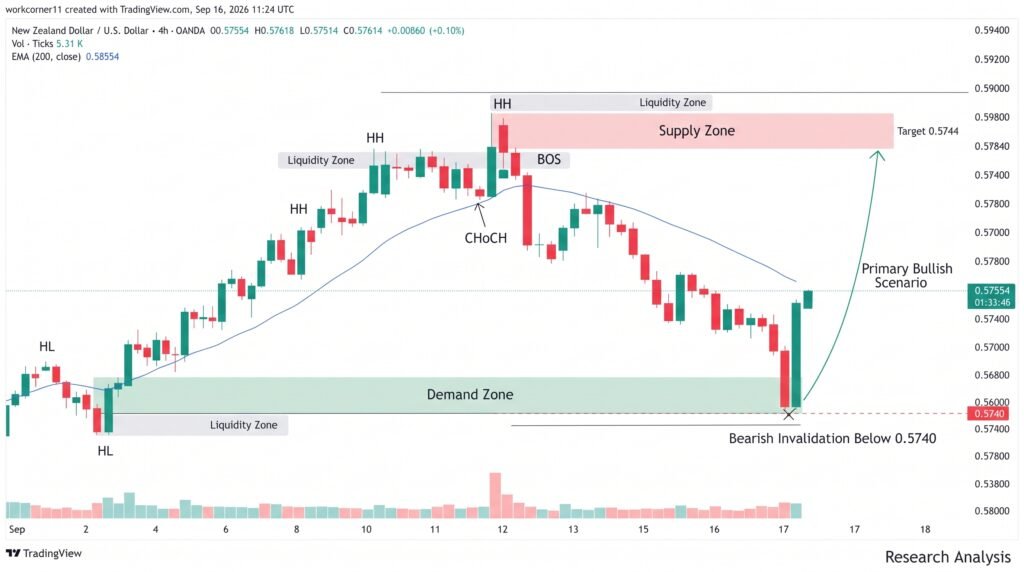
The technical structure remains weak while NZD/USD trades below its 200-day SMA near 0.5855. The broader resistance area also includes the 38.2% Fibonacci retracement near 0.5850, creating a closely packed ceiling around 0.5850-0.5855.
The first upside hurdle is the 61.8% Fibonacci level near 0.5765, followed by the 50% retracement at 0.5807. A sustained move above these levels would begin to reduce the immediate downside pressure and could bring the 0.5850-0.5855 region back into focus.
Momentum indicators remain tilted lower. The MACD histogram is negative, while the RSI near 32 is approaching oversold territory. That combination shows that sellers remain active, although the low RSI also raises the possibility of a short-term corrective rebound.
On the downside, 0.5704 is the first major Fibonacci support. A decisive break below that level would expose the recent swing low near 0.5627.
Fed Guidance Could Define Next Move
The immediate direction of NZD/USD will likely depend on whether the Fed signals that September’s expected increase is part of a broader tightening cycle or primarily an inflation-management move.
For New Zealand’s currency, the U.S. dollar remains the dominant short-term driver. Oil prices above $100 a barrel and elevated global yields have kept inflation risks high, encouraging traders to maintain expectations for restrictive U.S. monetary policy.
The Fed is scheduled to release its decision at 2:00 p.m. ET on September 16, followed by the press conference at 2:30 p.m. ET.
For the chart, 0.5765 is the first test on any recovery, while 0.5807 and 0.5850-0.5855 represent increasingly important resistance. On the downside, 0.5704 remains the first support before the 0.5627 swing low.
Conclusion:
NZD/USD has bounced from 0.5735, but the recovery remains fragile while the pair trades below the 0.5850-0.5855 resistance zone. Negative MACD momentum and an RSI near 32 show continued selling pressure, although the oversold reading leaves room for a corrective rebound. The key levels are 0.5765 and 0.5807 on the upside, while 0.5704 and 0.5627 remain the main downside references. The Fed’s rate decision and Warsh’s guidance could determine whether the pair extends its decline or begins a broader recovery.
Sources & Methodology
Primary-source standard: Market-moving facts should link to original data releases, regulator notices, company filings or official project announcements whenever available. Secondary reporting is used for additional context, not as a substitute for original evidence.
Page last reviewed: