The NZD/USD pair remains under pressure on Tuesday after falling to a session low of 0.5836, below its 200-day simple moving average near 0.5850-0.5854. The decline extends the New Zealand Dollar’s reversal from the 0.5900 area reached last week, as geopolitical risk, higher oil prices and demand for the US Dollar weigh on the Kiwi.
The broader market backdrop has become less supportive of risk-sensitive currencies. Renewed fighting involving the United States and Iran, together with attacks affecting Gulf energy infrastructure, has pushed Brent crude toward $100 a barrel. Brent was trading around $97 on Tuesday after reaching a six-week high, increasing concern that a prolonged energy disruption could feed into global inflation.
The Strait of Hormuz remains central to the oil-market risk because it is a major route for Middle Eastern energy shipments. New Zealand is particularly exposed to higher imported energy costs, while its trade links with Asia make developments in the region important for the NZD outlook. New Zealand’s Ministry of Foreign Affairs and Trade has identified the Iran conflict and disruption around the Strait as risks to the country’s trade and economy.
Oil and China Weigh on the Kiwi
The rise in oil prices is occurring alongside weaker risk appetite across financial markets. Higher energy costs can increase inflation pressure and reduce consumers’ purchasing power, creating a difficult environment for currencies tied closely to global growth expectations.
China’s latest trade figures offered a mixed signal for the New Zealand Dollar. Exports jumped 25% year over year in August, while imports increased 28.2%. However, imports were slightly below market expectations, leaving concerns about the strength of underlying domestic demand. China’s August trade surplus reached $119.09 billion.
Several developments are now important for NZD/USD:
- Brent crude has climbed toward the $100-per-barrel threshold.
- China’s August imports rose 28.2% but missed forecasts.
- The RBNZ has raised its Official Cash Rate to 2.75%.
- Geopolitical risk continues to support demand for defensive assets.
The Reserve Bank of New Zealand raised the Official Cash Rate by 25 basis points to 2.75% in September. The central bank also said inflation had risen to 4.1% in the June quarter, partly reflecting higher fuel prices. While higher New Zealand interest rates can support the Kiwi, the currency is currently facing stronger external pressures from oil and global risk sentiment.
0.5800 Is the Key Technical Trigger
Technically, NZD/USD is trading near 0.5843 in the cited market snapshot, below the 200-day SMA at 0.5854. The next major level is the 0.5800-0.5820 zone, which forms the neckline of a potential bearish Head and Shoulders pattern. A sustained break below 0.5800 would provide confirmation of the formation rather than simply another test of support.
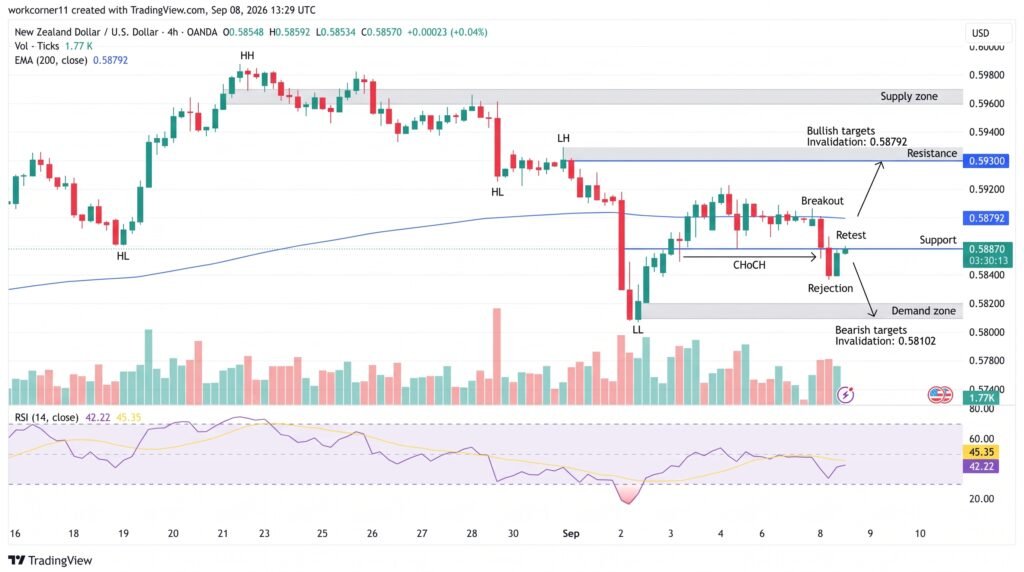
Momentum also favors sellers. The Relative Strength Index is approaching the low-40s, indicating weakening upside momentum without yet reaching deeply oversold territory. Meanwhile, the MACD remains below its zero line with a negative histogram, reinforcing the short-term bearish structure.
A confirmed break below 0.5800 would put the following levels into focus:
- 0.5765: late-July low.
- 0.5745: July 13 low.
- 0.5626: measured Head and Shoulders target.
The bearish setup would weaken if buyers reclaim 0.5900, which corresponds with Friday’s high. A sustained recovery above that level could shift attention toward the late-August high near 0.5990 and indicate that the break below the 200-day SMA failed to develop into a deeper decline.
Conclusion
NZD/USD is approaching a decisive technical area after breaking below its 200-day SMA near 0.5854. The 0.5800 neckline is now the key level for the bearish outlook. A confirmed break could expose 0.5765 and 0.5745 before the measured 0.5626 target. The fundamental backdrop remains challenging as oil prices approach $100, Middle East tensions disrupt energy markets and China’s domestic-demand concerns persist. A recovery above 0.5900 would weaken the immediate bearish structure and reopen the path toward 0.5990.
Sources & Methodology
Primary-source standard: Market-moving facts should link to original data releases, regulator notices, company filings or official project announcements whenever available. Secondary reporting is used for additional context, not as a substitute for original evidence.
Page last reviewed: