Swedish electric-vehicle maker Polestar on Thursday cut its full-year 2026 delivery growth forecast to low-to-mid single digits from previous low double-digit guidance. The revision follows intensified competition, portfolio transition pressures, and the June decision by the US Commerce Department’s Bureau of Industry and Security denying authorization for model-year 2027 and later vehicles under the Connected Vehicle Rule targeting Chinese-linked technology. Majority-owned by China’s Geely Holding, Polestar will exit new-vehicle sales in the US after clearing existing inventory.
Polestar Q2 Sales Drop 4% to 17,296 Vehicles as US Exit Charges Hit Results
Polestar reported second-quarter retail sales of 17,296 vehicles, down 4.0% from 18,026 a year earlier. First-half 2026 retail sales reached a record 30,423 units, up just 0.4% from 30,289, or +3.1% to 28,562 when excluding the US. Europe accounts for nearly 80% of volumes; the US contributed roughly 6% in the first quarter of 2026, with 94% of Q1 retail sales outside the US.
Q2 revenue fell 8% to $727 million from $791 million. First-half revenue declined 4.4% to $1.36 billion from $1.423 billion. Net loss narrowed 55.3% to $459 million in the second quarter from $1.027 billion a year earlier (when a $724 million impairment was recorded); first-half net loss improved 29% to $842 million from $1.193 billion. Operating loss for H1 fell 43% to $629 million. Adjusted EBITDA loss widened to $521 million in H1 and $286 million in Q2.
The company recorded about $130 million in charges tied to US restructuring in the quarter (primarily residual-value guarantees, inventory net-realizable-value adjustments, and employee/supplier provisions). US operations increased consolidated operating and net losses by roughly $170 million and $165 million in Q2, respectively. Free cash flow was negative $1.061 billion in the first half versus negative $787 million a year earlier, despite $700 million in new equity raised and approximately $640 million in debt-to-equity conversions with Geely Sweden and Volvo Cars. Cash ended June 30 at about $888 million.
CEO Michael Lohscheller said: “Working in a challenging environment, we continue to be disciplined in our execution and focused on improving the business.” The company opened its order book for the new Polestar 4 SUV (first of a refreshed model series) and expects initial customer deliveries of the Polestar 5 in coming weeks, with Polestar 4 SUV deliveries in the fourth quarter.
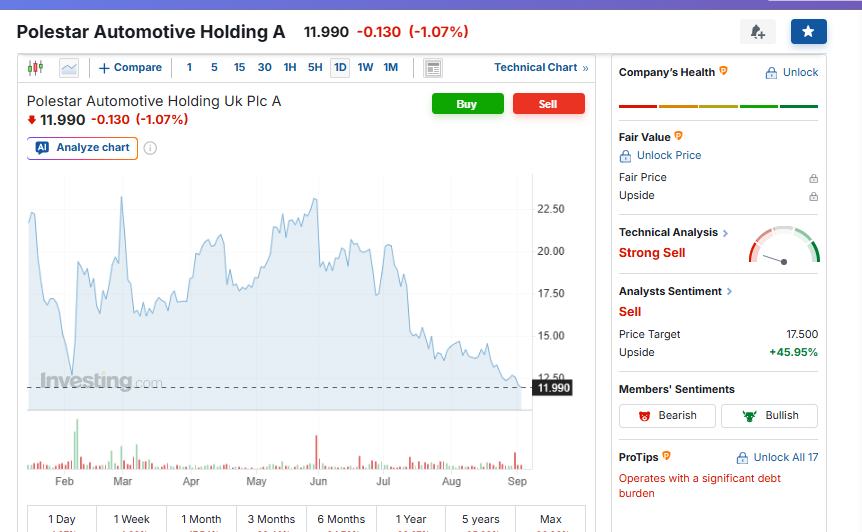
Polestar Faces $250M Revenue Risk and Funding Pressures After US Ban Hits Shares
The forecast cut and US exit highlight ongoing challenges for China-linked EV makers amid regulatory barriers, pricing pressure, and slower volume growth. Analysts earlier estimated roughly $250 million of 2027 revenue (about 5% of group sales) could be at risk from the ban. Polestar shares had already fallen around 6% in late June on the authorization denial. Persistent losses, negative free cash flow, and reliance on equity injections from Geely underscore funding and profitability risks even as the company pivots to Europe.
US Bars Polestar from 2027 Sales Over China Ties, Forcing Europe Pivot
In June 2026, the US Commerce Department’s Bureau of Industry and Security denied Polestar authorization under the Connected Vehicle Rule (finalized under the Biden administration and maintained under Trump). The rule restricts vehicles with Chinese-linked connected technology (software restrictions effective model year 2027; hardware later) on national-security grounds related to data access. Polestar, majority-owned by Zhejiang Geely Holding, became the first automaker forced out of future US sales under the measure, even though the Polestar 3 is built in South Carolina and the Polestar 4 in South Korea. Sister brand Volvo Cars received authorization.
Polestar will sell remaining Polestar 3 and 4 inventory in the US, maintain service and warranty support, and shift strategic focus to Europe while preparing regional manufacturing (including the Polestar 7 at a planned Volvo site in Slovakia). The retail network grew 39% year-on-year. Full-year 2025 deliveries were 60,119 units. The company plans four new or refreshed models over three years: Polestar 5 (deliveries starting summer/fall 2026), Polestar 4 SUV variant (Q4 2026), next-generation Polestar 2 (2027), and Polestar 7 compact SUV (around 2028).
Polestar Eyes Q3 Results Nov. 5 as Focus Shifts to Europe Growth and New Model Ramp-Up
Polestar expects to publish third-quarter financial results on November 5. Near-term focus remains on ramping Polestar 5 and Polestar 4 SUV deliveries, expanding the European retail network (including Baltic launches), cost discipline, and navigating competitive and regulatory headwinds. Further US restructuring costs are expected as inventory clears and operations wind down new-vehicle sales. Long-term success hinges on Europe-centric growth, improved mix/margins, and continued support from Geely.
Sources & Methodology
Primary-source standard: Market-moving facts should link to original data releases, regulator notices, company filings or official project announcements whenever available. Secondary reporting is used for additional context, not as a substitute for original evidence.
Page last reviewed: