SK Hynix board approves Korea’s largest share buyback of 40 trillion won ($28.8 billion), cancelling 24.07 million shares (3.3% of capital) over three months and raising shareholder returns to over 50% of free cash flow.
SK Hynix said on Wednesday its board approved a plan to repurchase and fully cancel treasury shares worth up to 40 trillion won (approximately $28.8 billion), the largest such programme in South Korean corporate history. The buyback of about 24.07 million shares (roughly 3.3% of issued capital) will begin on 20 August and run for about three months, as the memory chip giant returns a larger share of its AI-driven cash windfall to investors.
SK Hynix to Buy Back 24.07 Million Shares Worth 40.43 Trillion Won ($28.8bn), Equal to 3.3% of Capital
The Board of Directors resolved to repurchase 24.07 million common shares valued at 40.43 trillion won, based on the previous day’s closing price of 1,662,000 won. This equates to approximately 3.3% of the company’s 730.49 million total issued shares. All purchased shares will be cancelled upon completion.
The programme starts on 20 August 2026 and is scheduled to last roughly three months (targeted completion around mid-November). SK Hynix also raised its shareholder-return target for the 2025–2027 period to over 50% of cumulative free cash flow, up from the previous “within 50%” guideline. Returns will be delivered through a dual track of share repurchases/cancellations and cash dividends, with the company also reviewing higher regular dividends and possible special dividends.
The company stated it views its shares as undervalued relative to intrinsic value and aims to enhance shareholder value through the cancellation of treasury stock.
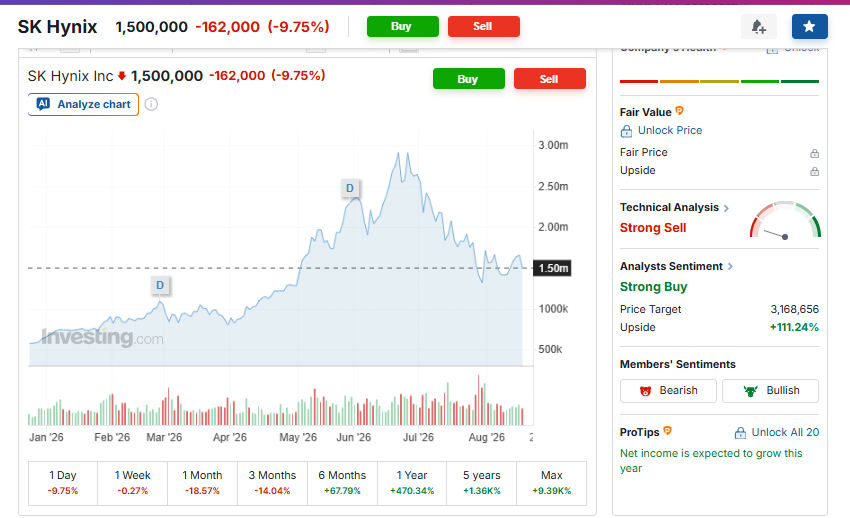
SK Hynix Buyback Seen as Buffer After Stock Rises 120–155% YTD but Falls 15% in Past Month
Investors had been closely watching for larger capital returns after several quarters of record, AI-fuelled earnings. The announcement is among the biggest buybacks ever by a Korean company and accelerates the existing shareholder-return framework. While SK Hynix stock had gained more than 120–155% year-to-date in 2026, it had fallen about 15% over the prior month amid broader cooling in AI-related valuations and rising global bond yields. The buyback is widely seen as a potential buffer against further near-term share-price pressure.
SK Hynix Posts Record Q2 Profit of 60.54 Trillion Won (+557%) on AI HBM Boom as Net Cash Hits 69 Trillion Won
SK Hynix has posted exceptional results driven by surging demand for high-bandwidth memory (HBM) used in AI servers. In the second quarter of 2026 the company reported record revenue of 79.32 trillion won (up 257% year-on-year) and operating profit of 60.54 trillion won (up 557%), with an operating margin of 76%. First-half revenue exceeded 100 trillion won for the first time. Net cash stood at approximately 69 trillion won.
The firm has long-term supply agreements with around 10 major customers and began mass production of HBM4 in Q2 2026. Management has repeatedly stated that tight supply conditions and strong AI memory demand are expected to persist for several years. Rival Samsung Electronics is also anticipated to expand its own shareholder returns on the back of similar AI-related strength.
Previous shareholder returns in 2025 totalled around 14.3 trillion won (including 2.1 trillion won in dividends and 12.2 trillion won in share cancellations). The new 40-trillion-won buyback alone represents a substantial acceleration of capital returns.
SK Hynix Buyback Runs Aug 20–Nov as Focus Shifts to Over 50% FCF Returns and HBM4 Ramp
The open-market repurchase programme will run from 20 August for approximately three months, after which the shares will be cancelled. Investors will monitor execution pace, any accompanying dividend increases, and further details on the expanded “over 50% of cumulative FCF” policy for 2025–2027. Attention will also remain on HBM4 ramp-up, overall memory pricing, and whether the company maintains its outlook for sustained tight supply and elevated demand into 2027 and beyond. Full-year 2026 results and any additional return measures will be key upcoming catalysts.
Sources & Methodology
Primary-source standard: Market-moving facts should link to original data releases, regulator notices, company filings or official project announcements whenever available. Secondary reporting is used for additional context, not as a substitute for original evidence.
Page last reviewed: