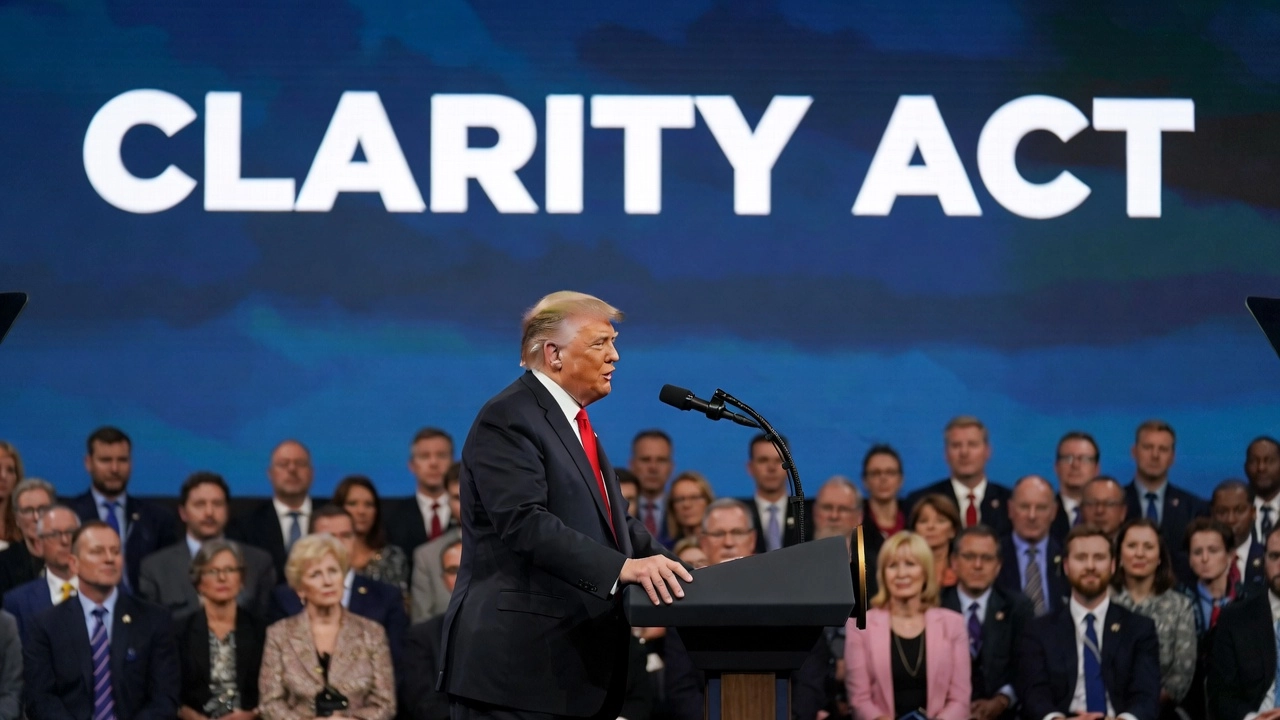
President Trump told crypto executives at the White House on Aug. 19 to pass a “fair version” of the Digital Asset Market Clarity Act. The same day, Sen. Ruben Gallego, the Arizona Democrat who chairs the Senate Banking digital-assets subcommittee, told the SALT Wyoming symposium that he and Sen. Thom Tillis had sent ethics language to the White House before the August recess and had not received a point-by-point answer. Offers came back blank, came back weaker, or drew no reply, he said. SEC Chair Paul Atkins used the White House session to tie the agency’s new offering proposal to the case for a statute. The two messages do not add up to a deal.
Gallego: No Point-by-Point Reply
The remaining fight is who may issue or profit from digital assets while in office, and who enforces that ban. Gallego and Tillis proposed letting state attorneys general enforce the limits. Republicans have resisted that. In July the White House accepted language that would rely on the Justice Department and sunset in January 2029. Democrats called that insufficient.
Gallego told the room not to force a fast vote. “A fast vote gets you a fast result, but I’m not sure it’s the result you want.” He said the Agriculture Committee title, the assembled package and the path back to the House are still open. He also said he thought “fair,” as the president used it, meant fair for the president. The White House did not provide Cointelegraph a comment.
Cloture Is Not Passage
The House passed H.R. 3633 on July 17, 2025, by 294–134. Senate Banking reported a version on June 1, 2026, 13–11. Majority Leader John Thune filed a cloture motion on the motion to proceed on Aug. 8. That motion ripens at 2:15 p.m. Eastern on Sept. 15 and needs 60 votes. It only opens debate.
Republicans hold 53 seats. If Sens. Rand Paul and Josh Hawley vote no, supporters need nine Democrats. Banking’s June roll call produced three Democratic yes votes. Sixty is still the number. Polymarket priced 2026 enactment near 20% on Aug. 19, on more than $7.2 million of volume. Miller Whitehouse-Levine of the Solana Policy Institute put the chance of a law before the November midterms at 10% on Aug. 18, citing the calendar and industry splits.
CFTC Will Write Rules Anyway
CFTC Chair Michael Selig told Bloomberg on Aug. 20, before the agency’s first Innovation Advisory Committee meeting, that market structure can come through rules or through a statute. He said he would give the Senate a vote first. If the bill fails, staff would propose a “crypto asset market” designation modeled on designated contract markets, so registered venues and some unregistered platforms could offer leveraged crypto trading under CFTC watch.
That is a backup, not a substitute for splitting securities and commodities in law. Atkins’s Regulation Crypto Assets is also a proposal. Agency rules can be rewritten by the next chair.
Bitcoin traded near $77,693 on Aug. 21, up about 8% in 24 hours and 24% on the week, with $58.3 billion of volume, per CoinPaprika. That tape does not change the Senate arithmetic.
Conclusion
Trump asked for a fair Clarity Act. Gallego said the White House has not answered the ethics text that would bring Democrats along. Sept. 15 is a 60-vote test on whether debate starts, not whether the bill becomes law. Selig will draft CFTC rules if Congress does not. Until the White House replies in writing, treat “fair version” as a slogan and 20% on Polymarket as the market’s count of the remaining work.
Sources & Methodology
Primary-source standard: Market-moving facts should link to original data releases, regulator notices, company filings or official project announcements whenever available. Secondary reporting is used for additional context, not as a substitute for original evidence.
Page last reviewed: