USD/CAD is holding near 1.3995 after extending its recent advance toward the 1.4000 psychological level. The Canadian dollar has weakened as the U.S. Federal Reserve adopted a firmer policy stance, widening the interest-rate gap with the Bank of Canada. At the same time, elevated oil prices are providing some support for the commodity-linked Canadian dollar, limiting the pair’s upside.
Reuters reported Thursday that the Canadian dollar traded near a six-week low of 1.3985 per U.S. dollar, after falling to 1.4001, its weakest intraday level since August 7. The move reflected the widening U.S.-Canada rate differential following the Fed’s latest decision.
Fed-BoC Gap Supports Dollar
The Federal Reserve raised its target range by 25 basis points to 3.75%-4.00% on September 16. The decision was unanimous, and the Fed’s September projections showed a median year-end policy rate of 4.1%, although policymakers’ individual projections remain dispersed.
By contrast, the Bank of Canada has kept its overnight rate at 2.25% since September 2. That leaves a 1.50-percentage-point policy-rate gap between the two central banks, a differential that can support demand for U.S.-dollar assets relative to Canadian-dollar assets.
The divergence is occurring while Canadian inflation remains elevated. Canada’s August consumer inflation rate held at 3.0% year over year, although the median and trimmed core measures remained near 2%, suggesting the underlying inflation picture is less intense than the headline rate.
The dollar also retains support from the Fed’s more restrictive outlook, while traders continue to monitor Federal Reserve officials for clues about the next policy move. Michelle Bowman is scheduled to speak Friday.
Oil Gives CAD a Partial Buffer
Crude oil remains an important counterweight to dollar strength. Canada is a major oil exporter, so stronger energy prices can improve export revenues and support the Canadian Dollar.
That support has moderated as oil prices retreated from this week’s highs. On Friday, Brent crude fell to $102.68 a barrel and WTI slipped to $100.08, with Saudi Arabia restoring some export capacity after attacks disrupted its East-West pipeline.
Still, geopolitical risks remain significant. Reuters reported that only four commodity vessels crossed the Strait of Hormuz on Thursday, compared with a 10-day average of 16. This keeps the energy market sensitive to fresh disruptions and gives the Canadian dollar a potential source of support if crude prices rise again.
The key fundamental drivers are:
- Fed: policy rate now 3.75%-4.00%.
- BoC: policy rate remains 2.25%.
- Oil: WTI remains near $100 despite the recent retreat.
1.3945 Holds the Technical Key
The daily USD/CAD chart remains constructive while price stays above the 100-day Simple Moving Average (SMA) near 1.3945. The pair is pressing the upper Bollinger Band, while the 14-day Relative Strength Index (RSI) near 61 indicates positive momentum without reaching the conventional overbought threshold.
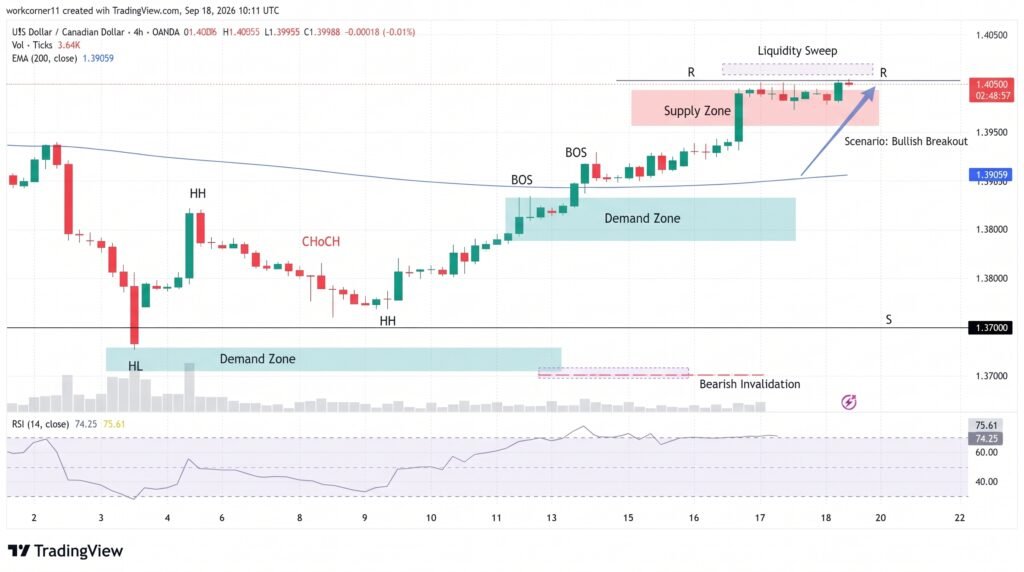
The first major upside barrier is the August 5 high at 1.4080. A sustained break above that level would expose 1.4226, followed by the June 24 high at 1.4248.
On the downside, 1.3945 is the first technical defense. A daily break below that level would shift attention to the Bollinger middle band around 1.3872, with deeper support near 1.3750.
The immediate technical map is:
- Resistance: 1.4080
- Next resistance: 1.4226 and 1.4248
- Immediate support: 1.3945
- Deeper support: 1.3872 and 1.3750
Conclusion
USD/CAD remains near 1.3995 as the wider U.S.-Canada policy gap favors the U.S. dollar, while elevated oil prices provide the Canadian dollar with a partial offset. The technical structure remains constructive above 1.3945, but the pair is approaching resistance at 1.4080 after a strong advance. A decisive break above that level would put 1.4226 and 1.4248 in focus. A move below 1.3945, however, would weaken the setup and bring 1.3872 into view.
Sources & Methodology
Primary-source standard: Market-moving facts should link to original data releases, regulator notices, company filings or official project announcements whenever available. Secondary reporting is used for additional context, not as a substitute for original evidence.
Page last reviewed: