
Quick Answer
What does a broker do? A broker is a financial intermediary that helps clients buy or sell investments or trading products. In securities markets, a broker executes transactions for customers; a brokerage account gives investors access to products such as stocks, ETFs and bonds. In retail forex, the structure can differ: a regulated forex dealer may act as the counterparty to an off-exchange trade rather than simply passing an order to a central exchange. Most retail traders use a broker because it provides the account, market access, order entry, record-keeping and execution infrastructure. But a broker is not required for every financial transaction: some companies offer direct stock purchase plans, and crypto can also be bought through exchanges or other venues.
A broker is the access point many retail traders use to reach financial markets, but the broker's exact role changes with the product and market structure.
What Is a Broker in Trading?
In financial markets, the word broker has a more specific meaning than simply 'middleman.' Investor.gov defines a securities broker as a person or firm engaged in buying and selling securities on behalf of customers. A firm can also act as a dealer when it trades for its own account.
For a retail investor, the practical experience is usually a brokerage account: you deposit cash or transfer assets, choose an investment, send an order through a trading platform, and the broker handles the transaction through the relevant market infrastructure.
However, not every trading market works the same way. Shares generally trade through securities markets and broker-dealers. Retail off-exchange forex can involve a dealer acting as the counterparty. Crypto may be bought through a broker, a centralised crypto exchange or, in some cases, a decentralised protocol. That is why 'you always need a broker' is too broad.
What Does a Broker Actually Do?
| Broker function | What happens in practice | Why it matters to a trader |
|---|---|---|
| Opens and maintains the account | Creates the legal/account relationship and records cash, positions and transactions | You need an account structure through which trades and holdings are managed |
| Provides market access | Connects the client to exchanges, dealers, liquidity venues or other execution infrastructure | Retail traders generally cannot interact directly with institutional market infrastructure |
| Receives and handles orders | Processes market, limit, stop and other supported order instructions | The broker/platform turns your trading decision into an executable instruction |
| Executes or routes orders | May route an order, match it, or act as principal/counterparty depending on the market and model | Execution model can affect spreads, slippage and conflicts |
| Handles settlement and records | Maintains transaction history and facilitates settlement/custody arrangements where applicable | You need accurate records of what you own, owe or traded |
| Provides margin where offered | May lend funds or provide leveraged exposure subject to product and regulation | Leverage increases buying power and risk |
| Provides account tools | Platforms, statements, alerts, tax documents, research or education may be included | Useful services can simplify trading, but they do not guarantee better outcomes |
How a Stock Trade Reaches the Market
Imagine you want to buy 10 shares of a listed company. You enter a buy order in your brokerage platform. The broker receives the instruction and handles it according to its routing and execution arrangements. Once filled, the transaction appears in your brokerage account, while clearing, settlement and custody infrastructure handle the post-trade process.
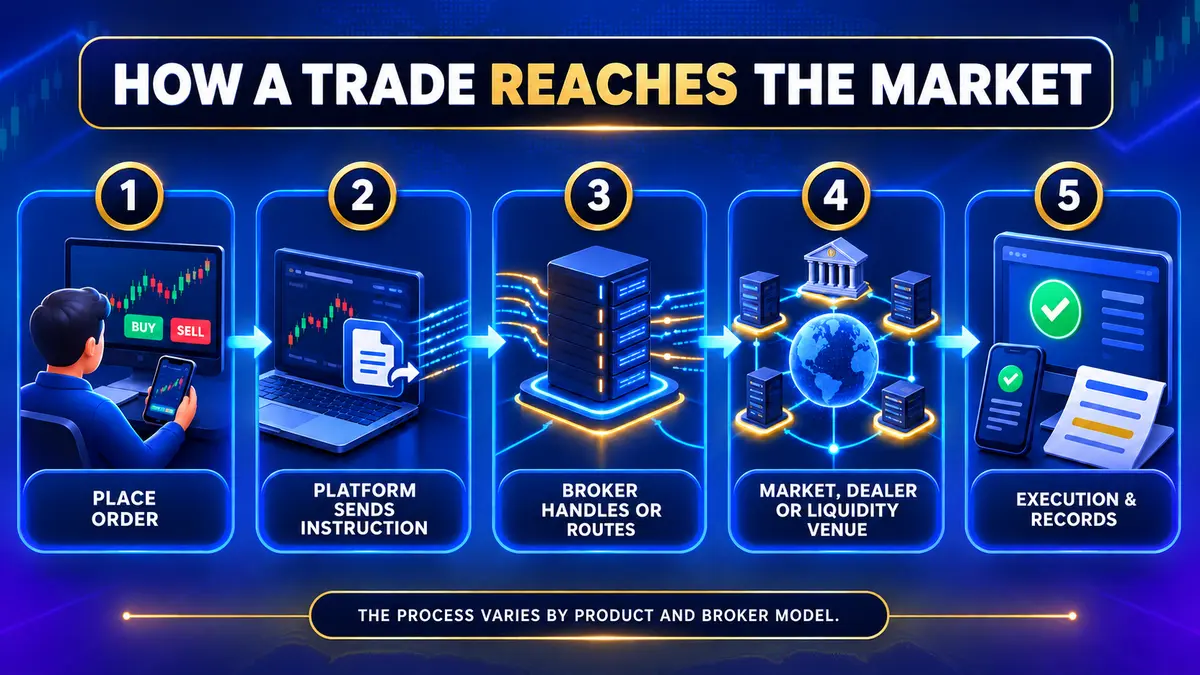
The broker therefore does more than display a chart. It provides the account and operational connection between the retail investor and the securities-market infrastructure.
How Forex Is Different
Retail forex is not organised around one central global exchange. In the United States, NFA describes a Retail Foreign Exchange Dealer (RFED) as an entity that can act as the counterparty to certain off-exchange foreign-currency transactions with retail customers. Registered RFEDs must be NFA members.
This is an important distinction from the simplified statement that every forex broker merely 'sends your order to the market.' Depending on the jurisdiction and business model, the firm may act as principal, hedge client flow, use liquidity providers, or combine several execution arrangements.
For the trader, the due-diligence question is therefore not just 'Do I have a broker?' but 'Which legal entity is serving my account, how is it regulated, and how are my orders executed?'
Do You Need a Broker to Buy Stocks?
For most self-directed stock investors, a brokerage account is the normal way to buy and sell listed shares. It gives you access to market orders, limit orders, portfolio records and a broad range of securities.
But there are exceptions. Investor.gov notes that some companies offer direct stock plans that allow investors to buy or sell shares directly through the company or its plan structure without using a traditional broker. These plans can reduce or eliminate brokerage commissions, but they may charge plan fees and often do not let you choose an exact market price or execution time.
So the precise answer is: you usually use a broker to trade stocks actively, but a broker is not legally or mechanically required for every possible stock purchase.
Do You Need a Broker to Trade Forex?
A retail individual normally needs an authorised trading firm or dealer relationship to access leveraged online forex trading. Retail traders do not simply log into the institutional interbank market and trade directly with major banks on equal terms.
The legal structure varies by country, and the word 'broker' is often used loosely. In some retail forex models the provider acts as the dealer/counterparty; in others, order flow may be hedged or passed to liquidity venues. Before trading, verify the exact entity and its regulatory permissions.
Do You Need a Broker to Trade Crypto?
Not necessarily. Crypto is the clearest example of why this article should not say brokers are essential for every market. A user may buy crypto through a crypto exchange, use a broker that offers underlying crypto or derivatives, or interact with decentralised infrastructure where legally and technically available.
Those routes are not equivalent. Buying spot Bitcoin that can be withdrawn to a wallet is different from trading a Bitcoin CFD through a broker. The first involves ownership/custody of the asset; the second is a derivative price exposure. The regulatory and counterparty risks are also different.
Can You Trade Without a Broker?
Sometimes, yes – but it depends on the market. Direct stock purchase plans are one example. Crypto exchanges and decentralised venues are another. Institutional participants can also access markets through structures that look very different from a retail brokerage account.
For most retail stock and leveraged forex traders, however, a regulated brokerage or dealer account is the practical route because the firm provides market access, execution infrastructure, account records and the legal relationship required to use the service.
Broker vs. Exchange vs. Trading Platform vs. Adviser
| Term | What it means |
|---|---|
| Broker / broker-dealer | A firm that executes securities transactions for customers and may also act as dealer/principal, depending on the activity. |
| Forex dealer / provider | A regulated entity that may be counterparty to retail off-exchange FX transactions; terminology varies by jurisdiction. |
| Exchange | A marketplace or trading venue where participants' orders are brought together under the venue's rules. |
| Trading platform | Software used to analyse markets and submit/manage orders; MT5 or TradingView is not automatically the broker. |
| Investment adviser | A person or firm providing investment advice under an advisory relationship. A broker and adviser can have different duties, services and fee structures. |
| Crypto exchange | A digital-asset venue that may allow spot crypto trading and custody; it is not automatically a securities broker. |
What Brokers Do Not Guarantee
- A regulated broker does not guarantee that your trades will be profitable. Market risk remains yours.
- A broker cannot guarantee that a standard stop-loss will always fill at the requested price during a gap or very fast market.
- A familiar platform does not prove the broker itself is properly regulated.
- Research, education and market commentary are tools, not guarantees of future results.
- Access to high leverage is not an advantage by itself. It can make losses accumulate faster.
What About Broker Fees?
Brokers can earn money through spreads, commissions, margin interest, overnight financing, account fees, interest on client cash, securities lending or other revenue sources depending on the business model. That topic deserves its own explanation rather than turning this page into a fee guide.
When comparing providers, focus on the total cost you will actually pay for your trading style. A 'zero commission' account can still have spreads, financing, currency conversion or other economic costs.
Before You Open a Broker Account: 6 Checks
- Find the exact legal entity that will serve your account, not only the brand name.
- Verify the firm's licence or registration on the regulator's official website.
- Confirm the products and markets the entity is authorised to offer.
- Read the execution policy and understand whether the firm acts as agent, principal or counterparty where disclosed.
- Review total costs, client-money/custody arrangements and withdrawal rules.
- Test the platform and order types in a demo environment if one is available.
Frequently Asked Questions
What does a broker do?
A financial broker provides an account and helps execute or arrange transactions in financial products. Depending on the market, the broker may route orders, arrange execution or act as principal/dealer.
What is a broker in trading?
A broker in trading is a firm or professional that facilitates access to financial markets and transactions. For securities, brokers execute trades on behalf of customers; other markets can use different legal structures.
Do you need a broker to buy stocks?
Most active stock investors use a brokerage account, but some companies offer direct stock plans that can let investors buy shares without a traditional broker.
Do you need a broker to trade forex?
Retail traders generally need an authorised forex provider/dealer relationship to trade leveraged online forex. The provider may not always act as a simple agent, so check the execution model and regulation.
Can you trade without a broker?
Yes in some markets and structures, such as certain direct stock plans or crypto venues. But brokerage/dealer accounts remain the standard route for most retail stock and leveraged forex trading.
Is a broker the same as a trading platform?
No. A platform is the software interface. A broker is the financial firm providing the account and execution relationship. The same platform can be offered by many different brokers.
Is a broker the same as an investment adviser?
No. Brokerage and advisory relationships can differ in services, duties and fees. Some firms or professionals may offer both, so investors should understand which service they are receiving.
Does a broker guarantee liquidity?
No. A broker can connect you to markets, dealers or liquidity providers, but available liquidity depends on the instrument, venue, market conditions and execution model.
Bottom Line
Most retail traders use brokers because brokers provide the account, execution infrastructure, market access and record-keeping needed to trade efficiently. But the broker's exact role depends on the market: securities brokerage, retail forex dealing and crypto trading do not use identical structures.
Continue Learning
- How Do Brokers Make Money? Spreads, Fees & Commissions Explained
- Best Forex Trading Platforms: MT4, MT5, cTrader & TradingView
- Financial Regulators Explained: Forex, Crypto and Stock Market Rules
- Crypto Broker vs Exchange: Key Differences Explained
Editorial Sources
- Investor.gov: Brokers
- Investor.gov: Brokerage Accounts
- Investor.gov: Direct Investing
- U.S. SEC: Guide to Broker-Dealer Registration
- NFA: Retail Foreign Exchange Dealer Registration
Risk Warning
Trading and investing involve risk. Broker regulation, execution structure, client protections and product availability vary by legal entity and jurisdiction. Leverage can magnify losses. This article is educational and does not constitute personalised financial advice.
Sources & Methodology
Primary-source standard: Market-moving facts should link to original data releases, regulator notices, company filings or official project announcements whenever available. Secondary reporting is used for additional context, not as a substitute for original evidence.
Page last reviewed: