

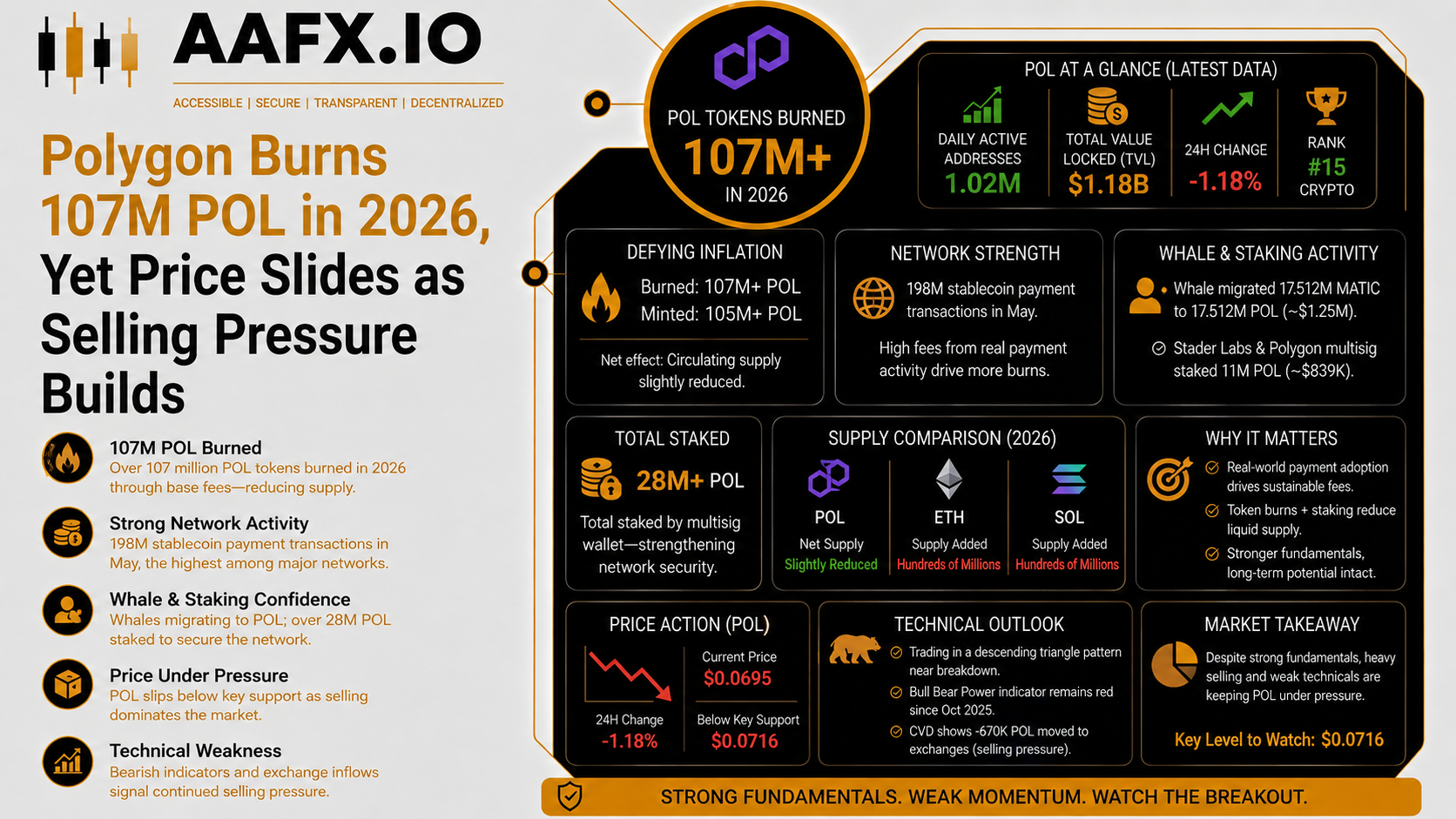
Polygon burned 107M POL in 2026, but its price continues falling. Explore how token burns, whale activity, staking, and technical signals shape POL’s outlook.
Polygon’s Deflation Strategy
Polygon is strengthening its position as one of the leading blockchain networks for digital payments, yet its native token, POL, continues to struggle in the market. While many investors expect token burns and rising network activity to support higher prices, recent market behavior tells a different story.
The network has burned more than 107 million POL tokens during 2026, according to Polygon co-founder Sandeep Nailwal. The burn mechanism removes a portion of transaction fees from circulation, gradually reducing the available token supply.
Interestingly, Polygon achieved this milestone even after issuing more than 105 million new POL tokens, leaving the overall circulating supply slightly lower than it otherwise would have been.
This contrasts with several major blockchain ecosystems that expanded their token supplies significantly over the same period. The deflationary mechanism reflects Polygon’s long-term strategy of balancing network growth with supply management.
Polygon’s payment ecosystem has also continued to expand rapidly. The blockchain recorded approximately 198 million stablecoin payment transactions in May, making it one of the busiest payment-focused networks and placing it alongside, and in some cases ahead of, established competitors in transaction volume.
Growing Network Activity
Strong blockchain fundamentals remain one of Polygon’s biggest strengths despite recent market weakness.
Institutional and large-scale investors continue to show confidence through staking and token migration activities. One notable whale converted 17.512 million MATIC into 17.512 million POL, representing roughly $1.25 million in value. Such migrations demonstrate ongoing commitment following Polygon’s ecosystem transition.
Another encouraging development came from a multisignature wallet associated with Polygon and Stader Labs. The wallet staked an additional 11 million POL, valued at approximately $839,000, increasing its total staked holdings to more than 28 million POL.
These developments offer several positive signals:
- More than 107 million POL permanently removed from circulation.
- Over 28 million POL committed to staking.
- Stablecoin payment activity reached 198 million transactions in May.
- Whale accumulation and token migration continue despite market volatility.
Higher staking participation not only reduces the liquid supply available for trading but also strengthens network security and validator participation across the blockchain.
Technical Weakness Persists
Despite improving fundamentals, market sentiment remains the dominant force driving POL’s price.
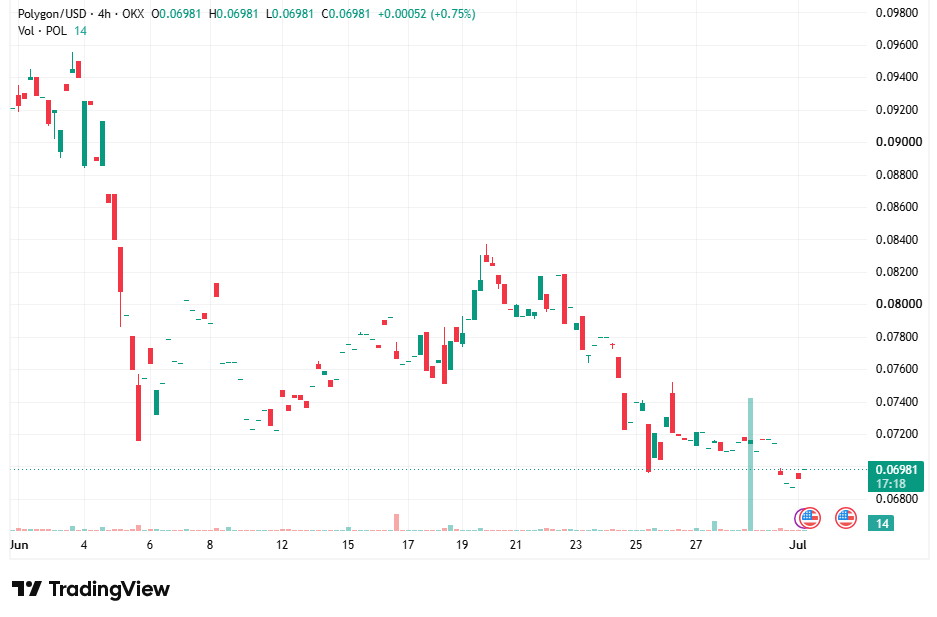
The token recently slipped below an important support level near $0.0716 before falling to approximately $0.0695, extending a broader downtrend that has persisted since late 2024. Technical analysis shows Polygon trading within a large triangle consolidation pattern that appears to be approaching a decisive breakout point.
Momentum indicators continue to favor sellers. The Bull Bear Power indicator has remained negative since late 2025, reflecting sustained bearish pressure. Meanwhile, the Cumulative Volume Delta (CVD) indicates that roughly 670,000 POL have recently flowed onto exchanges, suggesting investors continue taking profits or reducing exposure.
This divergence between network performance and market price illustrates an important lesson for cryptocurrency investors. Strong blockchain adoption, increasing transaction volume, token burns, and rising staking participation can improve a project’s long-term fundamentals, but they do not always translate into immediate price appreciation.
For Polygon, the underlying network continues to expand through payment adoption and supply reduction mechanisms. However, until selling pressure eases and technical momentum improves, POL may remain under pressure despite one of its strongest years in terms of blockchain activity and ecosystem growth.
