

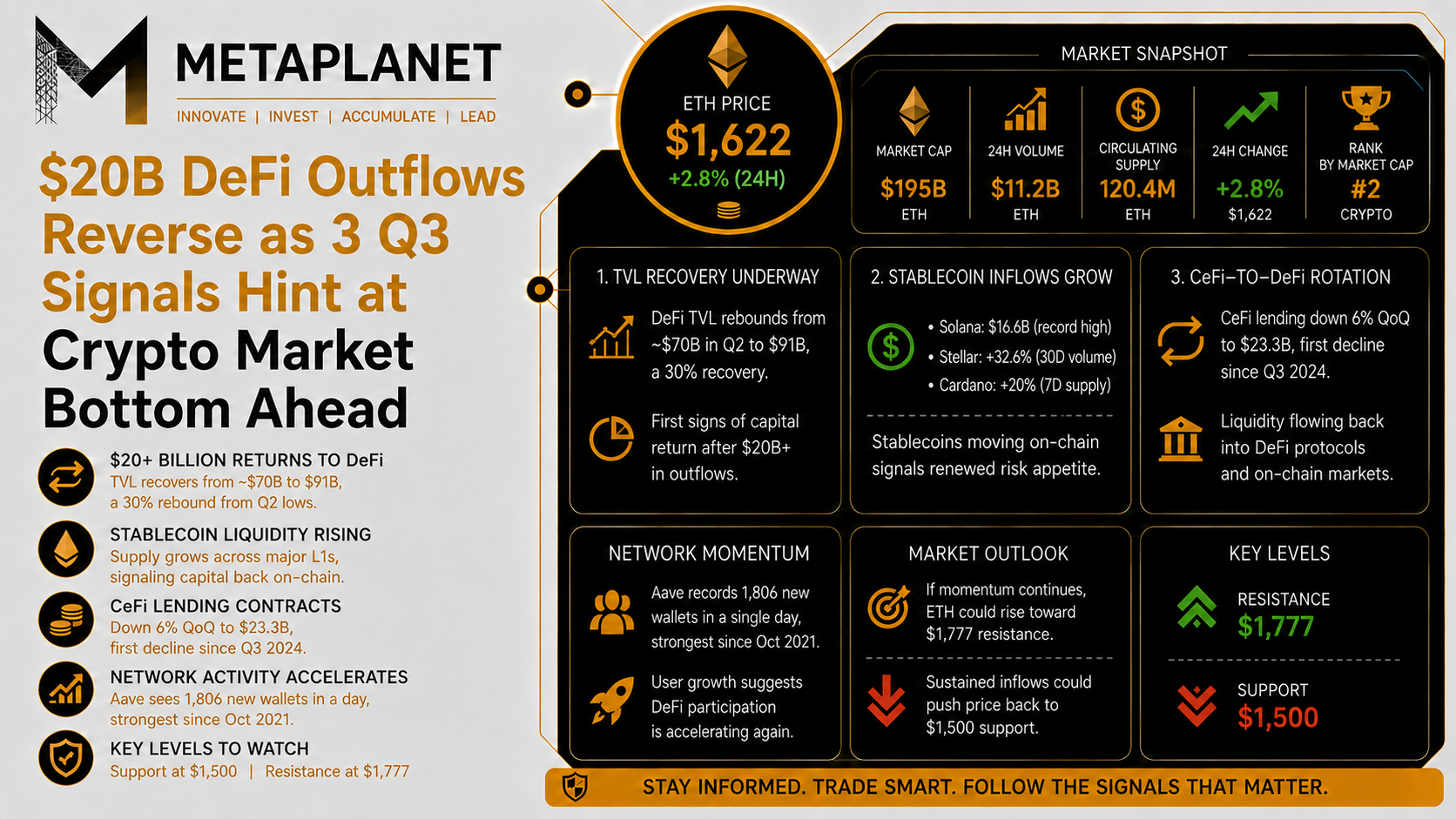
Crypto markets may be nearing a Q3 bottom as $20B returns to DeFi, stablecoin inflows rise, and CeFi lending slows, signaling renewed investor confidence.
DeFi Shows Early Recovery Signs
The cryptocurrency market may be entering a new phase after one of the sharpest contractions in decentralized finance (DeFi) since 2021. During the second quarter of 2026, investors rapidly reduced exposure to on-chain protocols following a series of high-profile security breaches that erased more than $600 million in digital assets.
The attacks triggered widespread withdrawals, forcing users to unstake funds and shift capital toward safer positions.
The market reaction was swift. More than $20 billion flowed out of DeFi protocols during the quarter, causing total value locked (TVL) to fall from approximately $150 billion before October 2025 to nearly $70 billion. The decline represented the largest quarterly contraction in DeFi liquidity in several years and highlighted how quickly investor sentiment turned defensive.
One of the biggest casualties was Aave. Following the KelpDAO exploit, the lending protocol recorded an 18% decline in TVL, dropping to roughly $17.8 billion within a single day as liquidity providers rushed to withdraw funds.
The broader Ethereum ecosystem also suffered, losing more than $10 billion in TVL as concerns spread across decentralized applications.
Recent blockchain data, however, suggests that the selling pressure may be easing. Aave recently registered 1,806 new wallet addresses in a single day, marking its strongest daily network expansion since October 2021. Although a single data point cannot confirm a sustained recovery, it indicates renewed participation from users returning to DeFi platforms.
Stablecoins Lead Capital Return
Stablecoin activity is increasingly pointing toward improving market conditions. Because stablecoins often represent idle capital waiting to be invested, growing supply across blockchain networks typically reflects rising investor confidence.
Several leading ecosystems have already reported meaningful growth:
- Solana ended Q2 2026 with a record $16.6 billion in stablecoin supply.
- Stellar posted a 32.6% increase in 30-day stablecoin transfer volume.
- Cardano expanded its native stablecoin supply by more than 20% in just one week.
These figures suggest that liquidity is steadily moving back on-chain rather than remaining on centralized exchanges or in cash-equivalent positions. Historically, sustained stablecoin growth has often preceded increased trading activity and stronger participation across decentralized applications.
CeFi Weakens as DeFi Gains
Another important development is the changing balance between centralized finance (CeFi) and decentralized finance.
According to recent industry data, CeFi lending declined 6% quarter-over-quarter to approximately $23.3 billion, marking its first quarterly contraction since Q3 2024. While centralized lending platforms experienced lower activity, blockchain protocols appear to be attracting fresh liquidity.
The combination of rising stablecoin balances, improving network activity, and recovering TVL suggests investors are gradually becoming more comfortable deploying capital directly on-chain instead of relying on centralized intermediaries.
Several indicators now deserve close attention:
- DeFi wallet creation is accelerating.
- Stablecoin liquidity continues expanding across major Layer-1 networks.
- TVL losses are beginning to stabilize after steep declines.
- CeFi lending is slowing while decentralized protocols regain momentum.
No single metric can confirm that the crypto market has reached its bottom. However, the convergence of these trends provides stronger evidence that risk appetite is returning. If capital continues rotating from CeFi into DeFi throughout the third quarter, the sector could be laying the foundation for a broader cryptocurrency recovery after months of sustained caution.
