

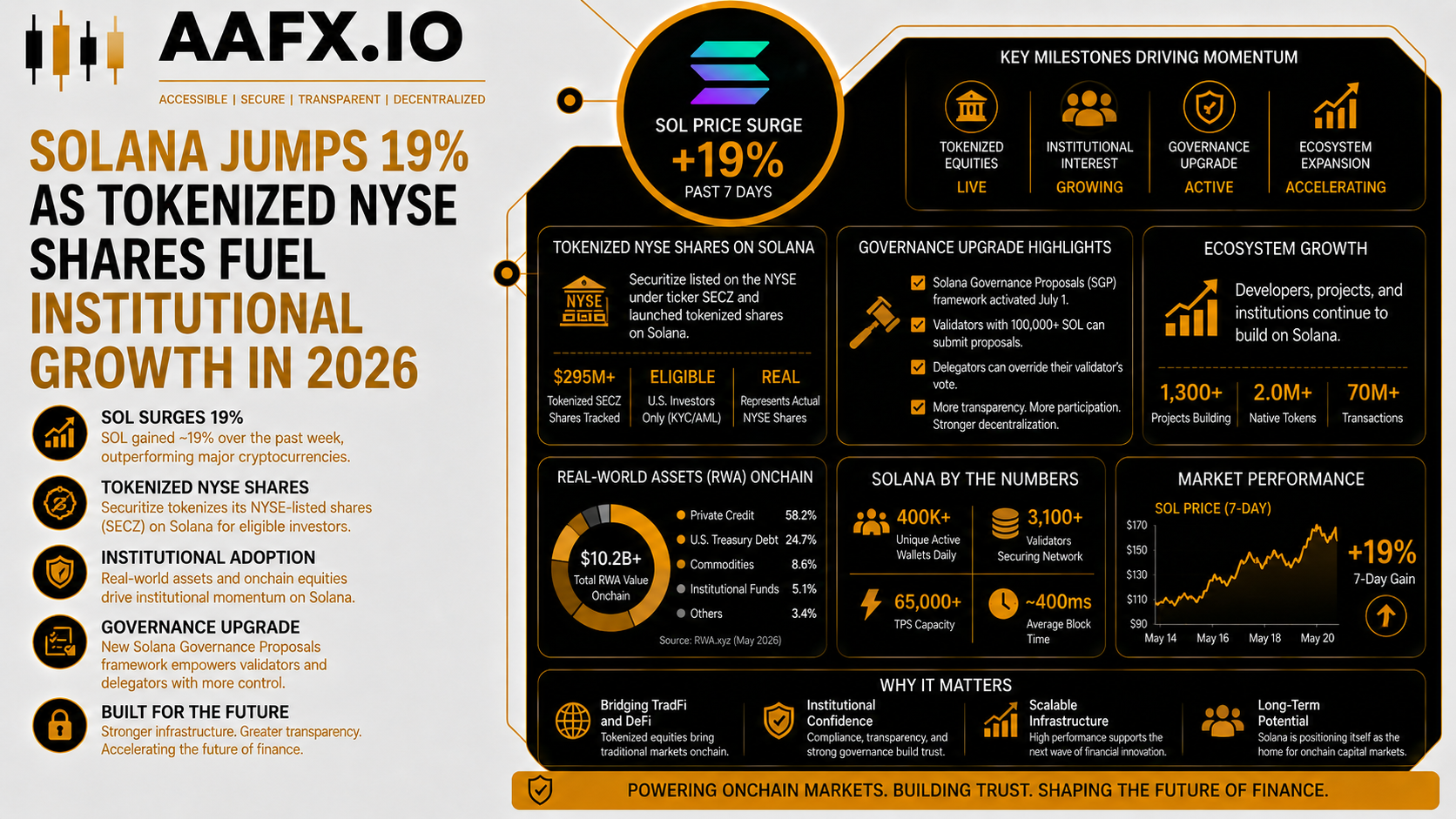
Solana rises 19% as Securitize tokenizes NYSE-listed shares onchain. Discover how institutional adoption and governance upgrades are boosting SOL.
Solana Powers Tokenized Equities
Solana is strengthening its position as a leading blockchain for institutional finance after digital asset firm Securitize launched tokenized versions of its newly listed New York Stock Exchange (NYSE) shares on the network. The move marks another step toward connecting traditional capital markets with blockchain infrastructure, allowing qualified investors to access blockchain-based representations of publicly traded equities.
Securitize began trading on the NYSE under the ticker SECZ after completing its merger with Cantor Equity Partners II. Shortly after its market debut, the company announced that eligible investors could own tokenized versions of the same common shares through the Solana blockchain.
Unlike synthetic assets that simply mirror stock prices, these digital securities represent ownership of the underlying NYSE-listed shares. This approach aims to combine the regulatory framework of traditional markets with the efficiency, transparency, and settlement capabilities offered by blockchain technology.
According to blockchain analytics platform RWA.xyz, nearly $295 million in tokenized SECZ shares was recorded shortly after the launch, highlighting early institutional interest in tokenized real-world assets (RWAs).
Key highlights include:
- Tokenized SECZ shares represent actual NYSE-listed equity.
- Nearly $295 million in tokenized shares was tracked after launch.
- Only identity-verified eligible U.S. investors can participate.
- The offering follows existing regulatory compliance standards.
Governance Upgrade Strengthens Solana
While institutional interest expanded, Solana also introduced a major governance improvement designed to increase transparency and decentralization across its ecosystem.
Beginning on July 1, the Solana Foundation activated its new Solana Governance Proposals (SGP) framework, establishing a formal voting system for protocol-level decisions. The upgrade creates a structured process for validators to propose and evaluate network policies while keeping software development responsibilities with core engineering teams.
Validators staking at least 100,000 SOL can submit governance proposals under the new framework. One of the most notable additions gives delegators the ability to override their validator’s vote whenever they disagree with its position. This feature allows token holders to participate more directly in governance without operating their own validator.
The governance overhaul is expected to improve accountability, encourage broader participation, and support Solana’s long-term decentralization strategy as the network continues to expand.
Institutional Demand Keeps Rising
The combination of tokenized securities and stronger governance reflects Solana’s growing appeal among institutional participants seeking scalable blockchain infrastructure.
Financial institutions increasingly view tokenization as a way to modernize capital markets by enabling faster settlement, lower transaction costs, and improved accessibility. At the same time, decentralized governance strengthens confidence that blockchain networks can evolve without relying solely on centralized decision-makers.
Although it remains too early to determine the long-term trading volume of tokenized SECZ shares, the launch represents another practical demonstration of blockchain technology operating alongside traditional financial markets.
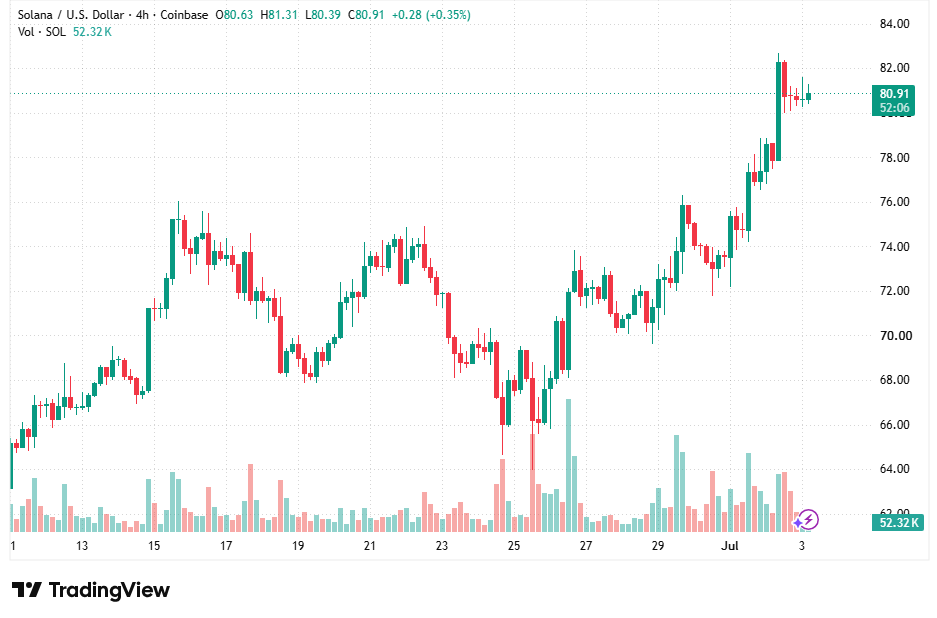
Market sentiment has also reflected this optimism. SOL has climbed approximately 19% over the past week, outperforming several major cryptocurrencies as investors responded to rising institutional adoption, expanding real-world asset initiatives, and continued ecosystem development.
If tokenized equities continue gaining traction and Solana’s governance model proves effective, the blockchain could further establish itself as a preferred platform for digital securities, real-world assets, and next-generation financial infrastructure.
Together, these developments reinforce Solana’s ambition to bridge traditional finance with decentralized technology while supporting broader institutional participation in blockchain-powered markets.
