


Ethereum is entering its most ambitious development phase since its landmark transition to proof-of-stake in 2022. Co-founder Vitalik Buterin has unveiled an updated technical roadmap, known as “Lean Ethereum,” outlining a broad redesign of the blockchain over the next three to four years.
The proposal reflects growing agreement among Ethereum researchers on the network’s long-term direction, but it also highlights increasing concern from developers who believe the pace of execution must accelerate.
Presented after Ethereum’s Berlin research summit on July 5, the roadmap proposes improvements across nearly every major layer of the network. The consensus system, execution environment, cryptographic foundations, and state management architecture are all scheduled for significant upgrades.
Together, these changes aim to strengthen Ethereum’s position as the leading smart contract platform while preparing it for future technological challenges.
Unlike previous upgrades that focused on specific network improvements, Lean Ethereum introduces a comprehensive vision designed to improve efficiency, security, and scalability simultaneously.
Privacy and Security Lead Priorities
The revised roadmap places quantum resistance and privacy at the center of Ethereum’s future strategy. As advances in quantum computing continue, blockchain developers increasingly recognize the need to replace today’s elliptic curve cryptography with quantum-resistant alternatives capable of protecting digital assets for decades.
Privacy has also been elevated from an optional feature to a core protocol objective. Rather than depending on external privacy solutions, future Ethereum upgrades aim to support trustless private transactions directly within the network’s design. This shift could improve both user security and institutional adoption.
Another major technical proposal involves replacing repetitive transaction verification with recursive STARKs, an advanced cryptographic proof system. Instead of every node independently reprocessing every transaction, nodes would verify compact mathematical proofs confirming the work was completed correctly.
This approach is expected to reduce hardware requirements, improve scalability, lower operating costs, and strengthen resistance against censorship.
Additional long-term improvements include limiting the growth of Ethereum’s current state database while introducing more scalable storage models. Developers are also evaluating RISC-V as a possible successor to the Ethereum Virtual Machine (EVM), potentially creating a faster and more flexible execution environment for future decentralized applications.
Key highlights include:
- Three-to-four-year protocol modernization plan
- Privacy becomes a built-in network feature
- Quantum-resistant cryptography moves to the forefront
- Recursive STARKs improve verification efficiency
- RISC-V remains a leading candidate to replace the EVM
Developers Want Faster Progress
While Ethereum’s research community broadly supports the roadmap, implementation speed remains the biggest source of debate. The proposed upgrades require extensive testing, security reviews, and coordination among developers, making rapid deployment difficult despite widespread agreement on the overall vision.
The timing is especially important as competing blockchains continue expanding their market presence. Networks offering faster transaction processing and lower latency have attracted developers and institutional participants seeking immediate performance advantages. This growing competition increases pressure on Ethereum to translate long-term research into production-ready upgrades more quickly.
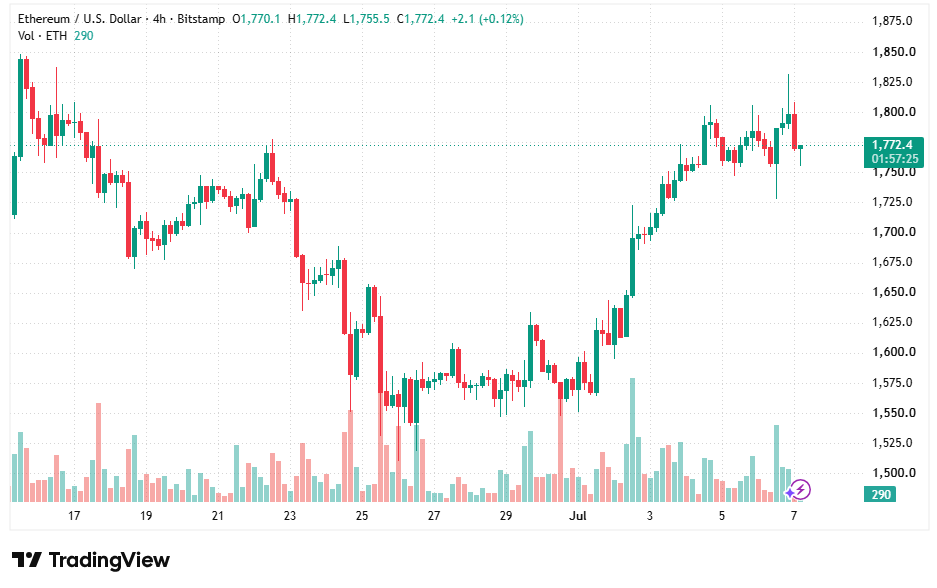
Investor sentiment has remained constructive despite the lengthy timeline. Ethereum recently traded near $1,780.99, posting an 11.92% gain over the previous seven days, while Bitcoin changed hands around $63,411, rising 5.78% during the same period. These gains suggest investors continue to view Ethereum’s long-term development strategy positively.
Lean Ethereum presents a technically unified vision supported by much of the research community. The remaining challenge is execution. As blockchain innovation accelerates across the industry, Ethereum’s ability to deliver these upgrades within a competitive timeframe may ultimately determine whether its technological leadership remains intact.
