Solana records $5.77B in tokenized asset volume and $14B in stablecoins, yet SOL struggles below $80. Discover the key reasons behind the disconnect.
Institutional Growth Hits New Highs
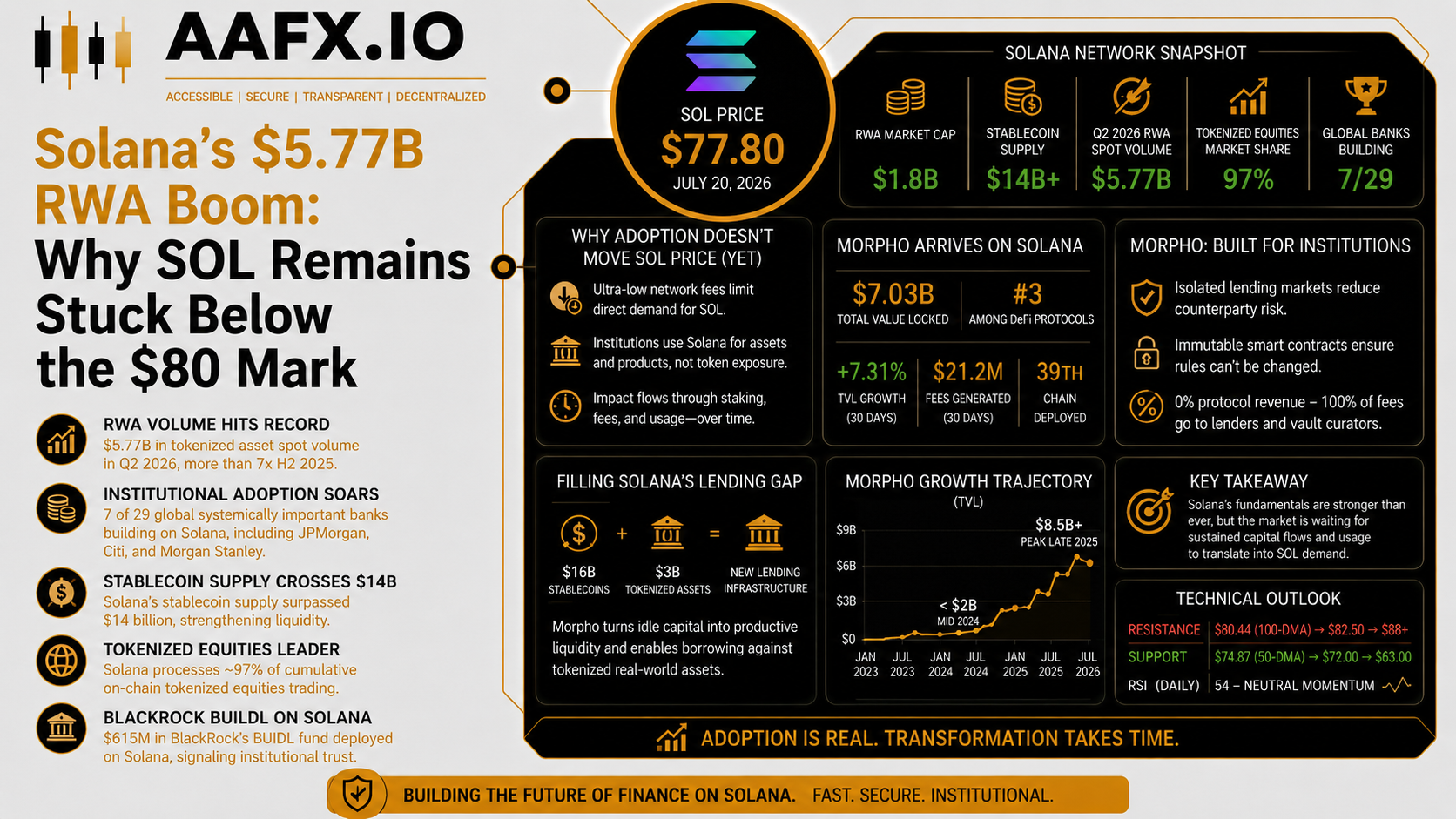
Solana is experiencing one of the strongest periods of institutional adoption in its history, yet its native token continues to trade below key resistance levels. While SOL hovered around $77.80, network fundamentals painted a far different picture than market sentiment.
During the second quarter of 2026, Solana generated a record $5.77 billion in tokenized asset spot volume, more than seven times the combined volume recorded during the second half of 2025. At the same time, the network’s Real-World Asset (RWA) market capitalization surpassed $1.8 billion, while stablecoin supply climbed beyond $14 billion.
Perhaps the most significant milestone is Solana’s dominance in tokenized equities. The blockchain has processed approximately 97% of cumulative on-chain tokenized stock trading, establishing itself as a leading infrastructure layer for regulated financial assets.
Major financial institutions are increasingly choosing Solana for blockchain-based initiatives. According to Solana Foundation leadership, seven of the world’s 29 globally systemically important banks are building solutions on the network.
Notable participants include:
- Morgan Stanley
- JPMorgan
- Citi
- BNY
- Société Générale
- Standard Chartered
The presence of these institutions suggests that Solana is evolving beyond its retail-focused reputation and becoming a platform for large-scale financial applications.
Why SOL Price Isn’t Following Adoption
Despite impressive growth metrics, institutional adoption does not automatically translate into immediate demand for SOL.
The primary reason lies in Solana’s design. Network fees remain extremely low, which benefits users and institutions but limits direct token demand generated by transaction activity. Even when billions of dollars move across the network, the resulting fee consumption represents only a small fraction of SOL’s circulating supply.
A notable example is the $615 million BUIDL fund presence from BlackRock, which highlights confidence in Solana’s infrastructure. However, institutional participants often interact with tokenized assets, stablecoins, and financial products rather than accumulating large amounts of SOL itself.
As a result, network expansion strengthens long-term fundamentals through:
- Increased staking participation
- Higher fee generation over time
- Greater financial activity on-chain
- Growing institutional credibility
However, the impact on token valuation develops gradually rather than immediately.
Morpho Adds a New Capital Market Layer
A major development supporting Solana’s financial ecosystem is the arrival of Morpho, one of decentralized finance’s largest lending protocols.
Morpho currently manages approximately $7.03 billion in total value locked (TVL), ranking among the largest DeFi platforms globally. Over the past month, its TVL increased 7.31%, while the protocol generated $21.2 million in fees during the last 30 days.
Its lending model allows institutions to borrow against tokenized assets such as Treasury bills, equities, and credit products. This fills a critical gap in Solana’s ecosystem, where capital accumulation has outpaced lending infrastructure development.
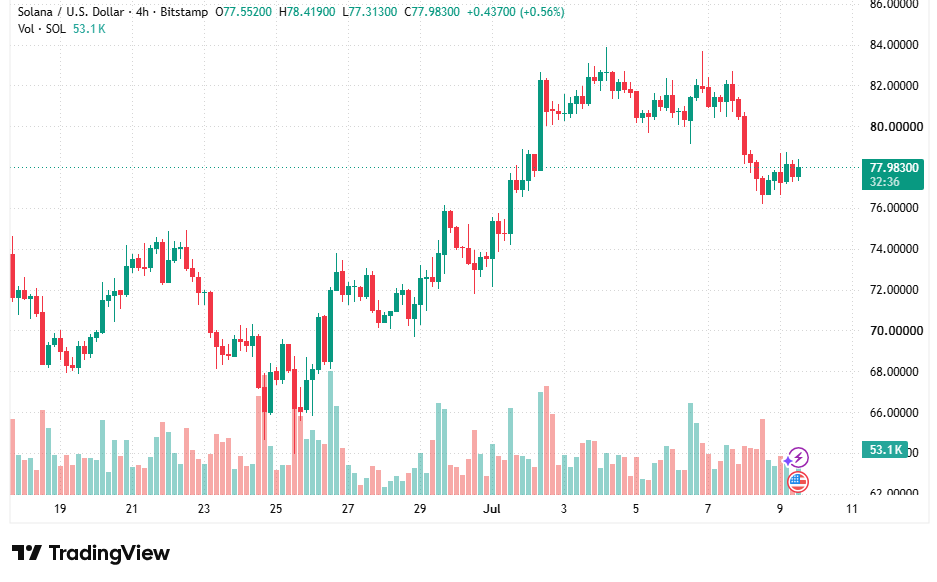
From a market perspective, traders are watching several technical levels. Resistance remains near $80.44, followed by $82.50, while support sits around $74.87 and $72. A sustained move above resistance could open the path toward the high-$80 range, whereas a break below support may return SOL to its previous consolidation zone.
For now, Solana’s story is defined by a growing divide between record-breaking institutional adoption and a token price still waiting for a clear catalyst. The network’s fundamentals continue to strengthen, but investors remain focused on when those gains will finally be reflected in SOL’s market value.
Sources & Methodology
Primary-source standard: Market-moving facts should link to original data releases, regulator notices, company filings or official project announcements whenever available. Secondary reporting is used for additional context, not as a substitute for original evidence.
Page last reviewed: