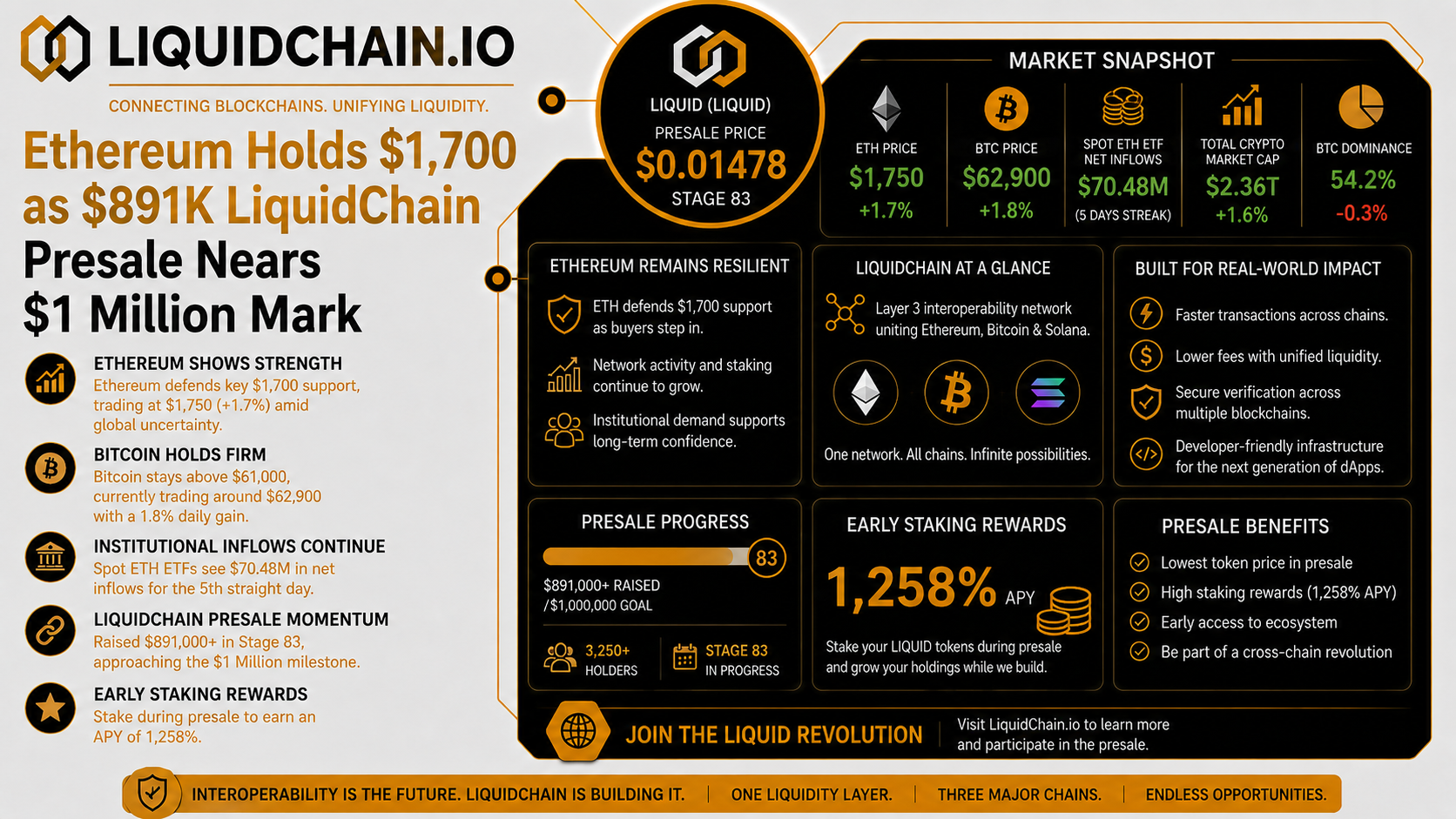
Ethereum defends $1,700 amid market uncertainty while LiquidChain’s presale surpasses $891K, highlighting rising demand for cross-chain innovation.
Ethereum Shows Market Strength
The cryptocurrency market continues to demonstrate resilience despite renewed geopolitical uncertainty and shifting macroeconomic conditions. Recent tensions involving the United States and Iran triggered short-lived volatility across traditional financial markets, yet major digital assets largely maintained their positions. This performance underscores the increasing maturity of the blockchain sector and the growing confidence investors place in leading cryptocurrencies.
Ethereum remains one of the strongest examples of this resilience. The second-largest cryptocurrency by market capitalization successfully defended the critical $1,700 support level and climbed approximately 1.7% to trade near $1,750. Bitcoin also posted gains, advancing roughly 1.8% while holding close to the $63,000 mark.
The ability of both assets to withstand external pressures reflects a broader shift in investor behavior. Digital assets are increasingly being viewed as long-term technology investments rather than purely speculative instruments. As blockchain adoption expands globally, market participants appear more willing to maintain exposure during periods of uncertainty.
Institutional Demand Boosts ETH
Institutional participation remains a major driver behind Ethereum’s stability. Spot Ethereum exchange-traded funds (ETFs) attracted approximately $70.48 million in net inflows during the latest trading session, marking the fifth consecutive day of positive investment activity.
Several factors continue to support Ethereum’s position:
- Spot Ethereum ETFs recorded $70.48 million in daily inflows.
- Ethereum maintained support above $1,700 despite global uncertainty.
- Bitcoin remained firmly above the $61,000 threshold.
- Institutional capital continues flowing into digital asset products.
These figures suggest professional investors remain confident in Ethereum’s long-term potential. Continued ETF inflows also provide additional liquidity and market depth, helping reduce volatility during periods of heightened geopolitical risk.
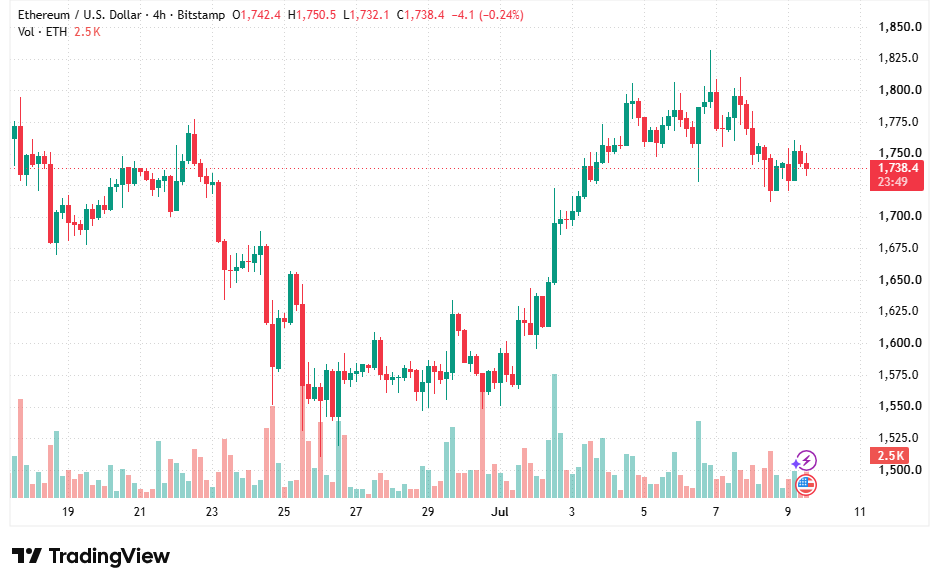
Meanwhile, the broader cryptocurrency market has benefited from Bitcoin’s ability to remain above key psychological levels. With Bitcoin trading near $62,900 and Ethereum maintaining upward momentum, investor sentiment has remained constructive across the sector.
LiquidChain Targets Web3 Connectivity
Against this backdrop, emerging blockchain projects are attracting growing attention, particularly those focused on solving infrastructure challenges. One such project is LiquidChain (LIQUID), a Layer 3 network designed to improve interoperability between major blockchain ecosystems.
Today, networks such as Bitcoin, Ethereum, and Solana largely operate independently, creating friction for users and developers. Transferring assets between chains often involves bridges, wrapped tokens, and additional transaction costs. These limitations have slowed the development of seamless decentralized applications.
LiquidChain aims to address this challenge by creating a unified liquidity and data layer capable of verifying transactions across multiple blockchains. The project’s goal is to enable developers to build applications that deliver faster execution, lower costs, and a more streamlined user experience.
Momentum around the initiative continues to grow. The project’s presale has exceeded $891,000, bringing it closer to the significant $1 million milestone. Currently in Stage 83, LIQUID tokens are priced at $0.01478, while participants who choose to stake their holdings are being offered a reported annual percentage yield (APY) of 1,258%.
For investors exploring next-generation blockchain infrastructure, LiquidChain represents a growing trend toward interoperability-focused solutions. As Ethereum and Bitcoin continue demonstrating resilience, projects that simplify connectivity across blockchain networks may play an increasingly important role in the evolution of Web3.
Sources & Methodology
Primary-source standard: Market-moving facts should link to original data releases, regulator notices, company filings or official project announcements whenever available. Secondary reporting is used for additional context, not as a substitute for original evidence.
Page last reviewed: