
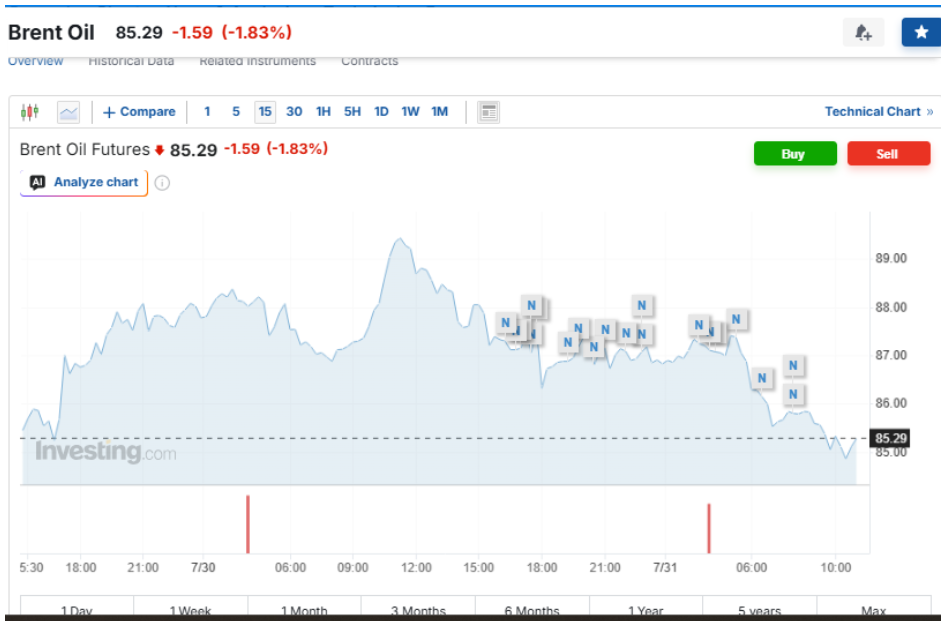
Global oil prices edged higher during Asian trading on Friday, with Brent crude nearing $90 per barrel and WTI above $84, as escalating military tensions between the United States and Iran fueled concerns over prolonged supply disruptions across the Middle East. Despite a volatile week, both benchmarks remain on track for their strongest monthly performance since March, supported by tightening inventories, refinery disruptions, and growing risks to key global shipping routes.
Brent Near $90 as Middle East Supply Risks Intensify
- Brent crude futures for September delivery rose 0.7% to $89.64 per barrel, while West Texas Intermediate (WTI) gained 0.6% to $84.06 per barrel during Asian trading.
- Although both benchmarks were set for a weekly decline of nearly 7% after hopes of renewed diplomacy earlier in the week, they remained on course for a monthly gain of around 21%, marking the strongest monthly rally since March.
- According to market reports, fresh U.S. strikes on Iranian military targets prompted retaliatory Iranian missile attacks on U.S. positions and regional allies, increasing fears that the conflict could further disrupt global energy supplies.
- Investors were also concerned after an unidentified drone struck gas vessels at Egypt’s Damietta Port, located near the Suez Canal, raising fresh questions about the security of one of the world’s most important energy transit corridors.
- Security concerns extend beyond the Suez Canal. The Strait of Hormuz, through which roughly 20% of global oil consumption passes every day, and the Red Sea shipping corridor remain under pressure from regional conflict and Houthi attacks on commercial shipping.
- Saudi Arabia reportedly held discussions with representatives from 43 countries to establish a multinational maritime coalition aimed at protecting commercial shipping in the Red Sea.
U.S. Crude Inventories Hit Lowest Level Since 2018
Oil prices strengthened as traders priced in a higher geopolitical risk premium.
The biggest concern remains the possibility of supply disruptions through critical Middle Eastern export routes. Any prolonged interruption to tanker traffic through the Strait of Hormuz, the Suez Canal, or the SUMED pipeline could significantly reduce global crude availability, particularly for European and Asian refiners.
Adding to bullish sentiment, attacks on refineries across the Middle East and Russia have tightened supplies of refined fuels including gasoline, diesel, and jet fuel, keeping refinery profit margins close to record highs even though crude prices remain below the peaks seen earlier this year.
Supply concerns were reinforced by the latest U.S. inventory data. According to the U.S. Energy Information Administration (EIA), commercial crude oil inventories fell by 7.2 million barrels to 404.5 million barrels during the week ending July 24, leaving U.S. crude stockpiles at their lowest level since 2018. The drawdown was substantially larger than market expectations, signaling stronger demand or tighter supply conditions.
Spot Crude Near $110 as July Supply Risks Intensified
Oil markets have experienced exceptional volatility throughout July as geopolitical developments repeatedly shifted investor sentiment.
Prices initially surged after military exchanges between the United States and Iran raised fears of widespread disruptions to Middle Eastern exports. Later, optimism surrounding potential diplomatic negotiations briefly pushed crude lower before fresh attacks reignited supply concerns.
Physical oil markets have already shown signs of tightening. Several spot crude grades traded close to $110 per barrel earlier in July as shipping disruptions forced tankers to reroute around Africa and reduced the availability of Middle Eastern crude for European buyers. Saudi Arabia has also explored alternative export routes through Egypt to maintain deliveries.
What’s Next: OPEC+ August 2 Meeting and EIA Inventory Data
Market participants will closely watch the OPEC+ ministerial meeting scheduled for August 2, where producers are widely expected to approve another output target increase of around 188,000 barrels per day for September, while signaling whether further hikes will be paused amid heightened geopolitical risks. Investors will also monitor the next U.S. Energy Information Administration (EIA) Weekly Petroleum Status Report after commercial crude inventories fell by 7.2 million barrels to 404.5 million barrels, their lowest level since 2018.
At the same time, developments around the Strait of Hormuz, which normally handles about 20% of global oil consumption, and the Red Sea shipping corridor will remain key market drivers. Analysts say oil prices are likely to remain highly sensitive to military developments between the United States, Iran and regional allies, with geopolitical risk expected to outweigh economic fundamentals in the near term.
Sources & Methodology
Primary-source standard: Market-moving facts should link to original data releases, regulator notices, company filings or official project announcements whenever available. Secondary reporting is used for additional context, not as a substitute for original evidence.
Page last reviewed: