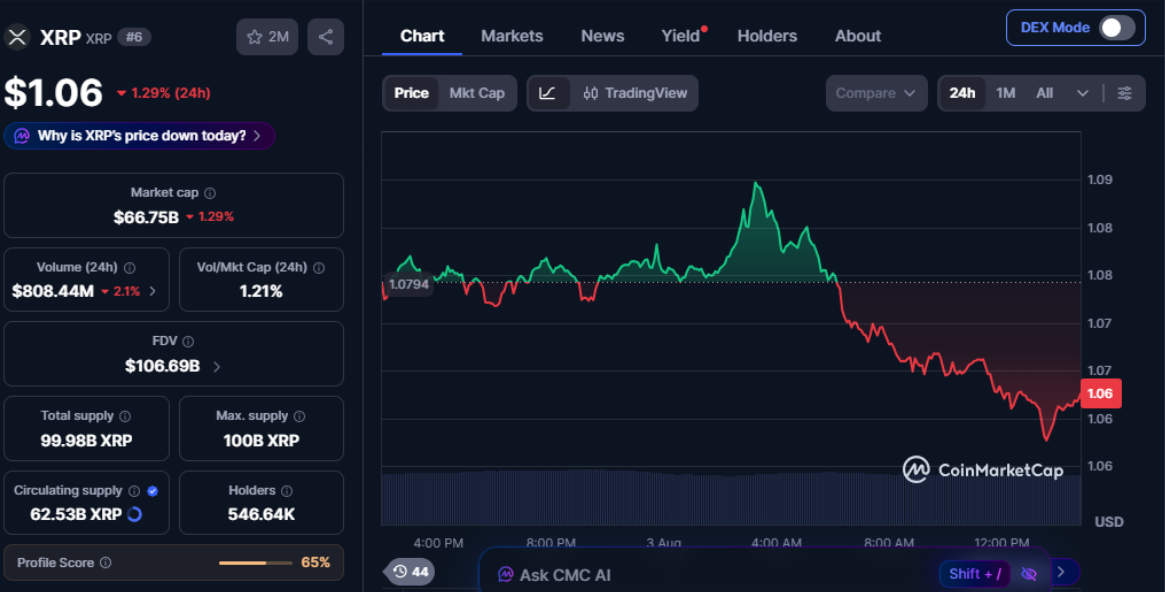
Ripple has expanded its institutional blockchain strategy by investing in digital capital markets infrastructure firms ZILO and Licuido, aiming to strengthen tokenization capabilities on the XRP Ledger (XRPL). The announcement focuses on regulated transfer agency, token issuance and collateral mobility for financial institutions. Despite the development, XRP traded around $1.07, down about 1% over the past 24 hours, indicating that investors viewed the news as a long-term infrastructure milestone rather than an immediate catalyst for the token’s price. The investment terms were not disclosed.
Ripple Backs 2 Firms to Add 3 Institutional Capabilities to XRPL
Ripple announced the investments on August 3 as part of its broader strategy to build institutional-grade infrastructure on the XRP Ledger. According to the company, the partnership with UK-based ZILO and Licuido will introduce regulated transfer agency services, token issuance infrastructure and collateral mobility, allowing traditional financial assets to be issued, transferred and settled more efficiently on-chain. Ripple said existing capital markets remain burdened by legacy systems that slow settlement, lock up collateral and increase operational costs, while XRPL is designed to support instant settlement, multi-currency investment and tokenized asset management. The company also confirmed that its U.S. dollar stablecoin, RLUSD, will be used as the settlement asset for delivery-versus-payment (DvP) transactions on the network.
ZILO provides transfer agency and fund administration technology for asset managers, custodians and transfer agents, and Ripple said the investment will accelerate infrastructure for tokenized fund share classes. Licuido, an FCA-regulated platform, specializes in token issuance, digital asset distribution and collateral mobility, enabling tokenized financial assets such as fund shares to be transferred and used as collateral on-chain. Ripple Senior Vice President of Trading and Markets Nigel Khakoo said tokenization alone is not enough, arguing that the real value comes when tokenized assets can be traded, settled, borrowed against or posted as collateral instantly within regulated financial markets.
XRP Falls 1% as Ripple’s Infrastructure Announcement Fails to Spark Rally
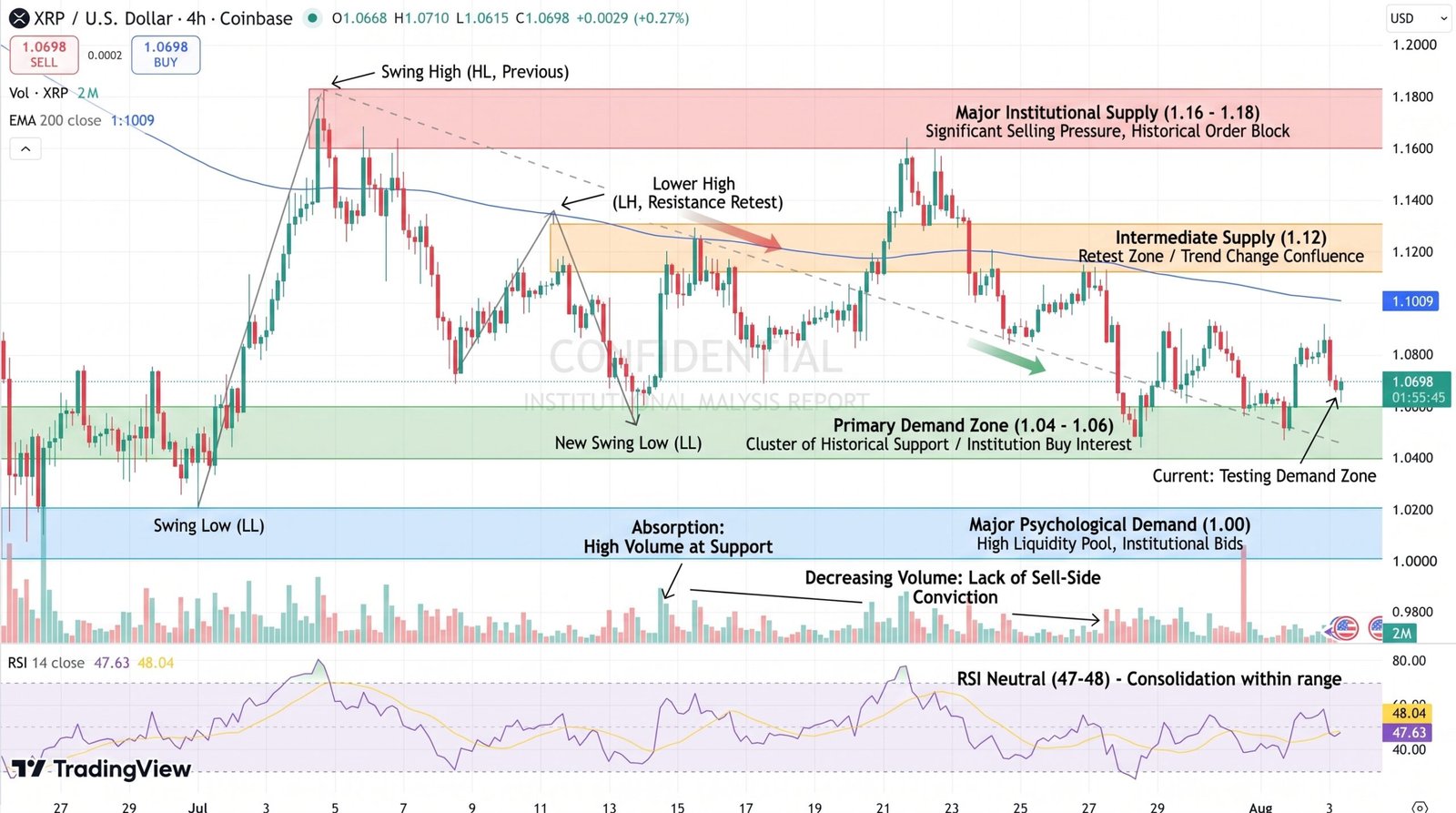
Despite the announcement, XRP showed little immediate response in the market. The cryptocurrency traded near $1.07, remaining within the $1.06-$1.09 range after the news, while posting a decline of roughly 1% over the previous 24 hours. The muted reaction suggests traders viewed the investments as infrastructure developments that could support institutional adoption over the long term rather than generate immediate demand for XRP. Analysts also noted that investors are increasingly looking for measurable growth in on-chain activity and institutional usage before pricing ecosystem announcements into the token.
XRPL Surpasses 4 Billion Transactions as Ripple Expands Tokenization Strategy
Ripple has accelerated its tokenization strategy throughout 2026. Earlier this year, the company partnered with Aviva Investors to tokenize traditional fund structures on the XRP Ledger using infrastructure from ZILO and Licuido. On July 29, Aviva Investors launched a tokenized share class of its USD Liquidity Fund on XRPL after receiving approval from the Central Bank of Ireland. The launch was supported by digital asset custodian Komainu and Licuido’s tokenization platform. According to Aviva Investors, the XRP Ledger has processed more than 4 billion transactions, supports nearly 8 million active wallets, and is maintained by over 130 independent validators, making it one of the largest public blockchains designed for institutional financial applications.
Ripple’s latest investments also follow several strategic infrastructure deals announced this year, including investments in payment platform Flutterwave and compliance provider Notabene, reflecting the company’s broader effort to expand RLUSD and XRPL adoption across regulated financial markets. Rather than focusing solely on payments, Ripple is positioning the XRP Ledger as a platform for tokenized securities, investment funds and institutional settlement.
Ripple Eyes Institutional Growth as XRPL Tops 8.4 Million Accounts
Ripple is expected to continue expanding the XRP Ledger’s institutional ecosystem by integrating additional regulated infrastructure providers and encouraging asset managers to issue tokenized financial products on XRPL. Investors will be watching for greater adoption of RLUSD in settlement, increased issuance of tokenized funds and securities, and growth in on-chain institutional activity. While the ZILO and Licuido investments strengthen the foundation for regulated digital capital markets, analysts believe XRP’s price is more likely to respond once these initiatives translate into measurable transaction volume and institutional usage across the network.
Sources & Methodology
Primary-source standard: Market-moving facts should link to original data releases, regulator notices, company filings or official project announcements whenever available. Secondary reporting is used for additional context, not as a substitute for original evidence.
Page last reviewed: