
- Pi Network stabilized above $0.080 after three consecutive daily declines totaling roughly 15%.
- More than 417,000 Pioneers flagged for possible duplicate accounts can now continue KYC after additional evaluation.
- A separate migration fix is expected to unblock about 497,000 Pioneers, while PI remains below its major moving averages.
Pi Network’s PI token attempted to stabilize near $0.083 on Friday after three consecutive sessions of losses erased roughly 15% of its value. The price recovery coincides with a new KYC and Mainnet migration update from the Pi Core Team designed to remove account-verification bottlenecks affecting hundreds of thousands of users. While the network improvements address important operational issues, PI’s technical structure remains weak. The token is trading below its major exponential moving averages, leaving $0.0819 and the record-low region around $0.0704 as important downside levels.
Pi Unblocks 417,000 KYC Users
Pi Network announced several changes to its Know Your Customer (KYC) and Mainnet migration systems on September 17. The most significant change concerns accounts previously flagged for possible duplication. After additional evaluation, Pi determined that more than 417,000 affected Pioneers were not duplicates, allowing them to continue through the KYC process.
This distinction matters. The update did not remove 417,000 duplicate accounts; it resolved a verification bottleneck affecting legitimate users. Pi has also developed a fix for 497,000 Pioneers with Fast-Track Mainnet wallets who were unable to claim migrated balances because their wallets lacked sufficient PI to cover the required gas fee. According to the Core Team, that fix is expected to be deployed within a week.
Pi Expands Identity Verification
The update includes several additional changes to Pi’s identity-verification infrastructure. The network has optimized machine-learning processes used for video analysis, expanded liveness-check compatibility for older or lower-spec smartphones and enabled resubmissions for some users affected by earlier verification systems.
Pi is also conducting a one-month trial of palm-print authentication for selected users who require multiple liveness checks. The feature is being introduced gradually as another method of confirming that accounts belong to genuine individuals.
These changes build on Pi’s broader KYC expansion. Earlier in 2026, the project reported that 16 million Pioneers had migrated to Mainnet, after another update made nearly 2.5 million previously blocked users eligible to complete migration.
PI Price Remains Technically Weak
Despite the ecosystem update, PI’s chart continues to show downside pressure. At around $0.083, the token remains below its 50-day EMA near $0.0931, 100-day EMA around $0.1037 and 200-day EMA near $0.1364.
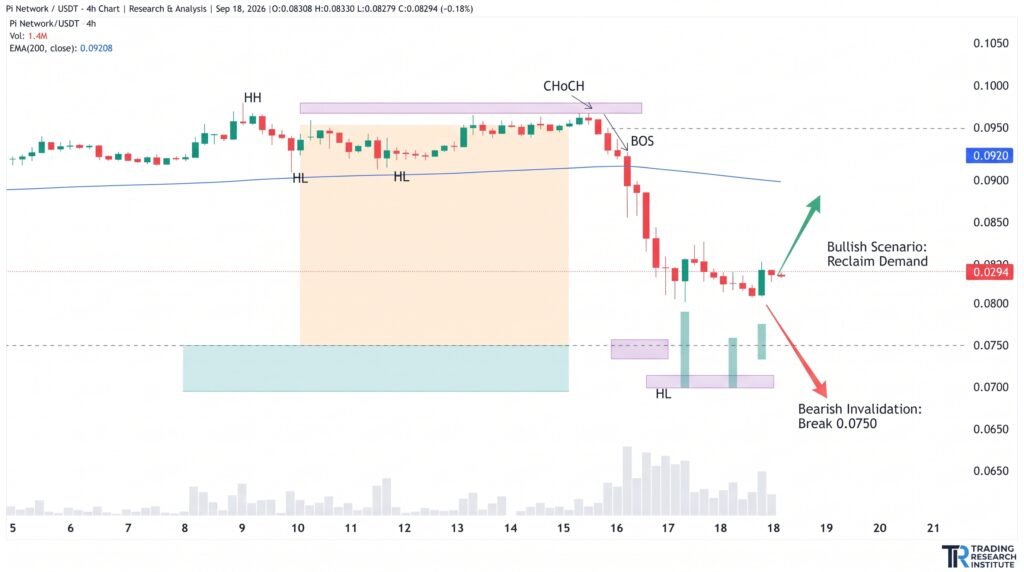
That alignment leaves all three moving averages above the market and creates several layers of potential resistance. The Relative Strength Index near 36 also remains below its neutral 50 level. Meanwhile, a negative MACD configuration points to continued weak momentum.
Immediate support sits around the 23.6% Fibonacci retracement at $0.0819. A decisive break below this area could put the $0.0704 record-low region back in focus. A recovery would first need to overcome the 50-day EMA around $0.0931. Above that, approximately $0.0971–$0.10 becomes the next important resistance area.
Conclusion
Pi Network’s latest KYC and Mainnet changes address genuine infrastructure bottlenecks, potentially allowing more than 900,000 affected users to progress through verification or migration once the announced fixes are fully deployed. The development, however, does not automatically change PI’s price trend.
For traders, $0.0819 is the immediate support to monitor, followed by $0.0704 if selling resumes. On the upside, PI would need to reclaim roughly $0.0931 and then $0.0971–$0.10 before its short-term technical structure improves materially. The KYC update strengthens Pi’s account-verification and migration process; sustained price recovery will still depend on demand for PI, broader crypto conditions and whether buyers can reclaim those technical resistance levels.
Sources & Methodology
Primary-source standard: Market-moving facts should link to original data releases, regulator notices, company filings or official project announcements whenever available. Secondary reporting is used for additional context, not as a substitute for original evidence.
Page last reviewed: