Quick answer: The USD/CAD forecast depends on relative US and Canadian interest rates, growth, trade conditions and demand for the US dollar. Oil matters, but it cannot explain every move. AAFX’s September 2026 research used scenario ranges of 1.35–1.45 for 2026, 1.30–1.42 for 2027 and 1.20–1.50 around 2030. These are dated editorial estimates, not live trading levels or guaranteed outcomes.
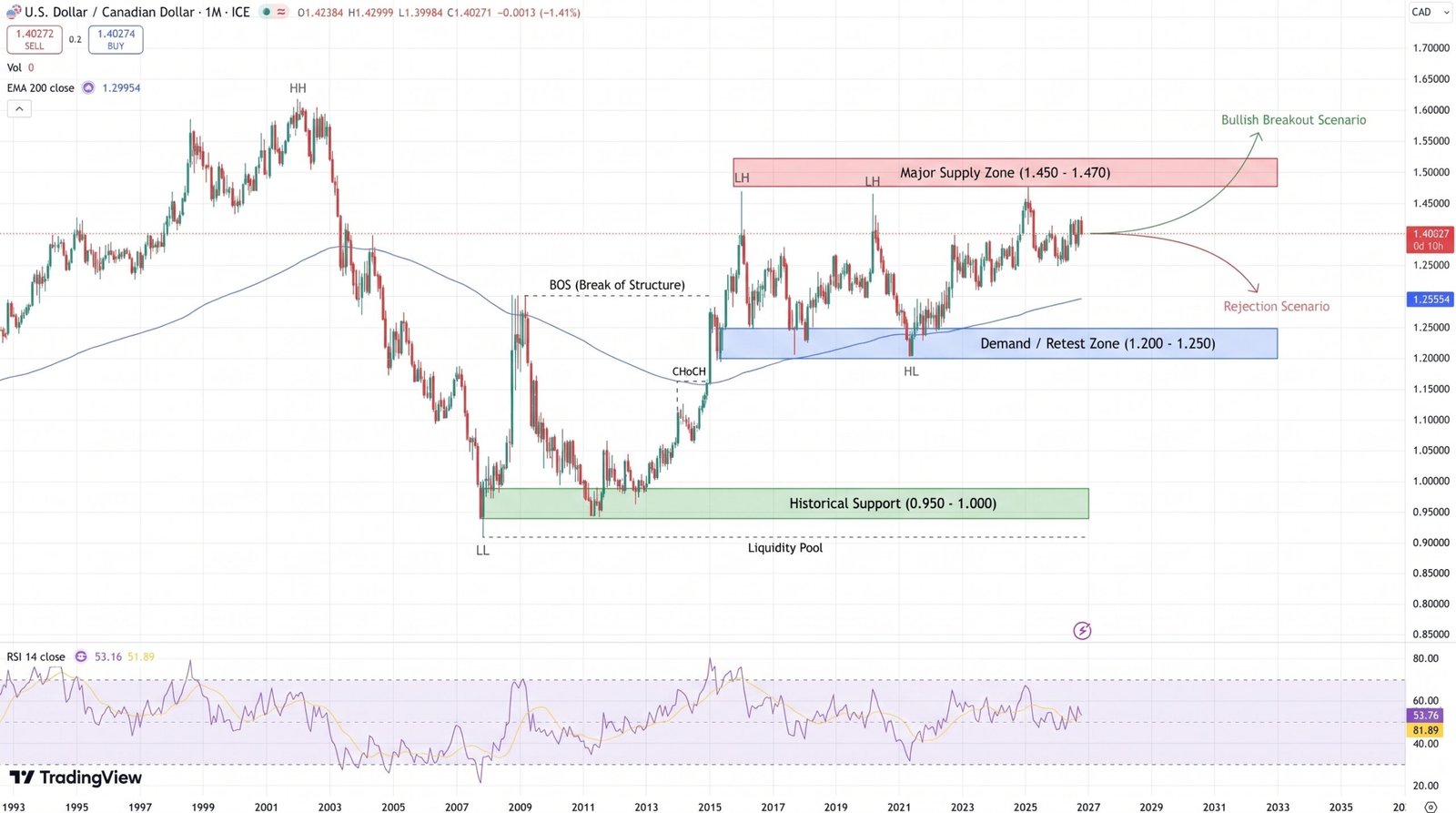
Evergreen framework reviewed October 28, 2026. Numerical scenarios originate from September 2026 research. This article does not show a live exchange rate.
USD/CAD expresses how many Canadian dollars buy one US dollar. At 1.40, US$1 costs C$1.40. A rise means the US dollar strengthens relative to the Canadian dollar; a decline means the Canadian dollar strengthens. This distinction helps avoid a common mistake: a bullish Canadian-dollar outlook normally implies a bearish USD/CAD outlook.
The pair is a useful lens on two closely connected economies. Shared regional shocks can affect both currencies, while different inflation pressures, policy responses and export exposures can pull them apart. This guide explains the assumptions to test alongside our forex forecast collection.
USD/CAD forecast at a glance
| Horizon | Original scenario range | Assumption to assess |
|---|---|---|
| 2026 | 1.35–1.45 | US rate support is balanced by Canadian growth and export-income conditions. |
| 2027 | 1.30–1.42 | A narrower relative yield gap allows gradual Canadian-dollar recovery. |
| Around 2030 | 1.20–1.50 | Productivity, trade and commodity cycles create a wide set of plausible outcomes. |
The table preserves the September 2026 research record. These bands are not statistical confidence intervals or instructions to buy and sell at their edges. They describe broad scenarios rather than specific year-end closing prices. A sustained move beyond a band calls for reassessing its assumptions, not assuming that price must return.
How the Fed and Bank of Canada influence USD/CAD
Relative policy expectations matter more than either interest rate in isolation. If investors expect US returns to rise relative to Canadian returns, the dollar may gain support. If the expected gap narrows, that source of dollar support can weaken. The timing and size of the market surprise matter alongside the direction of a rate decision.
For example, a Bank of Canada rate cut need not weaken the Canadian dollar if it was fully anticipated and the accompanying guidance is firmer than expected. Conversely, favorable Canadian news can be overwhelmed by a larger reassessment of the US policy outlook. An analysis of USD/CAD must consider both economies.
Compare bond yields at similar maturities and distinguish nominal returns from inflation-adjusted returns. Currency hedging and funding costs can also change the return available to an international investor. The policy-rate gap alone is an incomplete measure of the investment decision.
Why oil prices do not tell the whole story
Energy export receipts can influence the Canadian-dollar outlook. However, the currency’s relationship with oil varies over time and with the source of the shock. Bank of Canada staff research on global currency factors and foreign-exchange risk premiums finds that oil has become relatively less important in explaining Canadian-dollar movements in the period it examines. That is a reason to test the relationship rather than assume a permanent one-for-one link.
Consider a rise in oil caused by stronger global demand. That backdrop may support export expectations. A supply disruption can also raise oil prices, but it may simultaneously damage growth and increase demand for US dollars. Similar oil-price moves can therefore produce different USD/CAD outcomes.
For an annual outlook, examine the persistence of export-income changes, the broader commodity environment and the response of investment. A brief price spike is not enough to establish a lasting change in Canada’s relative economic position.
Canadian growth, housing and household demand
The domestic economy affects the exchange rate through expected returns and policy. Slower consumption or investment may alter the Bank of Canada’s assessment, while stronger productivity and business spending can improve the longer-term outlook. A single growth release should be read alongside revisions and other evidence.
Housing and household borrowing are relevant because financing conditions affect spending decisions. However, weak housing activity does not translate into a fixed number of Canadian-dollar losses. The currency response depends on how the news changes expectations relative to what investors already anticipated.
A useful forecast distinguishes a temporary slowdown from a persistent deterioration in growth potential. The former may mainly affect the next few policy decisions; the latter can influence investment and currency demand over years.
Trade conditions and broad US-dollar demand
Trade disruptions can change costs, confidence and investment decisions on both sides of the border. Their currency effects depend on the details, expected duration and monetary-policy response. Avoid treating a tariff headline as proof of a specific long-term exchange rate without assessing those channels.
USD/CAD can also rise because the dollar strengthens broadly. Comparing our EUR/USD outlook and USD/JPY outlook can help separate a global dollar theme from a Canada-specific one. Remember that dollar strength pushes EUR/USD lower but normally pushes USD/CAD higher.
For a second commodity-sensitive currency framework, read the AUD/USD forecast. Australia and Canada have different trading partners and export mixes, so their currencies should not be treated as interchangeable.
USD/CAD outlook for 2027
The original 1.30–1.42 scenario assumes a less pronounced US yield advantage and enough resilience in Canadian activity to support gradual currency recovery. It describes a possible path, not a guarantee that every month will trade inside the band.
The scenario would weaken if Canadian demand or investment deteriorated more than expected, trade uncertainty persisted or US real returns remained comparatively attractive. It would strengthen if Canadian productivity, growth and export conditions improved while the relative yield gap narrowed.
Policy convergence alone does not guarantee a stronger Canadian dollar. Investors also need confidence in the growth and investment outlook. That is why this framework combines monetary conditions with economic fundamentals rather than projecting the current interest-rate gap forward mechanically.
USD/CAD price prediction for 2030
The original 1.20–1.50 structural range is broad because several policy and commodity cycles may occur before 2030. Its midpoint is not a precise target, and no probability is assigned to either edge.
Stronger Canadian productivity, attractive domestic investment opportunities and favorable export conditions would support the lower-USD/CAD scenario. A sustained US relative return advantage or weaker Canadian investment environment would support a higher pair. Unexpected changes in trade relationships or energy demand can alter either case.
Long-term forecasts are most useful when they make their assumptions visible. If the assumptions fail, the appropriate response is to revise the outlook rather than widen the range indefinitely to preserve an appearance of accuracy.
Bull, base and bear scenarios
| Scenario | Supporting evidence | What could invalidate it? |
|---|---|---|
| Bullish USD/CAD | A persistent US yield advantage, weaker Canadian activity or stronger global dollar demand. | A durable narrowing in relative yields and improved Canadian investment conditions. |
| Base framework | Gradual policy convergence with mixed growth and commodity signals. | A major trade shock or sustained divergence in economic performance. |
| Bearish USD/CAD | Stronger Canadian fundamentals, supportive export income and a softer dollar. | Weakening Canadian demand or renewed demand for dollar liquidity. |
How to use current data with a long-term forecast
Check the date and purpose of any quoted rate. The Bank of Canada’s exchange-rate resource provides reference data and methodology; a broker’s executable bid or ask can differ. A reference rate is not a promise that a transaction can be completed at that price.
For short-term decisions, use a current chart and the economic calendar. Define the timeframe before discussing support and resistance. A monthly scenario does not provide an intraday entry signal, and a forecast range is not a substitute for position sizing.
Review spreads, financing charges and possible slippage. Our leverage and margin guide explains how exposure can amplify losses even when the underlying exchange-rate move looks modest.
Frequently asked questions
What is the USD/CAD forecast for 2027?
AAFX’s September 2026 research used 1.30–1.42 as a broad 2027 scenario, assuming gradual narrowing of relative yield differences and resilient Canadian conditions. It is a dated estimate, not a live target.
Does higher oil always mean lower USD/CAD?
No. The source of the oil-price change, relative interest rates and global dollar demand can alter the relationship. Oil is one input rather than a complete forecasting model.
Does a stronger Canadian dollar make USD/CAD rise?
No. With other factors unchanged, a stronger Canadian dollar means fewer Canadian dollars are required to buy US$1, so USD/CAD falls.
Is the 2030 forecast reliable enough for a fixed target?
No multi-year exchange-rate estimate can eliminate uncertainty. The original 1.20–1.50 range is a structural scenario band, not a guaranteed outcome or statistical confidence interval.
Is this page suitable for tomorrow’s forecast?
This is a long-term guide. Tomorrow’s outlook requires current prices, event information and a recent chart. Annual editorial maintenance cannot keep daily targets up to date.
Methodology and revision record
The outlook is conditional editorial analysis combining relative yields, inflation, growth, trade and capital flows. Official sources support the explanation of market mechanisms, not AAFX’s scenario numbers. No backtested success rate is claimed.
- September 2026: Original scenario ranges recorded: 1.35–1.45 for 2026, 1.30–1.42 for 2027 and 1.20–1.50 around 2030.
- October 28, 2026: Reworked into an evergreen article with dated scenarios, sources, FAQs and internal links. Removed stale spot quotes and short-term targets.
The framework is intended for annual review, with earlier revisions after a major policy or trade-regime change or evidence that the central assumptions no longer hold.
Risk notice: Currency trading can cause substantial losses, especially with leverage. This is educational analysis rather than personalized investment advice. Read the AAFX risk disclaimer.