
Bitcoin edged higher to ~$64,829 amid Strait of Hormuz deal optimism but stayed rangebound. Spot ETFs saw $381M+ August inflows after July’s $172M. Strategy sold 1,638 BTC; Coldcard hac
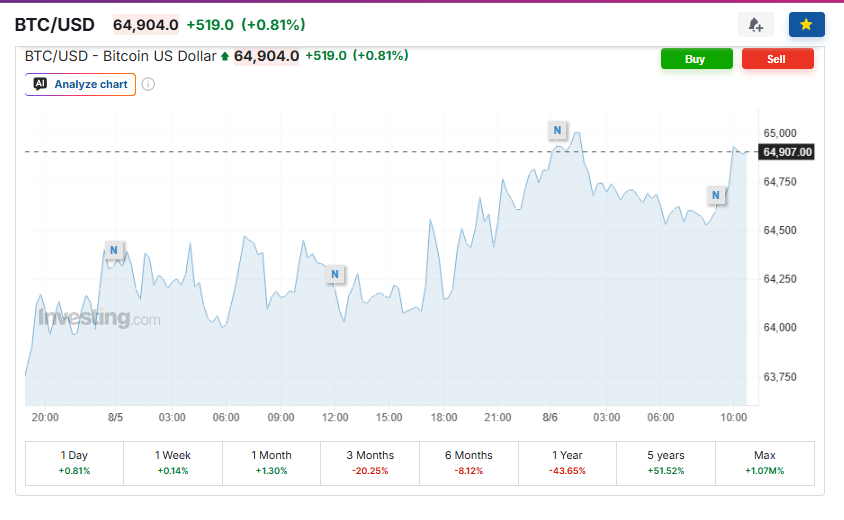
Bitcoin rose about 0.8% to around $64,829 on Wednesday, extending a mild recovery as optimism grew over a potential deal to reopen the Strait of Hormuz. The world’s largest cryptocurrency remained tightly rangebound near $64,000, however, as markets digested a high-profile hardware-wallet hack that cost users more than $100 million and continued Bitcoin sales by corporate holder Strategy. Spot Bitcoin ETFs logged improving inflows, while Circle’s Q2 results highlighted expanding USDC use.
Bitcoin Near $64,829 (+0.8%) Amid Hormuz Hopes, $381M ETF Inflows & $100M+ Hack
Bitcoin last traded near $64,829 (up 0.8% as of 16:58 ET / 20:58 GMT), holding within a narrow band after closing recent sessions between roughly $62,800 and $64,800. Ethereum gained about 2% to around $1,910–$1,909. Broader altcoins were mixed: Solana and BNB edged up 0.2%–0.4%, while XRP fell about 0.8%–1.15%, Cardano dropped 1.7%, Dogecoin was little changed or slightly lower, and the $TRUMP meme token slid roughly 0.9%.
U.S. officials, including President Donald Trump, described a Strait of Hormuz deal involving the U.S., Oman and Iran as “imminent,” with Axios reporting an aim for a Wednesday announcement of a temporary 60-day arrangement. Under reported terms, inbound traffic would use a northern lane through Iranian waters and outbound traffic a southern lane through Omani waters, with no tolls during the initial period and mines cleared from the median lane within 30 days. Iranian media and officials pushed back, saying any deal could be delayed by continued U.S. threats and denying direct U.S. negotiations while confirming progress with Oman mediators.
Spot Bitcoin ETFs recorded roughly $381.6 million in net inflows so far in August (including strong sessions such as ~$244 million on Aug. 5 and ~$211 million on Aug. 4), following $172.4 million in July after heavy outflows in prior months. Total U.S. spot Bitcoin ETF holdings stood near 1.22 million BTC (about $78–$79 billion in assets). Strategy (formerly MicroStrategy) sold 1,638 BTC for about $104.7 million between July 27 and Aug. 2 at an average ~$63,957, leaving it with 842,138 BTC (still ~4% of eventual supply and worth tens of billions). Proceeds helped fund preferred dividends and share repurchases; a related wallet later moved another 1,030 BTC.
A firmware flaw in Coldcard hardware wallets enabled hackers to steal an estimated $100–$130 million in Bitcoin (around 1,596–2,000 BTC) across multiple waves from thousands of wallets. Coinkite confirmed the issue in certain firmware versions and advised users to migrate funds. Circle reported Q2 revenue and reserve income of $701.3 million (up 7% year-over-year, slightly below some estimates), net income of $0.18 per share (ahead of $0.17 consensus), USDC circulation of $73.3 billion (up 19%), and on-chain transaction volume up 151% to roughly $14.8 trillion. Its reserve return rate fell 66 basis points to 3.5%. Shares initially rose then reversed.
Oil Falls on Hormuz Hopes as Bitcoin Stays Rangebound
Optimism over a Hormuz reopening—historically carrying about 20% of global oil and LNG shipments—triggered sharp oil-price declines (WTI falling toward the mid-$70s and Brent near $79 after multi-percent drops) and a broader risk-on tone. Crypto received only fleeting support, as investors favored AI and tech stocks with clearer fundamentals and recent strong earnings over more speculative digital assets.
Bitcoin remained pinned in a tight range amid residual caution from the Coldcard hack, Strategy’s ongoing sales under its monetization program, and the fact that Bitcoin is still roughly 50% below its October 2025 record high near $126,000. Improving ETF inflows and Circle’s adoption metrics provided a modest counterweight.
Bitcoin Consolidates $62K–$66K; ETFs Hold $51B+ Inflows, Strategy Still Top Corporate Holder
Bitcoin has traded in a multi-week consolidation near $62,000–$66,000 after deeper 2026 losses. U.S. spot Bitcoin ETFs, launched in 2024, have accumulated over $51–$52 billion in cumulative net inflows and hold roughly 5.8–6% of total Bitcoin supply, but suffered heavy redemptions in May–June before the July–August rebound. Strategy remains the largest corporate holder despite 2026 sales totaling hundreds of millions of dollars used for balance-sheet management.
The Coldcard incident underscored ongoing self-custody risks even with hardware wallets. Circle’s results reflected growing institutional and business use of USDC beyond pure crypto trading, though sequential circulation softness and lower yields pressured the stock. The Hormuz talks follow months of U.S.–Iran conflict that disrupted the waterway, with prior interim understandings having collapsed.
Focus Turns to Hormuz Deal Outcome, ETF Flows and Strategy Sales
Markets will watch for a formal Hormuz announcement or further delays, which could swing oil prices and risk sentiment. Bitcoin’s ability to break out of its current range will depend on sustained ETF flows, any additional Strategy sales, resolution of hack-related confidence issues, and broader macro or tech-earnings catalysts. Circle’s longer-term USDC growth trajectory and competing stablecoin/tokenized-fund developments remain key for the issuer. Traders continue to monitor geopolitical headlines closely given the waterway’s strategic importance.
Sources & Methodology
Primary-source standard: Market-moving facts should link to original data releases, regulator notices, company filings or official project announcements whenever available. Secondary reporting is used for additional context, not as a substitute for original evidence.
Page last reviewed: