
Solana logs 169.9 million daily transactions after a 66% capacity upgrade, as trading activity and stablecoin payments both push the network’s limits.
Solana processed 169.9 million non-vote transactions on August 4, according to data from Blockworks, the highest single-day total in the network’s history. Non-vote transactions exclude the internal messages validators exchange to reach consensus, so the figure reflects genuine user and application activity. Weekly transaction volume has now surpassed the previous highs set in early February and sits roughly 55% above the lows recorded in April.
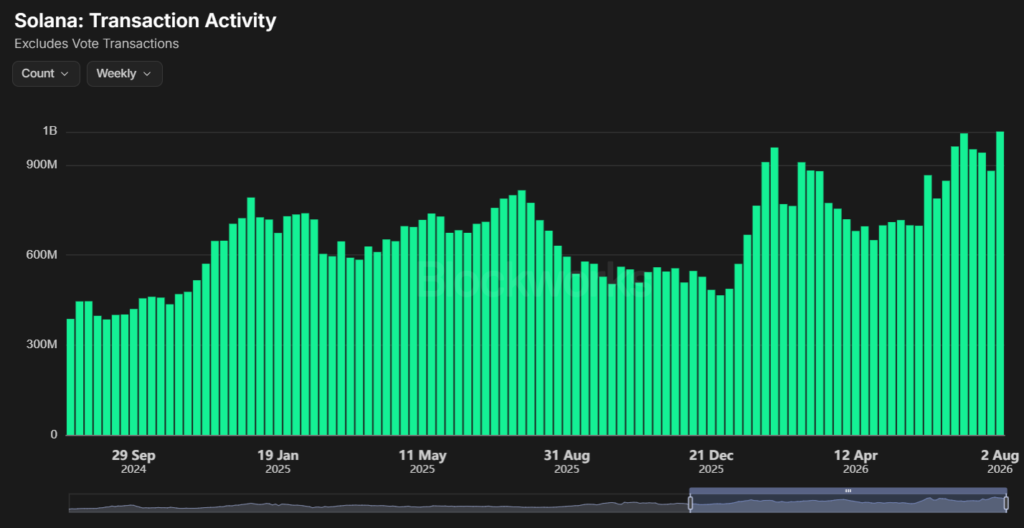
Source: Blockworks
A 66% Capacity Boost, Filled in Days
On July 29, Solana activated a network upgrade called SIMD-0286, raising the maximum compute limit per block from 60 million to 100 million compute units, a 66% increase. Compute units measure processing work, meaning the higher ceiling allows more transactions to fit into each block. The change, engineered by Jito Labs developer Lucas Bruder, marks the largest throughput expansion Solana has shipped since launch. Block times held steady at 400 milliseconds, a feat made possible after XDP kernel-bypass networking, a technique that speeds up data transfer by bypassing parts of the operating system, was adopted by 70% of staked SOL.
Data from the Solana Foundation shows the previous 60 million limit was already under strain: 11.2% of blocks were hitting 56 million compute units or higher, often during volatile trading periods when order execution matters most. Blockspace wasn’t sitting idle. Demand was being squeezed out.
Trading Activity Drives Most New Volume
Much of the added flow comes from trading infrastructure rather than retail speculation. Market makers running proprietary automated market makers continuously update onchain quotes, a category Blockworks Research estimated at roughly 20% of all Solana transactions in late 2025. Arbitrage and order-book maintenance add further volume. This activity naturally expands to fill available blockspace, a dynamic supported by Solana’s 400-millisecond blocks and sub-cent transaction fees.
Payments infrastructure is also expanding. Western Union’s Stablecard launched August 4 on Solana through Rain, covering 37 markets and running on the USDPT stablecoin. Circulation remains near 7.4 million tokens, too small yet to meaningfully affect transaction counts, but the same capacity that enabled the record now gives that flow room to scale.
- Q2 network fees totaled $51 million, Solana’s weakest quarter since Q3 2023
- DEX volumes are at their lowest level since September 2024
- Memecoin speculation historically generated higher fees per transaction than current activity
Revenue tells a different story than volume. Transaction counts are setting records, but the fees attached to them have thinned, reflecting a shift from memecoin speculation toward lower-margin trading and payment activity. Solana’s next upgrades, Alpenglow and 200-millisecond slots, aim to build capacity ahead of demand it hasn’t yet reached.
Sources & Methodology
Primary-source standard: Market-moving facts should link to original data releases, regulator notices, company filings or official project announcements whenever available. Secondary reporting is used for additional context, not as a substitute for original evidence.
Page last reviewed: