market has become just as competitive as the derivatives space Hyperliquid was trying to move beyond. The bank does point to one structural support for the token: Hyperliquid’s Assistance Fund, which channels roughly 99% of trading fees into open-market token buybacks. JPMorgan treats this mechanism as a genuine price floor rather than a reason to dismiss the ETF slowdown, since the buybacks operate independently of broader Wall Street sentiment.
From All-Time Highs to a Fee War Pause
HYPE’s ETF trajectory this year has moved through several distinct phases. Its early institutional momentum built in May, when Bitwise CIO Matt Hougan argued the market was undervaluing Hyperliquid by treating it as a crypto derivatives venue rather than a global multi-asset trading platform with a far larger addressable market, a call that coincided with HYPE approaching its all-time high on early ETF inflows.
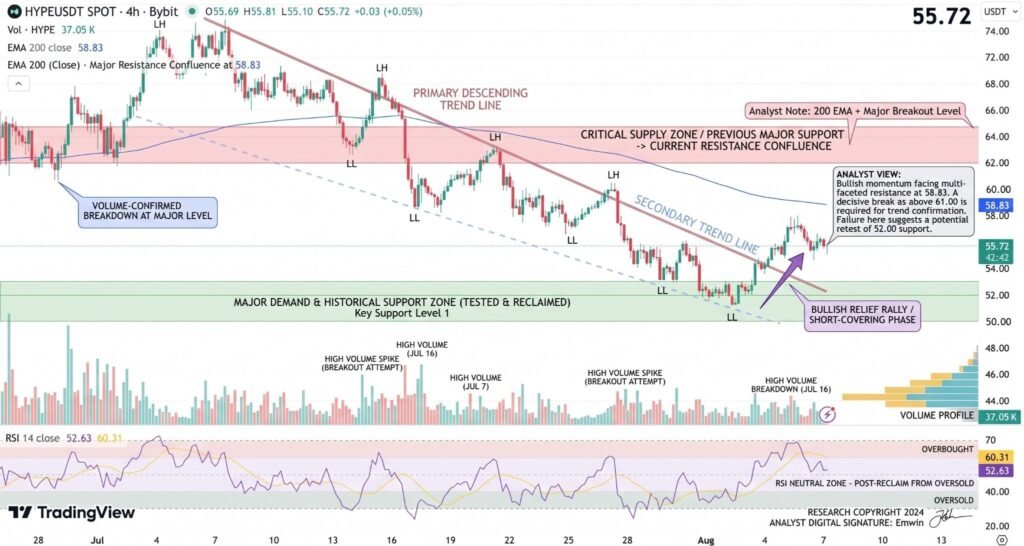
That momentum carried into June, when Grayscale’s HYPG launched on Nasdaq at the lowest fee among three competing U.S. HYPE products, the same week HYPE touched its all-time high of $75.51. JPMorgan’s latest note effectively marks the point where that fee competition and listing momentum stopped attracting fresh capital.
What’s Next
JPMorgan’s analysis carefully separates two distinct questions: whether investors are abandoning HYPE outright, or simply growing more cautious about its competitive positioning. The bank’s answer points to the latter, which means the real test ahead isn’t the current flow data itself but how Hyperliquid performs once the market fully absorbs the wave of newly regulated U.S. perpetual futures platforms alongside its own prediction-market expansion. If Hyperliquid holds its market share through that adjustment period, the July-August pause will likely be remembered as a temporary pricing correction. If it doesn’t, the ETF flow data will probably be the first place that shows up.
Sources & Methodology
Primary-source standard: Market-moving facts should link to original data releases, regulator notices, company filings or official project announcements whenever available. Secondary reporting is used for additional context, not as a substitute for original evidence.
Page last reviewed: