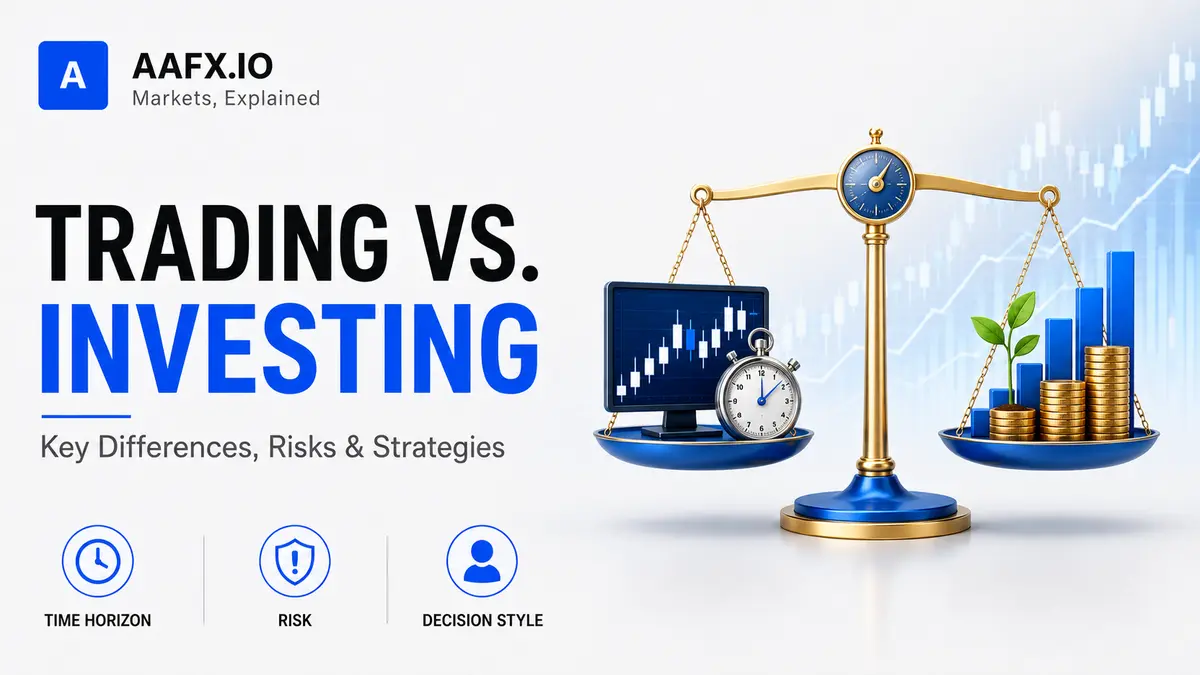
Quick Answer
Trading and investing both involve putting money into financial markets, but the objective and time horizon are different. Traders usually try to benefit from shorter-term price movements and may hold positions for minutes, hours, days, or weeks. Investors generally hold assets for years and focus more on long-term growth, income, business fundamentals, and compounding. Trading tends to require more frequent decisions and can become especially risky when leverage is used, while investing usually involves fewer transactions but still carries market, valuation, and company-specific risk. Neither approach is automatically better; the right choice depends on your goals, time, knowledge, financial situation, and tolerance for losses.
Introduction
Trading and investing are often discussed as if they were interchangeable, but they are different ways of participating in financial markets. A person can buy the same Apple share, Bitcoin, gold instrument, or index exposure and still be either a trader or an investor. What changes is the reason for entering, the amount of time the position is expected to remain open, the way risk is managed, and the evidence used to decide when to exit.
Understanding trading vs. investing therefore helps you answer a more useful question than “Which one makes more money?” The better question is: “Which process fits my objective, resources, and ability to manage risk?”
Trading vs. Investing at a Glance
| Factor | Trading | Investing |
|---|---|---|
| Typical time horizon | Seconds or minutes to weeks/months, depending on style | Usually years or decades |
| Primary objective | Capture short- or medium-term price movements | Build wealth, income, or ownership value over time |
| Typical analysis | Price action, technical analysis, catalysts, macro data, sentiment, liquidity | Business fundamentals, valuation, cash flow, diversification, economic trends |
| Decision frequency | Usually higher | Usually lower |
| Leverage | More common in forex, CFDs, futures, options, and margin accounts | Optional and often avoided in traditional long-term portfolios |
| Costs | Frequent spreads, commissions, slippage, financing and possible tax impact | Usually fewer trading costs, but fund fees, taxes and other charges still matter |
| Main risks | Volatility, leverage, execution, overtrading, behavioral errors | Market declines, valuation risk, company risk, concentration, inflation |
What Is Trading in Financial Markets?
Trading is the active buying and selling of financial instruments with the aim of benefiting from price changes over a relatively short period. Traders may operate in stocks, forex, commodities, cryptocurrencies, futures, options, or contracts for difference (CFDs), depending on local rules and the products offered by their broker.
A trade normally begins with a specific thesis. Imagine a stock is trading around $100 and has repeatedly failed to move above $103. A trader may decide to buy only if price breaks above $103 with strong momentum. Before entering, the trader might also decide that a move back below $101 would invalidate the setup. That creates three important parts of a trading plan: an entry condition, a risk level, and an exit method.
The point is not that the trader will necessarily make money. The point is that the decision is based on a defined short-term setup rather than an open-ended belief that the asset will eventually rise.
How Traders Make Decisions
Traders commonly combine several forms of analysis. Technical analysis studies price behavior using tools such as support and resistance, trendlines, moving averages, RSI, volume, candlestick patterns, and market structure. Fundamental or event-driven traders may instead focus on earnings, inflation data, central-bank decisions, employment reports, geopolitical events, or company announcements.
Liquidity also matters. A trader generally wants to know whether a position can be entered and exited efficiently and what the spread or expected slippage may be. In highly active strategies, small costs can accumulate quickly, so execution quality can matter almost as much as identifying the direction correctly.
Risk management is another defining feature. Position size, stop-loss logic, maximum loss per trade, leverage, and the relationship between potential risk and potential reward all affect the outcome. A good market idea can still produce a poor result if the position is too large.
Common Trading Styles
Day trading means opening and closing positions within the same trading day. The goal is to capture intraday moves without carrying the position overnight. Day traders may react to earnings releases, economic data, breakouts, or short-term momentum. FINRA warns that day trading can be extremely risky and generally requires substantial market knowledge, which is an important reminder for beginners not to confuse frequent activity with easy profit.
Swing trading usually involves holding positions for several days or weeks. Swing traders try to capture a larger portion of a move than day traders and may combine chart structure with news or macroeconomic themes.
Scalping is much shorter term. A scalper may make many trades while targeting relatively small price movements. Because the expected move per trade is small, spreads, commissions, slippage, latency, and discipline become particularly important.
Position trading sits between short-term trading and long-term investing. A position trader may hold for weeks or months while following a broader trend, macro theme, or fundamental catalyst.
What Is Investing?
Investing is the process of allocating money to assets with the expectation that they will increase in value, generate income, or both over a longer period. Common investments include individual stocks, bonds, exchange-traded funds (ETFs), mutual funds, and real estate. Some investors also hold commodities or digital assets, although each asset class has its own risks.
A long-term investor buying a diversified equity ETF is usually not focused on whether the market rises or falls over the next two hours. The investor may be saving for retirement, education, or another goal that is years away. That longer time horizon changes the questions being asked.
Instead of asking, “Will this stock break resistance today?” an investor might ask, “Can this company grow revenue and cash flow over the next five years? Is the balance sheet strong? Is the valuation reasonable? Does this investment improve or weaken the diversification of my portfolio?”
Investor.gov describes investing as putting money into assets such as stocks or bonds with the expectation of earning a return over time. It also emphasizes that all investments involve risk. A long holding period can provide more time to recover from ordinary market fluctuations, but it does not make a poor investment safe.
The Key Differences Between Trading and Investing
1. Time Horizon
Time horizon is the clearest distinction. Traders usually operate over shorter periods, while investors generally think in years or decades. The timeframe affects almost everything else: what information matters, how much price volatility is tolerated, how often decisions are made, and when a position should be closed.
2. What Drives the Decision
A trader may care more about the next earnings report, a central-bank announcement, a breakout above resistance, or a change in momentum. An investor may care more about multi-year revenue growth, free cash flow, debt, dividends, competitive advantages, and valuation.
These categories are not rigid. Professional traders can use fundamental analysis, and long-term investors can use charts. The difference is the role the information plays in the decision and the period over which the thesis is expected to work.
3. Risk and Leverage
Trading can become especially risky when leverage is involved because leverage magnifies both gains and losses. A 1% move in the underlying market can have a much larger effect on the trader’s account when the position is leveraged. Products such as CFDs, futures, options, and margin accounts therefore require careful position sizing and an understanding of how losses, margin requirements, and liquidation work.
Investing also carries meaningful risk. A company can fail, a sector can remain out of favor for years, an asset can be purchased at an excessive valuation, and a broad market can experience deep drawdowns. Diversification can help manage certain risks, but it cannot eliminate market risk.
4. Costs and Turnover
A trader who opens and closes many positions may repeatedly pay spreads, commissions, exchange fees, slippage, and—where applicable—overnight financing. Taxes can also differ depending on the jurisdiction and holding period. These costs can reduce the advantage of a strategy even when many individual trades are profitable.
Long-term investors usually transact less frequently, so trading costs may have a smaller effect. They still need to consider fund expense ratios, advisory fees, platform charges, taxes, and the cost of buying or selling less-liquid investments.
5. Time and Attention
Trading normally requires more frequent monitoring, preparation, and review. A serious trader may spend time building watchlists, studying charts or data, planning risk, recording trades, and reviewing mistakes. The shorter the timeframe, the faster decisions often need to be made.
Long-term investing can be less demanding day to day, particularly with a diversified passive strategy. That does not mean an investor should never review the portfolio. Goals, risk tolerance, diversification, fees, and personal circumstances can change over time.
Example: The Same Stock, Two Completely Different Decisions
Suppose a technology company trades at $100 before quarterly earnings.
A trader may study the chart and notice resistance at $103. Rather than buying immediately, the trader may wait for earnings and enter only if price breaks above $103 with strong volume. The trader may then define $101 as the level where the breakout thesis has failed. The focus is the reaction to a near-term catalyst.
An investor looking at the same company may ignore the $100-to-$103 move entirely. Instead, the investor may examine revenue growth, operating margins, free cash flow, debt, market share, management execution, competitive threats, and whether the current valuation already assumes years of strong growth.
The asset is identical. The process is not. That is the essence of trading vs. investing.
How Compounding Works
Compounding occurs when returns begin generating additional returns. For a simple illustration, imagine $10,000 grows at an average rate of 8% a year and all gains remain invested. After 10 years, the balance would be about $21,589. The calculation shows why time can be powerful for long-term investors.
It is only an illustration, not a forecast. Real markets do not deliver the same return every year, and actual results can be higher, lower, or negative. The useful lesson is that the combination of time and reinvested returns can become more important than frequent buying and selling.
Should a Beginner Trade or Invest?
For many beginners, long-term investing is easier to understand operationally because it can involve fewer decisions and can be implemented through diversified assets. Trading introduces additional skills: order execution, chart or catalyst analysis, position sizing, stop-loss logic, leverage, and emotional control.
That does not mean a beginner must choose one forever. Some people keep a long-term investment portfolio for major financial goals while using a much smaller, separately risk-managed account to learn trading. Keeping the two pools of capital separate can prevent a short-term loss from damaging a long-term plan.
Whichever path you choose, avoid using money required for rent, bills, emergency savings, debt payments, or other near-term obligations. FINRA specifically warns against funding day trading with money needed for living expenses or important long-term goals.
Which Is Better: Trading or Investing?
There is no universal answer. Trading may appeal to someone who enjoys active decision-making, has time to monitor markets, understands the products being used, and can follow strict risk controls. Investing may better suit someone whose main objective is long-term wealth building and who prefers a lower level of day-to-day activity.
The choice also does not have to be based on personality alone. Financial goals come first. Money needed in the near future generally should not be exposed to the same risks as capital intended for a multi-decade objective. Investor.gov emphasizes the importance of time horizon and risk tolerance when determining how investments should be allocated.
For beginners, the most useful objective is not to decide which label sounds more exciting. It is to build a process in which the timeframe, risk, expected return, and exit conditions all make sense together.
Frequently Asked Questions
Is trading better than investing?
Not necessarily. Trading and investing solve different problems. Trading focuses on shorter-term opportunities and requires more frequent risk decisions. Investing usually focuses on long-term growth or income. The better choice depends on your goals, experience, available time, and ability to tolerate losses.
Is trading riskier than investing?
Trading can be especially risky when it involves high leverage, frequent transactions, volatile instruments, or weak risk controls. Investing also carries substantial risk, particularly in concentrated portfolios or speculative assets. Neither approach is inherently safe.
How long do traders hold positions?
It depends on the style. Scalpers may hold positions for seconds or minutes, day traders for part of a trading day, swing traders for days or weeks, and position traders for weeks or months.
How long do investors hold assets?
Long-term investors often hold investments for years or decades, although they may rebalance, reduce a position, or sell when the investment thesis, valuation, goals, or risk needs change.
Do traders only use technical analysis?
No. Many traders combine technical analysis with macroeconomic data, earnings, company news, market sentiment, positioning, and other fundamental information. Technical analysis is one tool, not a complete definition of trading.
Can you lose money with long-term investing?
Yes. A longer holding period does not guarantee a positive return. Individual companies can lose most or all of their value, and broad markets can experience prolonged declines. Diversification and an appropriate time horizon can help manage risk, but they do not eliminate it.
Bottom Line
Trading is primarily about managing shorter-term price opportunities; investing is primarily about building value or income over a longer horizon. The biggest practical differences are time horizon, decision frequency, analysis, use of leverage, transaction costs, and risk management.
For beginners, understanding those differences is more important than deciding which approach sounds more profitable. A clear objective should come first, followed by a realistic assessment of time, knowledge, financial resources, and tolerance for losses. Once those pieces are defined, choosing a broker, market, strategy, or portfolio becomes much more informed.
AAFX.io provides educational guides, market analysis, and broker-comparison resources designed to help readers understand how financial markets work. This material is educational and should not be treated as personalized financial advice.
Risk Warning
Trading and investing involve risk, and losses are possible. Leveraged products such as CFDs, futures, options, and margin trading can magnify losses. Rules, product availability, leverage limits, and tax treatment vary by jurisdiction. Always understand the product and its risks before committing capital.
Sources & Methodology
Primary-source standard: Market-moving facts should link to original data releases, regulator notices, company filings or official project announcements whenever available. Secondary reporting is used for additional context, not as a substitute for original evidence.
Page last reviewed: