
US Dollar falls as weak US jobs data cuts September Fed hike bets. DXY tests 99.18 support as markets reassess rates, Treasury yields and FX outlook.
Labour Data Reshapes Fed Expectations
The US dollar extended its decline after weaker-than-expected US employment data and downward revisions sharply changed expectations for Federal Reserve policy. According to Societe Generale’s Kenneth Broux, markets have largely removed the possibility of a September rate increase, while still pricing in one hike for December.
The shift marks a significant change in the Federal Reserve outlook. For months, investors had focused heavily on inflation indicators such as the Consumer Price Index (CPI) and Personal Consumption Expenditures (PCE), both of which remained above the Fed’s 2% target. Softer employment data, however, has forced markets to place greater emphasis on the labor side of the central bank’s dual mandate.
The development has also weakened the dollar against major currencies as traders reassess the expected path of US interest rates.
Bond Markets Signal Policy Reassessment
The labor-market surprise has triggered a notable move in US Treasury markets. Broux said the 2-year/10-year Treasury yield curve has maintained a bullish steepening bias of about 45 basis points following the sharp drop in July employment and negative revisions to earlier figures.
A bull-steepening curve generally occurs when shorter-term yields fall faster than longer-term yields, often reflecting expectations for easier monetary policy. In this case, traders appear to be anticipating a less restrictive Federal Reserve as employment conditions lose momentum.
The changing rate outlook could remain important for currency markets during the second half of the year. Lower expectations for US rates can reduce the dollar’s yield advantage over other major currencies, potentially increasing pressure on the greenback.
Key developments now include:
- September rate-hike expectations have fallen sharply.
- Markets still see a December hike as possible.
- The Treasury curve remains tilted toward bull steepening.
- Softer employment data is challenging the previous inflation-focused outlook.
DXY Faces Critical 200-Day Support
The Dollar Index (DXY) is now approaching an important technical level. Societe Generale identifies the 200-day moving average at 99.18 as the key support zone that the index must defend to prevent a deeper decline.
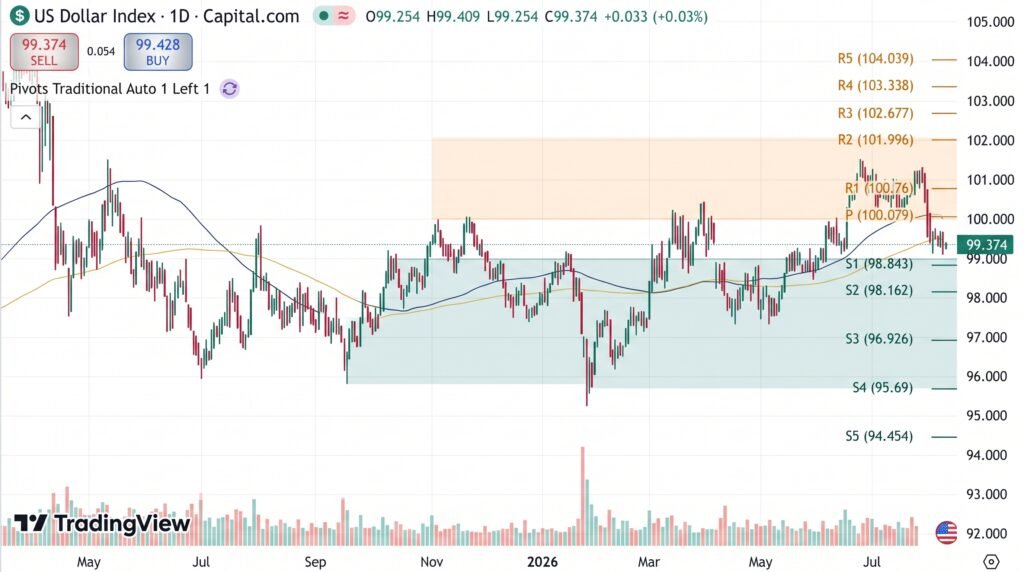
A sustained break below that level could reinforce bearish momentum and signal that investors are increasingly positioning for a weaker dollar environment. Conversely, holding above 99.18 could provide the DXY with a temporary base while traders await fresh economic data and Federal Reserve guidance.
The latest labor-market weakness has therefore created a more balanced policy debate. Instead of focusing almost exclusively on above-target inflation, investors are now weighing whether a slowing employment market could push the Fed toward a more accommodative stance.
For the dollar, Treasury yields and incoming labor and inflation data will remain central to the outlook. The next major moves in DXY could depend on whether economic weakness continues to outweigh inflation concerns.
Sources & Methodology
Primary-source standard: Market-moving facts should link to original data releases, regulator notices, company filings or official project announcements whenever available. Secondary reporting is used for additional context, not as a substitute for original evidence.
Page last reviewed: