
The U.S. dollar stayed near a multi-week high after the Federal Reserve held interest rates steady, while stronger Eurozone GDP growth and rising German inflation supported the euro ahead of key inflation data.
The U.S. dollar remained close to a multi-week high on Thursday as investors assessed the Federal Reserve’s decision to leave interest rates unchanged and weighed uncertainty over the timing of any future policy tightening. At the same time, the euro found support after stronger-than-expected Eurozone economic growth and rising German inflation reinforced expectations that the European Central Bank may need to keep monetary policy restrictive for longer.
Dollar Holds Multi-Week High as Eurozone GDP Grows 0.4%
The U.S. Dollar Index (DXY) traded around 101.0–101.3, remaining near its highest level in almost a month after the Federal Reserve kept its benchmark interest rate unchanged. According to Reuters, Fed Chair Kevin Warsh reiterated the central bank’s commitment to bringing inflation back to its 2% target, but stopped short of providing clear guidance on whether another rate hike remains possible this year. That uncertainty kept Treasury yields elevated, with the 30-year U.S. Treasury yield holding above 5.2%, helping support the dollar despite investors scaling back expectations for another immediate rate increase.
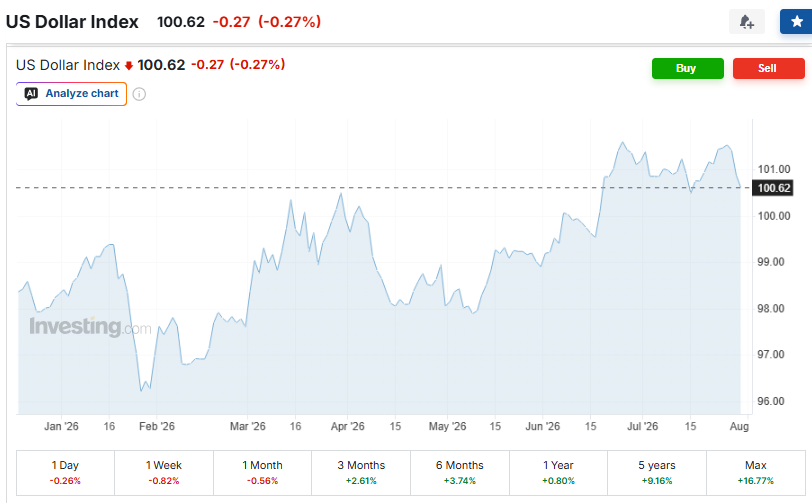
Source: investing.com
The euro traded around $1.146, recovering from earlier weakness after Eurostat reported that the Eurozone economy expanded 0.4% quarter-over-quarter in the second quarter, double economists’ expectations of 0.2%. Annual GDP growth accelerated to 1.0%, while the region’s unemployment rate remained at a record-low 6.3%, indicating continued resilience despite high borrowing costs and geopolitical uncertainty. Preliminary German inflation figures also pointed to stronger price pressures ahead of the Eurozone’s flash inflation report, where annual inflation is expected to rise to 2.9% from 2.8% in June.
Meanwhile, the British pound traded near $1.334 as investors awaited the Bank of England’s policy announcement. Markets largely expected the BoE to keep interest rates unchanged, although traders continued to price in the possibility of at least one additional rate increase before the end of the year depending on inflation and wage data.
Treasury Yields Support Dollar as Eurozone Growth Limits Euro Losses
Currency markets reacted primarily to the lack of clear forward guidance from the Federal Reserve. While policymakers maintained a restrictive policy stance, they avoided committing to another rate increase, leaving investors uncertain about the path of U.S. monetary policy. Elevated Treasury yields continued to support the dollar, while stronger-than-expected Eurozone growth and firmer German inflation prevented a deeper decline in the euro by reducing expectations of near-term European Central Bank easing.
Fed Maintains 2% Inflation Target Amid Persistent Price Pressures
The Federal Reserve has kept interest rates at restrictive levels in an effort to return inflation sustainably to its 2% target after several years of elevated price pressures. Although inflation has moderated significantly from its peak, policymakers remain cautious that strong consumer demand, elevated energy prices and geopolitical risks could slow the disinflation process. In Europe, economic activity has proven more resilient than expected, supported by government spending and continued investment in artificial intelligence and digital infrastructure, even as manufacturers continue to face higher financing costs and weaker external demand.
Markets Await PCE Inflation, GDP and Eurozone CPI Data
Investors are now turning their attention to upcoming U.S. Personal Consumption Expenditures (PCE) inflation data, second-quarter GDP figures and consumer spending numbers, all of which could reshape expectations for future Federal Reserve policy. In Europe, traders will closely watch the Eurozone’s flash inflation report for July, while the Bank of England’s policy decision is expected to influence movements in sterling and broader foreign exchange markets.
Sources & Methodology
Primary-source standard: Market-moving facts should link to original data releases, regulator notices, company filings or official project announcements whenever available. Secondary reporting is used for additional context, not as a substitute for original evidence.
Page last reviewed: