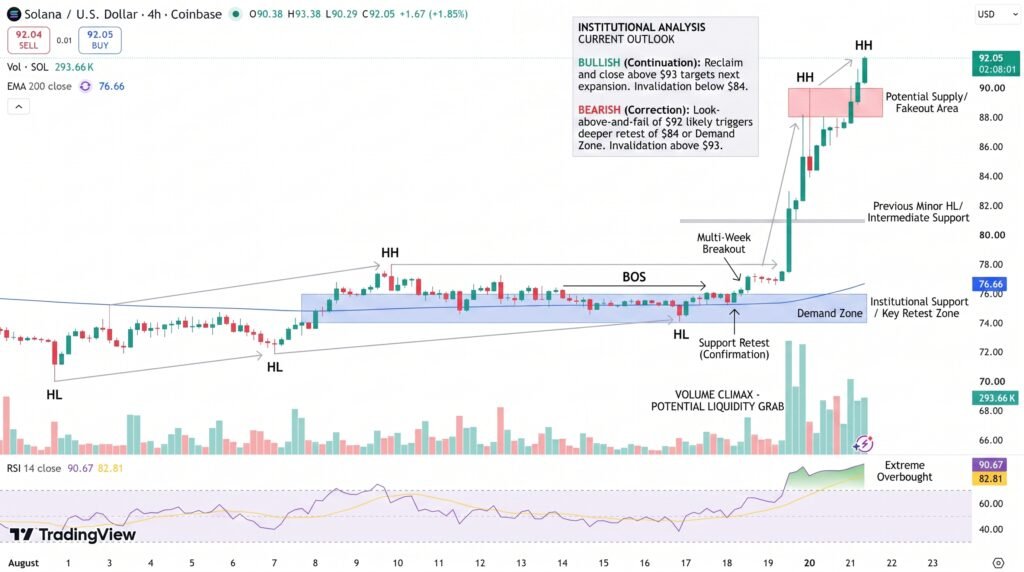
Solana (SOL) is testing the $90 area after gaining more than 19% this week, extending a sharp recovery from the mid-$70s. The token traded around $89-$90 on August 21, after closing near $85.34 a day earlier, as improving crypto sentiment and stronger institutional demand pushed buyers back into SOL. The rally has carried Solana through several important technical levels, but $90 remains the immediate test. A sustained break could put the previous $98 swing high back in focus, while failure to hold the breakout would increase the probability of a pullback.
SOL Tests the Key $90 Resistance
The technical structure has improved substantially since Solana traded around $71 in late June. Recent chart analysis places SOL above its 50-day and 100-day simple moving averages near $76 and above the 200-day SMA around $81.
Using the move from roughly $60 to $98, the 0.786 Fibonacci retracement falls near $90.09, placing SOL directly against a technically significant resistance level.
The key levels now are:
- $90: 0.786 Fibonacci resistance and psychological barrier.
- $83-$84: First important support on a moderate pullback.
- $74.60-$76.80: Major support around the 50-day and 100-day averages.
- $98: Previous swing high and the next major upside reference.
A daily close above $90 would provide stronger evidence that buyers can absorb supply around this resistance. An intraday move above the level followed by a close below it would offer much weaker confirmation.
RSI Signals an Overheated Rally
Momentum has strengthened quickly alongside price. The daily Relative Strength Index cited in the underlying Coinbase chart analysis reached approximately 80.7, well above the conventional 70 overbought threshold.
An RSI above 70 does not automatically mean that SOL must decline. Strong trends can remain overbought for extended periods. It does, however, indicate that the rally has become stretched and increases the importance of nearby support.
The first meaningful level is around $83, near the 0.618 Fibonacci retracement. Below that, the $74.60-$76.80 zone carries greater technical weight because several indicators converge there.
Recent market data confirms the speed of the advance. SOL closed near $75.46 on August 18, climbed to roughly $77 on August 19, and then accelerated above $85-$87.
Solana Upgrade Adds Fundamental Support
The rally is occurring as developers advance SIMD-0525, a proposed Solana protocol change designed to reduce target slot times from 400 milliseconds to 200 milliseconds.
The plan uses four stages:
- 350ms
- 300ms
- 250ms
- 200ms
Rather than simply doubling network workload, the proposal scales several per-slot processing limits as slot times decrease, aiming to keep the amount of work processed per unit of real-world time broadly stable.
Importantly, Anza’s feature-gate tracker currently lists the 350ms SIMD-0525 feature as pending Mainnet Beta activation. The 300ms stage is listed as pending Devnet activation, while the 250ms and 200ms stages remain pending Testnet activation.
That means the upgrade is a meaningful development for Solana’s performance roadmap, but it should not be presented as if the complete 200ms implementation is already running on mainnet.
Conclusion
Solana’s recovery has shifted its technical structure decisively higher, but $90 is the level that matters now. A confirmed daily break could expose the $98 swing high, while $83 is the first important support if momentum cools. The stronger $74.60-$76.80 support zone remains the level that would determine whether a deeper pullback damages the broader recovery. Meanwhile, SIMD-0525 strengthens Solana’s longer-term performance roadmap, but its staged deployment is still progressing. With SOL already up more than 19% this week, confirmation above resistance matters more than chasing an extended move.
Sources & Methodology
Primary-source standard: Market-moving facts should link to original data releases, regulator notices, company filings or official project announcements whenever available. Secondary reporting is used for additional context, not as a substitute for original evidence.
Page last reviewed: