
Bitcoin held above $77,000 on Monday, consolidating after briefly moving above $79,000 during a strong cryptocurrency-market rebound. BTC traded around $77,319, up roughly 1% in early U.S. hours, as investors responded to renewed hopes for U.S. crypto legislation and changing conditions in the Treasury market. President Donald Trump’s renewed push for Congress to advance the CLARITY Act helped improve sentiment, while expanded Treasury bond buybacks initially pushed long-term yields lower. The rally has cooled from its weekend peak, however, as traders assess regulatory uncertainty and the prospect of tougher U.S. sanctions against Iran.
CLARITY Act Lifts Bitcoin Sentiment
Bitcoin’s latest recovery accelerated after President Donald Trump urged lawmakers to reach an agreement on cryptocurrency market-structure legislation.
The proposed Digital Asset Market Clarity Act, commonly called the CLARITY Act, is intended to establish clearer federal rules for digital assets and clarify regulatory responsibilities between the Securities and Exchange Commission and Commodity Futures Trading Commission.
The House passed its version of the legislation in July 2025, but efforts to establish a final framework have faced disagreements in the Senate. Key disputes include how certain crypto assets should be classified and whether stablecoin issuers or affiliated companies should be permitted to offer yield or rewards.
Ethics provisions involving cryptocurrency holdings and trading by government officials have created another point of contention. Trump’s intervention improved expectations that negotiations could resume, helping Bitcoin briefly push above $79,000. However, there is still no certainty over when—or in what form—a final bill could become law.
That distinction matters for markets. Political support can improve sentiment immediately, while actual regulatory changes require Congress to agree on legislation and the president to sign the final bill.
Treasury Buybacks Support Risk Assets
Bitcoin’s recovery has also coincided with a significant change in U.S. debt-management operations. The U.S. Treasury Department announced plans to at least double the size of certain liquidity-support buybacks for longer-dated Treasury securities, increasing the maximum from $2 billion to at least $4 billion per operation.
The announcement initially pushed longer-term Treasury yields lower. Lower yields can improve financial conditions because they reduce the relative return available from government bonds, potentially making riskier assets more attractive.
Bitcoin and gold both strengthened following the announcement. However, describing Treasury buybacks as simply “releasing more liquidity into markets” overstates their effect. The program is primarily designed to improve Treasury-market liquidity and functioning, rather than operate like Federal Reserve quantitative easing.
The distinction is important because Treasury buybacks do not automatically translate into money flowing directly into Bitcoin or other speculative assets.
The broader reaction nevertheless reflects renewed interest in what investors sometimes call the debasement trade—buying scarce or alternative assets when concerns about government debt, fiscal deficits or currency purchasing power increase.
Bitcoin Holds $77K as Altcoins Rise
Bitcoin traded near $77,319 after reaching above $79,000 during the rebound, leaving the cryptocurrency below the psychologically important $80,000 level.
Other major digital assets also remained positive but generally traded below their recent peaks. Ether advanced roughly 1.9% to $2,458, extending a rally that recently carried ETH above $2,400. XRP traded around $1.48, while Solana and BNB gained more than 1%.
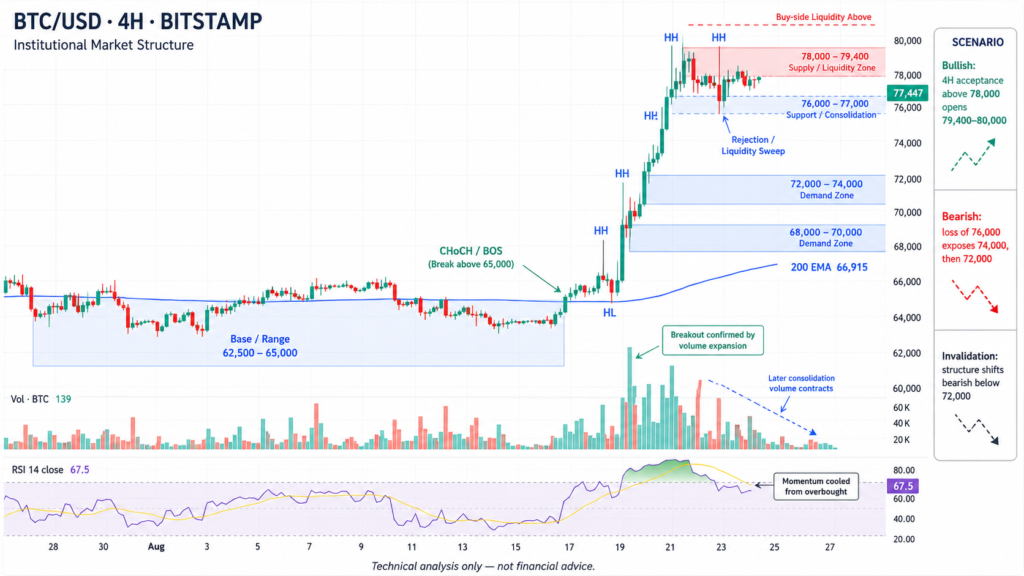
The market is now balancing several competing forces:
- Bitcoin: Holding above $77,000 after testing $79,000.
- Ethereum: Near $2,458 after its recent breakout.
- XRP: Around $1.48 following a sharp weekly rally.
- $80,000: Bitcoin’s next major psychological threshold.
Geopolitical risk remains an important counterweight. Washington is preparing additional sanctions against Iran, adding uncertainty to energy and financial markets. A material escalation could increase demand for traditional defensive assets while reducing appetite for volatile cryptocurrencies.
Bitcoin’s behavior during such periods remains inconsistent. Although advocates increasingly describe BTC as an alternative store of value, its volatility remains substantially higher than gold’s, meaning it can trade more like a risk asset during periods of severe market stress.
Conclusion
Bitcoin’s ability to remain above $77,000 shows that much of last week’s rebound remains intact, but the market has yet to establish a sustained break toward $80,000. Renewed momentum around the CLARITY Act has improved expectations for clearer U.S. crypto regulation, while Treasury buybacks and initially lower yields provided a supportive financial backdrop. Neither factor guarantees further gains: the legislation remains subject to congressional negotiations, and Treasury buybacks are a debt-management operation rather than direct monetary stimulus. For Bitcoin, holding the recent recovery while approaching $80,000 will provide the next test of whether the rebound can develop into a more durable advance.
Sources & Methodology
Primary-source standard: Market-moving facts should link to original data releases, regulator notices, company filings or official project announcements whenever available. Secondary reporting is used for additional context, not as a substitute for original evidence.
Page last reviewed: