
Cardano is trading near $0.21 on August 27 after a sharp rebound from roughly $0.175 earlier this month, but the rally is facing scrutiny over whether network fundamentals justify the move. ADA surged above $0.25 intraday on August 22 before pulling back, leaving the token well above its mid-August lows but below its recent peak. Austin Campbell, founder of Zero Knowledge Consulting, has questioned whether the strength reflects genuine Cardano adoption or simply ADA moving with Bitcoin and the broader crypto market.
Analyst Questions ADA Rally Strength
Campbell argued in an interview with The Wolf of All Streets that many altcoins are rising primarily because of their correlation with Bitcoin rather than improving underlying activity.
His comments are particularly relevant after ADA’s rapid move from $0.1746 on August 18 to $0.2291 on August 21, an increase of more than 31% in three sessions. ADA then reached $0.2584 intraday on August 22 before retreating toward $0.21. That means Cardano has already surrendered a meaningful portion of its recent gains.
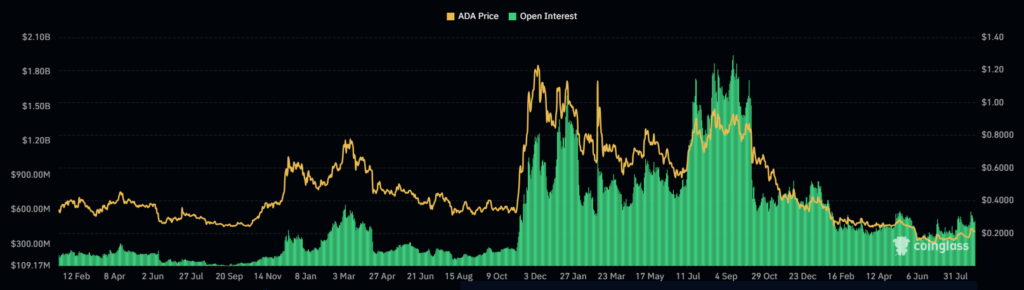
The seven-day performance also needs to be framed carefully. From the August 20 close near $0.1990 to roughly $0.210 on August 27, ADA is up only around 5%-6%, not 20%. The larger 20% figure reflects a longer window beginning closer to the August 18 lows. Campbell’s broader argument is that price appreciation alone does not demonstrate increasing network usage.
Cardano DeFi TVL Remains Weak
Cardano’s decentralized-finance ecosystem remains relatively small compared with the largest smart-contract networks. DeFiLlama currently shows approximately $59-$61 million in total value locked, equivalent to roughly 270-290 million ADA depending on the token price used. That supports the broader argument that Cardano’s DeFi activity has weakened from earlier levels.
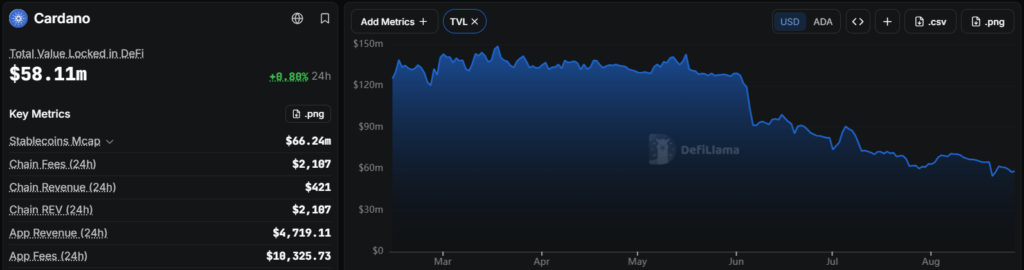
However, one claim circulating in recent reports needs correction. Cardano’s DEX volume is not currently around $965,000 per day. Recent DeFiLlama snapshots show approximately $21-$55 million in 24-hour decentralized-exchange volume, although the figure is volatile and can change sharply from one day to the next.
Current network metrics include:
- TVL: roughly $59-$61 million.
- Stablecoin market cap: about $67 million.
- Active addresses: roughly 24,000-30,000 daily.
- Daily transactions: around 28,000-38,000.
Those figures show that Cardano retains active users and DeFi activity, but its network usage remains modest relative to its multi-billion-dollar market capitalization.
Dijkstra Upgrade Remains Key Catalyst
Cardano developers are simultaneously preparing for the Dijkstra era, the network’s next major protocol stage. Official Cardano documentation says Dijkstra is expected to focus on Plutus V4, consensus and ledger integration, and transition-related improvements.
Development is already underway. Cardano’s August 7 development report said engineers were advancing Dijkstra nested transactions while continuing work related to future protocol capabilities. The precise timeline, however, remains fluid.
An August upgrade bulletin said developers were still targeting Dijkstra activation during 2026, while stressing that software stability takes priority over meeting a fixed deadline. Earlier community planning documents had discussed Q1-Q2 2027, showing that investors should avoid treating any single launch date as guaranteed.
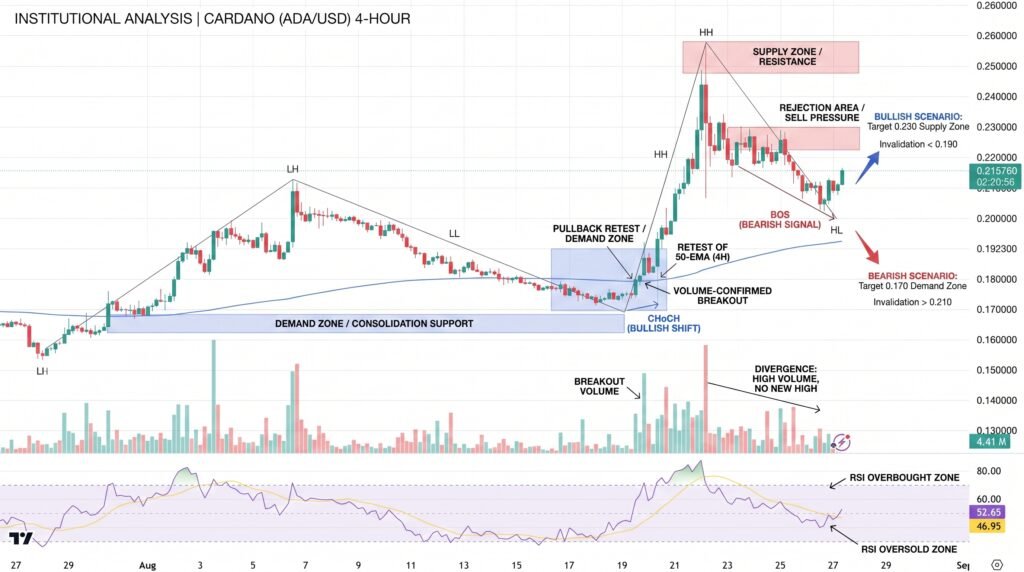
Technically, ADA’s recent rebound leaves $0.24-$0.26 as the most important resistance area after the August 22 rejection. Near-term support sits closer to $0.19-$0.20. Holding that region would preserve much of the recovery from the mid-August low, while a sustained break below it would weaken the bullish structure.
Conclusion
Cardano’s recovery from roughly $0.175 to above $0.25 showed that ADA can respond aggressively when broader crypto sentiment improves, but the move has not been matched by an equally clear expansion in network fundamentals. Cardano’s TVL remains near $60 million, while ADA has already retreated sharply from its August 22 peak. At the same time, current DEX activity is considerably stronger than some bearish reports suggest, making claims of near-total DeFi collapse inaccurate. For ADA, the immediate test is whether price can hold the $0.19-$0.20 region and eventually reclaim $0.24-$0.26 while development toward the Dijkstra era continues.
Sources & Methodology
Primary-source standard: Market-moving facts should link to original data releases, regulator notices, company filings or official project announcements whenever available. Secondary reporting is used for additional context, not as a substitute for original evidence.
Page last reviewed: