Circle Internet Group shares fell 2.3% to $89.91 on Wednesday as investors assessed a new competitive risk: major global banks are exploring their own stablecoins. CRCL had rallied sharply before the decline, gaining more than 25% between August 18 and August 25, so some profit-taking was already possible. The latest concern centers on whether banks with large corporate and retail customer networks could capture payments activity currently flowing through Circle’s USDC. The threat is credible, but no major bank has yet announced a competing global stablecoin product ready for launch.
Banks Explore Stablecoin Competition
The competitive discussion intensified after The Wall Street Journal reported that major banks are reconsidering their previous resistance to stablecoins. JPMorgan has held preliminary discussions about potentially issuing its own stablecoin. However, the bank stressed that it has no active product under development and no current launch plan. It would reassess the opportunity depending on customer demand and changes in regulation.
JPMorgan already operates JPM Coin, a tokenized bank deposit used by institutional customers. A tokenized deposit differs from a conventional stablecoin because it represents a bank deposit and generally operates within controlled banking infrastructure rather than circulating freely across public crypto markets. Competition could become broader than JPMorgan alone.
More than a dozen financial institutions, including Bank of America, Wells Fargo and Santander, have reportedly examined a joint stablecoin project aimed at commercial payments. The group has considered starting with a U.S. dollar-backed token before potentially expanding into euros and other major currencies.
For Circle, the risk is distribution. Banks already control enormous customer networks, payment relationships and corporate treasury operations. If those customers begin using bank-issued digital dollars instead of USDC, Circle could face pressure on transaction activity and stablecoin growth. The projects, however, remain exploratory rather than operational.
USDC Still Has Scale Advantage
Circle enters this competitive phase with significant existing scale. The company reported $73.3 billion of USDC in circulation at the end of Q2 2026, up 19% from a year earlier. USDC generated $14.8 trillion in on-chain transaction volume during the quarter, representing 151% year-over-year growth.
Circle also reported:
- $701 million in Q2 revenue and reserve income.
- $143 million in adjusted EBITDA.
- $48 million in net income from continuing operations.
Those figures show why new bank stablecoins represent competition rather than an immediate displacement of USDC. Circle already has liquidity, exchange integrations, institutional relationships and a substantial circulating supply. The company is also expanding beyond stablecoin issuance.
Circle received final OCC approval in July to establish Circle National Trust, a federally regulated national trust bank. The charter authorizes digital-asset custody and could eventually allow the bank to manage USDC reserves directly.
Arc Launch Adds September Catalyst
Another important catalyst arrives next month. Circle says its Arc blockchain will launch on public mainnet on September 16, 2026. More than 100 institutional and ecosystem builders are already involved, according to Circle.
Arc is designed as infrastructure for stablecoin payments, tokenized real-world assets and programmable finance. If adoption grows, it could help Circle diversify beyond reserve income from USDC. That diversification matters because reserve income remains highly dependent on interest rates and the amount of USDC in circulation.
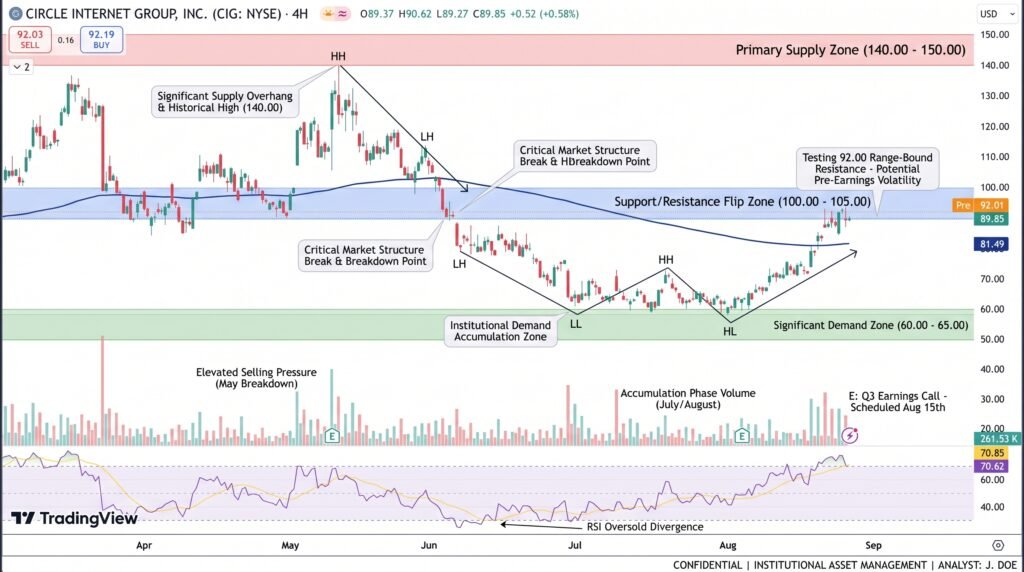
Bernstein remains constructive despite growing competition. The brokerage recently reiterated an Outperform rating and $140 price target, arguing that Circle’s growth does not depend solely on passage of the CLARITY Act. The firm instead points to payments, tokenization and broader stablecoin adoption as longer-term drivers. From Wednesday’s $89.91 close, a $140 target implies potential upside of roughly 56%.
Conclusion
Circle’s 2.3% decline reflects a legitimate competitive concern, but the bank-stablecoin threat remains at an early stage. JPMorgan has discussed the idea without committing to a launch, while the broader bank consortium is still developing its approach. Circle meanwhile has $73.3 billion of USDC in circulation, federal trust-bank approval and an Arc mainnet launch scheduled for September 16. Bank-issued stablecoins could eventually reduce USDC’s share of digital-dollar payments, but the near-term question is whether those institutions can turn exploratory projects into products capable of matching Circle’s existing liquidity and distribution.
Sources & Methodology
Primary-source standard: Market-moving facts should link to original data releases, regulator notices, company filings or official project announcements whenever available. Secondary reporting is used for additional context, not as a substitute for original evidence.
Page last reviewed: