
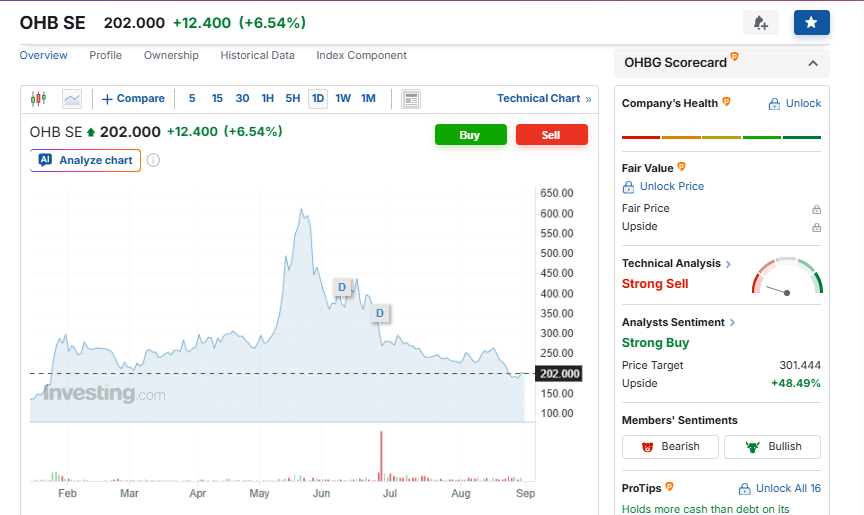
German space technology group OHB SE shares rose sharply on Monday after the company announced it had signed a contract worth nearly €1 billion with European satellite operator SES to develop and produce 18 medium-Earth orbit (MEO) satellite platforms for the European Union’s IRIS² Secure Connectivity Programme. The deal is the first major industrial contract awarded under the IRIS² concession following the official launch of the programme’s implementation phase on 6 August 2026.
OHB Wins Nearly €1 Billion Contract for 18 IRIS² MEO Satellites (15 kW, 2.6 t Each) in €15.6 Billion EU Constellation
OHB confirmed the award in an ad-hoc announcement on 31 August 2026. The contract covers the development and production of 18 MEO satellite platforms for SES, which leads the MEO segment within the SpaceRISE consortium (SES, Eutelsat and Hispasat). Each satellite is specified with a maximum power output of approximately 15 kilowatts and a launch mass of about 2.6 metric tons.
The overall IRIS² constellation will comprise 348 satellites (330 in low Earth orbit and 18 in MEO). First launches are scheduled for 2029, with initial services expected from 2030. The programme’s total estimated value stands at around €15.6 billion. OHB has served as a core technology partner of the SpaceRISE consortium since the programme’s inception and is part of its industrial core team.
CEO Marco Fuchs said the award further expands OHB’s role in Europe’s strategic space infrastructure, following its contributions to Galileo and Copernicus.
OHB Shares Surge on €1bn IRIS² Order as Record €3.304bn Backlog Meets Weak DAX and Supportive Analyst Targets
Investors responded positively to the concrete order, which adds substantial multi-year revenue visibility. At the end of the first half of 2026, OHB’s order backlog already stood at a record €3.304 billion (Space Systems €2.566 billion, Access to Space €440 million, Digital €298 million). Management had indicated that order intake would accelerate in the second half of the year.
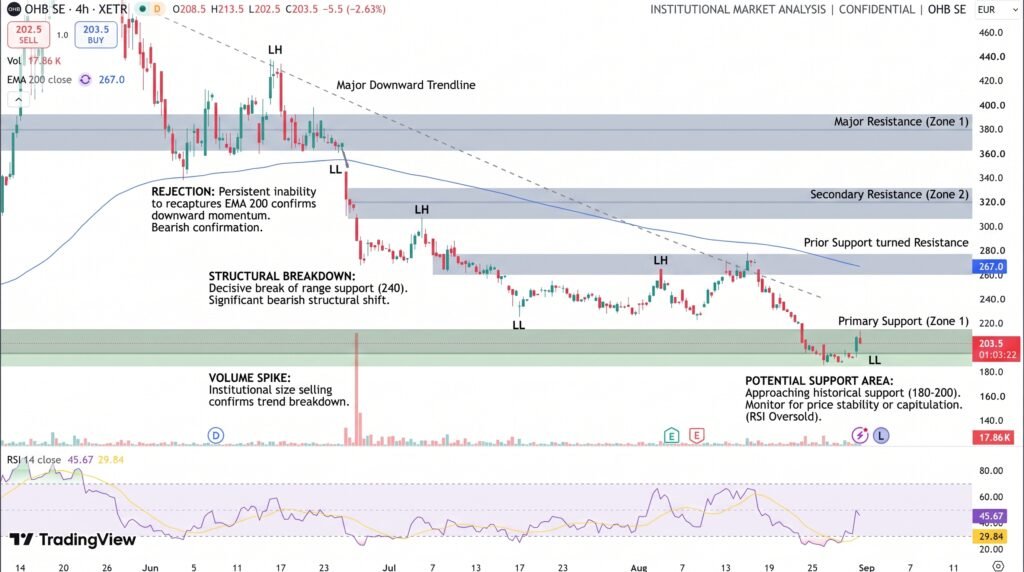
The move occurred against a weak broader market backdrop: the DAX traded lower on the day. No comparable contract news emerged from peers such as Airbus Defence & Space or Thales Alenia Space, pointing to a company-specific reaction rather than a sector-wide move. Analyst consensus remains supportive, with a “Buy” rating and average 12-month price targets generally well above recent trading levels.
IRIS² Hits 348 Satellites as OHB Posts €628m H1 Output and €60.4m EBITDA
IRIS² (Infrastructure for Resilience, Interconnectivity and Security by Satellite) is the EU’s flagship effort to create sovereign, secure and resilient satellite communications, reducing dependence on non-European systems. The SpaceRISE consortium holds the 12-year concession signed with the European Commission in December 2024. Implementation negotiations concluded with an agreement signed around 6–7 August 2026 that expanded the constellation to 348 satellites.
OHB’s H1 2026 results showed total operating performance of €627.9–€628 million (up about 11% year-on-year) and adjusted EBITDA of €60.4 million (up more than 30%). Full-year 2026 guidance remains total operating performance of approximately €1.4 billion with an adjusted EBITDA margin of 10.5–11%. A mid-term target aims for more than €4 billion in total operating performance and an adjusted EBITDA margin around 13%. A capital increase earlier in 2026 strengthened the balance sheet, raising the equity ratio to 43.3%.
Focus Shifts to IRIS² Execution, H2 2026 ESA/EU Orders and 2029 Launch Timeline
Attention will focus on execution of the IRIS² platforms, further order intake from ESA and EU programmes in the second half of 2026, and progress toward the 2029 launch window. Additional contracts within the broader IRIS² supply chain and other European space and defence programmes could further expand the backlog. Investors will also monitor margin progression as the company scales production.
Sources & Methodology
Primary-source standard: Market-moving facts should link to original data releases, regulator notices, company filings or official project announcements whenever available. Secondary reporting is used for additional context, not as a substitute for original evidence.
Page last reviewed: