
Ethereum traded below $2,520 resistance on Sept. 6 after sellers rejected another attempt above $2,500, with TradingView placing ETH near $2,481. The rejection carries weight because recent fund inflows and staking activity have tightened the available supply backdrop, keeping Ethereum price prediction attention fixed on the nearby ceiling. ETH remained roughly 30% higher over the past month, a level several analysts had already flagged as higher-timeframe resistance. Buyers now face a test between extending August’s momentum and absorbing supply built up around the recent peak.
ETH Rejected at $2,520 Again
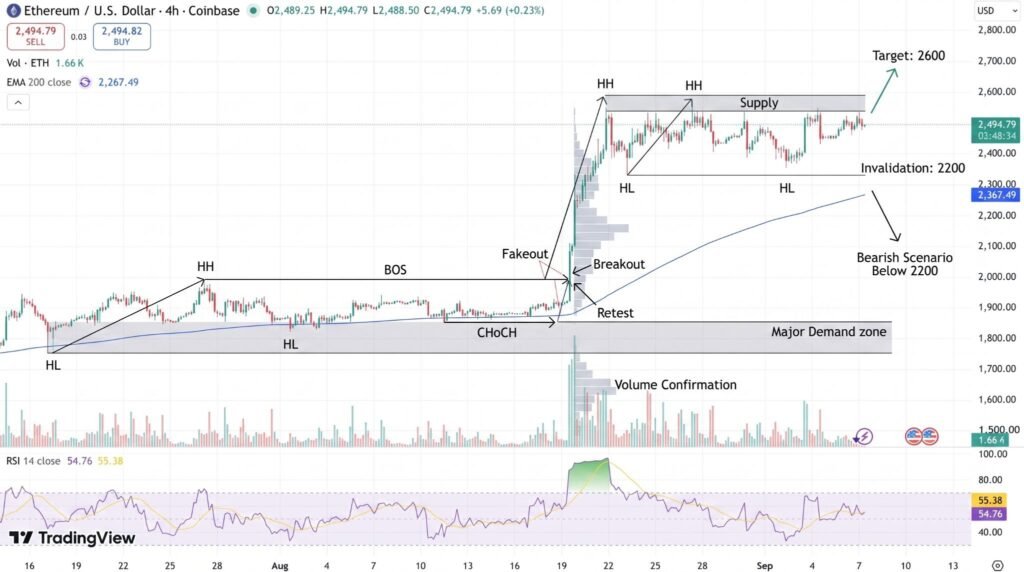
TradingView showed Ethereum near $2,481 on Sept. 6 after price failed to hold above resistance, with its ETHUSD chart showing a roughly 1% daily gain against a nearly 30% monthly advance. Trader Ted wrote on X that ETH reached his $2,520 resistance zone before sellers pushed price lower, while another analyst, Seth, had separately identified $2,500 as higher-timeframe resistance after ETH advanced from the $1,500 region, adding that clearing the area could reopen a test of the prior all-time high. TradingView data places Ethereum’s record high at $4,955.30, reached on Aug. 24, 2025, leaving a wide gap between current levels and that peak despite the recent momentum; a clean close above resistance would mark confirmation rather than an automatic return toward the record.
ETF Inflows Tighten Supply
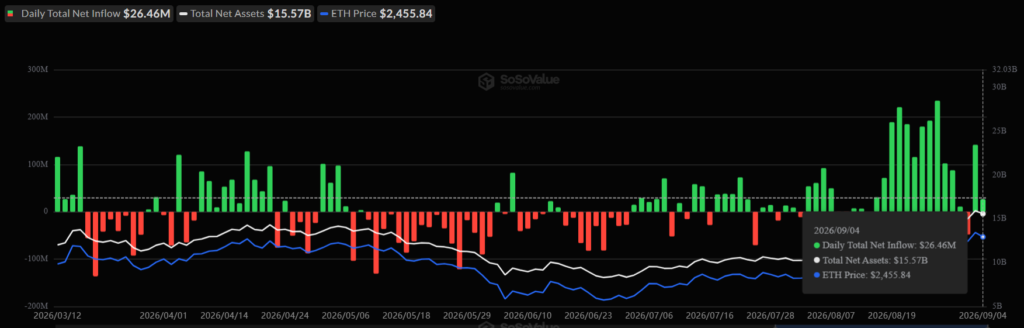
Farside Investors recorded about $1.57 billion of net U.S. spot Ethereum ETF inflows from Aug. 18 through Aug. 31, with nine of those ten trading sessions posting positive net flows. BlackRock reported $8.61 billion in net assets for its iShares Ethereum Trust ETF on Sept. 4, tracking the CME CF Ether Dollar Reference Rate with 464.56 million shares outstanding, a scale that shows regulated investment products now represent a material channel for Ethereum exposure. September flows have been less consistent than August’s: Farside data shows inflows and outflows alternating across the first four trading days of the month, a reversal from the steadier positive run seen in the second half of August, which makes continued daily flow data more relevant to the near-term outlook than last month’s cumulative total.
Source: sosovalue.com
Staking Locks Up 42.9M ETH
Beaconcha.in showed roughly 42.9 million ETH staked across about 908,000 active validators, tokens that remain committed to Ethereum’s consensus process even though withdrawal mechanics still allow validators to exit. Higher staking participation can reduce the liquid supply available for trading without guaranteeing higher spot prices on its own. Separately, CryptoGoos noted that ETH had produced a golden crossover comparable to an earlier bullish cycle, though that remains a technical interpretation rather than evidence a similar rally will repeat, since crossovers are derived from moving averages and can lag price. Seth described the broader pattern as Wyckoff accumulation between $1,600 and $1,900, treating $2,500 as the barrier separating accumulation from further expansion, though price confirmation is still required before that label implies direction.
Ethereum Price Chart – Source: Tradingview
Conclusion
The immediate test remains the $2,500-to-$2,520 zone identified across analyst and TradingView charts: failure to clear it keeps Ethereum inside its recent consolidation, while a sustained close above it would shift attention toward higher resistance rather than confirm any specific target. Fund flows add a measurable second catalyst, since August’s strong second-half demand has given way to a more uneven September, making continued ETF activity more relevant than last month’s totals alone. Until buyers secure the resistance zone on both price and flow data, the breakout case for Ethereum remains conditional rather than confirmed. This article is for informational purposes only and does not constitute financial advice; cryptocurrency markets can experience sharp price movements.
Sources & Methodology
Primary-source standard: Market-moving facts should link to original data releases, regulator notices, company filings or official project announcements whenever available. Secondary reporting is used for additional context, not as a substitute for original evidence.
Page last reviewed: